



|
Getting your Trinity Audio player ready...
|
(Chabad.org) his year, Purim falls on a Friday. For most of the day’s observances—hearing the Megillah, giving gifts to the poor, and sending food to friends and family—this just means we need to be a bit more organized.
But when it comes to the Purim feast, things get a little more complicated. The seudah is traditionally held late in the afternoon and often runs into the night. But should we do the same when Purim leads straight into Shabbat? And if so, how?
The Issue
Typically, we avoid large celebratory meals on Friday so that we’ll have an appetite for the Shabbat meal later that night. However, if a meal is tied to a mitzvah that must take place on Friday—such as a brit milah or a pidyon haben—it’s permitted, even if it affects one’s appetite for the Shabbat meal.1
That said, even for these mitzvah meals, it’s ideal to start before the “tenth halachic hour of the day” (which is just a fancy way of saying midafternoon2).3
In fact, while we do eat breakfast and lunch as usual on Fridays, ideally, we avoid sitting down for a full meal after this time (small snacks and drinks are fine).4
When to Start
It’s best to start your Purim meal before halachic midday (you can calculate that time here).5 If you miss that, at the very least, try to start before the beginning of the tenth hour,6 which is when other mitzvah-related meals on Fridays should begin. Even if your meal continues into the late afternoon, that’s fine—as long as you started on time.
What if you got delayed? You should still start your seudah later in the day. Since having a Purim feast is a mitzvah, it overrides the general preference to preserve your appetite for Shabbat.7 But do your best not to overdo it—leave room for the Shabbat meal!
When to Finish
No matter when you start, it’s best to finish your meal and recite Birkat Hamazon before Shabbat begins (either before sunset or even earlier if you’re accepting Shabbat early).8
What if you want to continue your Purim seudah into the night and combine it with your Friday night meal? In that case, you’ll need to pause eating once Shabbat starts and perform a procedure known as pores mapah umikadesh—literally, “spreading a cloth and making Kiddush,” which you can do as soon as you’ve accepted Shabbat.9
The Complications
Before we get into the details of pores mapah umikadesh, it’s important to know that this is a somewhat debated procedure.
For example, after spreading out your cloth and saying Kiddush, do you need to make a new blessing over the bread? On the one hand, you took a break from eating because Shabbat started, and you weren’t allowed to eat again until you said Kiddush. On the other hand, since you always intended to continue your meal, maybe it doesn’t count as an interruption?10
The general rule is that when in doubt, we don’t say an extra blessing. However, because of this and other uncertainties, the Alter Rebbe recommends avoiding this situation altogether. Instead, he advises finishing the meal before Shabbat begins.11
From a Kabbalistic perspective, Friday (Purim) and Shabbat have very different spiritual energies, and they shouldn’t be merged. Ideally, Maariv (the Friday night prayer) should be said between the Purim meal and the Shabbat meal.12
That said, there may be times and places where the pores mapah procedure will be followed.13 If you’re considering it, please speak to your rabbi to ensure everything is done properly and that no one accidentally violates Shabbat.14
If you do decide to continue your meal into Shabbat, here’s how it works:
The Pores Mapa Process
Important note: Shabbat candles must be lit before Shabbat begins—either at candle-lighting time or earlier, from Plag HaMinchah onward. You can calculate that time here.
- Pause the Meal Before Sunset – As soon as sunset arrives (or when you accept Shabbat), stop eating. 15
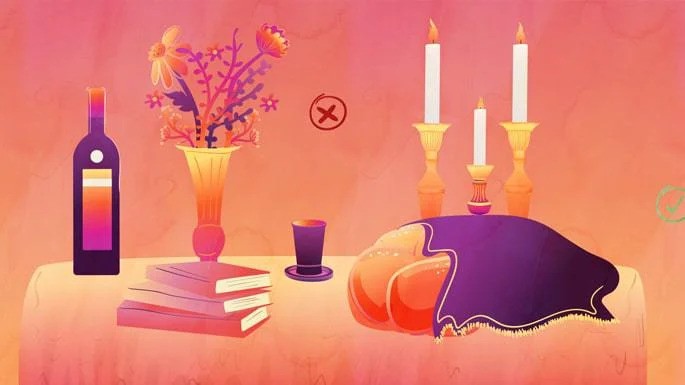
- Bring Out the Bread – Place two16 whole loaves of challah on the table and cover. (This is done to honor Shabbat. Although we have technically washed earlier, by covering it and then uncovering after kiddush it is as if it was now brought to the table in honor of the Shabbat meal).
- Recite Kiddush – Say Kiddush over wine.
- If you already drank wine earlier in the meal, you shouldn’t say Borei Pri Hagafen again.
- If others at the table didn’t drink wine earlier but the person leading Kiddush did, they need to say Hagafen before drinking.
- Uncover and Eat Bread Immediately – Without washing hands again or saying Hamotzi, the challah is cut, dipped in salt, and passed around. Each person must eat at least a kezayit (olive-sized) or k’beitza (egg-sized)17 portion to fulfill the Friday night meal requirement.18
Merging Shabbat and Purim in Grace After Meals
Since you’ve eaten a significant amount of bread both on Purim and on Shabbat, both additions—Al Hanissim (for Purim) and Ritzei (for Shabbat)—should be included in Birkat Hamazon.19
One exception: if you already davened Maariv before saying Birkat Hamazon, then Al Hanissim is omitted.20 However you decide to handle your Purim feast this year, just make sure to daven Maariv on time!
Happy Purim!
Shulchan Aruch Harav, Orach Chaim 249:5,6.
To calculate when this is, see bottom of our Halachic Times, which provides the length of a Shaah Zmanit (proportional hour) in your locale. Count ten of those starting from sunrise. Alternatively, the halachic time referred to as Mincha Ketanah (“Small Mincha”) is 9.5 hours into the day, so the beginning of tenth hour would be approximately a half hour before that.
Shulchan Aruch Harav, Orach Chaim 249:7.
Ibid. 249:9.
Rama, Shulchan Aruch, Orach Chaim 695:2 and Mishnah Beruah 10 ad loc. Although we cited the Shulchan Aruch Harav earlier as saying that meals tied to a mitzvah should ideally start before the 10th hour, see Ketzot Hashulchan 69, fn. 8, which says that since the Purim meal is generally a larger meal and there is greater risk of becoming inebriated, even the Shulchan Aruch Harav would agree with the Rama that for Purim one should ideally begin before halachic midday.
See Mishnah Berurah 695:10.
Shulchan Aruch Harav, Orach Chaim 249:6.
Shulchan Aruch Harav, Orach Chaim 271:11-12.
Ibid. 271:9-10.
Ibid. 271:11.
See Magen Avraham 271, sk. 10, and Shulchan Aruch Harav, ibid.
See Kaf Hachaim (quoting the Arizal) 271:22, 26.
In fact, on the last day of a festival that was on a Friday, the Rebbe would customarily partake of a meal together with the community directly before sunset and extend it into the night using the pores mapah procedure. Many would rely on this to continue eating and drinking after hearing Kiddush. The Rebbe himself, however, would not eat or drink anything from that time onward. In 5744, the Rebbe discontinued this practice because of the confusion that arose. It should be noted that while this was done on various holidays, it was not done in the Rebbe’s presence on Purim, when the public celebration was instead deferred to Shabbat afternoon.
See talk of the Rebbe, from the night following 15 Shevat, 5737.
See Shulchan Aruch Harav, Orach Chaim 271:11-12.
See Aruch Hashulchan 271:13. Although some (see for example Responsa Ha’elef Lecha Shlomoh, Orach Chaim 113) are of the opinion that you don’t need two loaves since you will not be making the blessing of Hamotzi, in practice, when pores mapah was done at Chassidic gatherings, the Rebbe instructed the chassidim to bring and cover two loaves.
See Shulchan Aruch Harav, Orach Chaim 274:6. There is a debate whether one is required to eat an olive-sized or egg-sized portion of bread. The Shulchan Aruch Harav seems to lean toward the opinion that one should eat an egg-sized portion of bread at the Shabbat meal.
If you intended to end the meal before sunset and you already washed Mayim Achronim, but sunset arrived before Birkat Hamazon was said, then pores mapah should still be performed. In this case, you must recite both Hagafen over the Kiddush wine and Hamotzi over the bread (see Shulchan Aruch Harav, Orach Chaim 271:12).
 -->>
-->>
See Shulchan Aruch Harav 188:17. See also Ketzot Hashulchan 47, fn 22.;Some are of the opinion that in this case, one can include it in the harachamans, just as you would if you had forgotten it in its usual place, see Ketzot Hashulchan 47, fn 23.
