



|
Getting your Trinity Audio player ready...
|
By: Tzirel Rosenblatt – Jewish Voice News
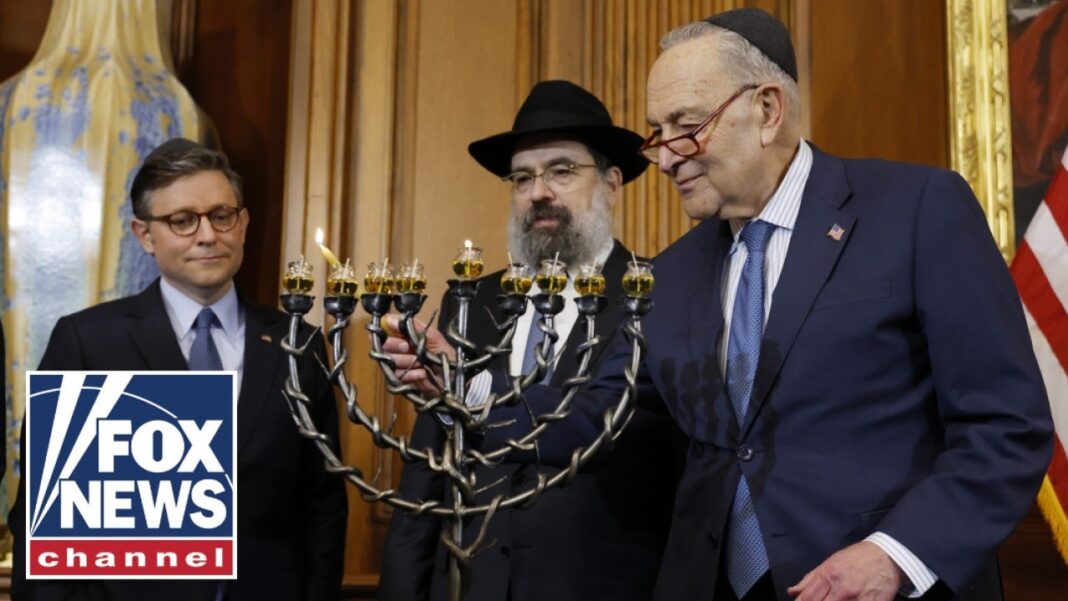
The soft glow of the Menorah illuminated the historic architecture of the Rayburn Room on Wednesday evening as congressional leaders from both parties convened for the annual U.S. Capitol Hanukkah reception and Menorah lighting. Hosted by House Speaker Mike Johnson and led by Rabbi Levi Shemtov, the gathering once again affirmed—at least for one evening—the rare bipartisan solidarity that still emerges on matters affecting Jewish life in the United States and abroad. As VIN News reported on Wednesday evening, lawmakers cast the ceremony as both a celebration of ancient resilience and a reaffirmation of contemporary vigilance.
The ceremony drew a notable roster of congressional leadership: Senate Majority Leader Chuck Schumer, House Minority Leader Hakeem Jeffries, Rep. Dan Goldman, newly elected Rep. Randy Fine, and numerous other legislators who have become increasingly outspoken as antisemitism reaches levels not seen in generations. Their presence, as the VIN News report emphasized, demonstrated that Hanukkah at the Capitol is more than a ceremonial tradition—it is a moment of reflection on the fragility of religious freedom and the persistence of threats against it.
Sen. Schumer, the nation’s highest-ranking Jewish elected official, opened the program with remarks that traced the spiritual arc of Hanukkah from antiquity to the present day. Calling the holiday “a story of inspirational perseverance against tyranny,” Schumer reflected on the ancient Maccabean revolt as both a historical anchor and a modern guidepost. As the VIN News report noted, the Senator reminded attendees that the miracle of the single jar of oil—burning for eight nights instead of one—was ultimately a miracle of faith: “that brighter days are always ahead, even in the darkest of times.”
This year, Schumer acknowledged, the symbolism cuts closer to the bone. With the return of all living hostages taken by Hamas two years ago—a moment he described as bringing “a profound sigh of relief”—the Majority Leader argued that Congress must continue its “ironclad commitment” to opposing antisemitism in all its forms and defending “Israel’s right to exist as a Jewish and democratic state.” His voice carried both triumph and caution, underscoring the fragile state of global Jewish security.
The VIN News report highlighted that Schumer’s remarks echoed a broader national climate in which Jewish Americans have expressed heightened fears following campus protests, online harassment, and a measurable uptick in violent incidents. The Senator’s insistence that Congress must “drown out the darkness” channeled a growing expectation among Jewish communities that elected leaders serve not merely as observers but as protectors.
Rabbi Levi Shemtov, a fixture at national Hanukkah ceremonies for decades, then took the podium to bless the candles and reflect on what the Menorah has come to signify within the halls of American government. To him, the bipartisan attendance was itself a message—a living expression of the Menorah’s purpose.
As he told VIN News, the Menorah represents “bringing light into the darkness and hope where there is despair.” His remarks evoked past moments when Republicans and Democrats united on legislation strengthening security for synagogues, enhancing penalties for hate crimes, or advocating for Jewish communities worldwide. In a year that has tested American civil cohesion, Shemtov’s message was unmistakable: unity remains possible, even within a divided political landscape.
Speaker Johnson, the host of the event, followed with an address that placed both historical and geopolitical emphasis on the holiday. He praised Hanukkah as a celebration of “the resilience and perseverance of the Jewish people,” portraying the Menorah as a beacon of endurance through centuries of persecution. As VIN News reported, Johnson’s remarks focused in particular on the unique symbolism of the Menorah used at the Capitol—a fixture crafted from steel salvaged from rockets intercepted by Israel’s Iron Dome.
“This Menorah is a reminder,” Johnson said, “that the struggle for security and survival is not ancient history but a contemporary reality for the Jewish people.” The Iron Dome steel, he argued, is more than artistic material—it is testament to a nation continuously defending its citizens from existential threats.
Johnson also referenced his recent joint effort with Israeli Knesset Speaker Amir Ohana to nominate President Trump for the 2026 Nobel Peace Prize, citing Trump’s role in brokering the Abraham Accords. The mention drew quiet nods from lawmakers familiar with the political implications of that initiative, which VIN News has reported as a significant gesture of alignment between pro-Israel factions in both countries.
Still, beneath the ceremonial warmth, the event carried an undercurrent of urgency. Recent polling cited by VIN News shows a growing percentage of Jewish Americans concerned about physical security at synagogues and Jewish institutions. This anxiety was reflected in Rabbi Shemtov’s call for communal vigilance and Schumer’s insistence that combating antisemitism “remains the responsibility of every branch of government.”
House Minority Leader Hakeem Jeffries, while not delivering a formal speech, circulated among attendees and reiterated to reporters his commitment to ensuring resources for community protection grants and educational programs aimed at combating hate. Jeffries has long advocated for congressional measures addressing antisemitism, often aligning with Jewish constituents in Brooklyn and Manhattan who have faced a surge in targeted harassment.
For Jewish lawmakers such as Rep. Dan Goldman, the ceremony carried deeply personal resonance. Goldman, who has spoken extensively about his family’s Holocaust history, emphasized to VIN News that Hanukkah at the Capitol is a reminder that democratic institutions must remain vigilant in defending minority rights. Rep. Randy Fine, newly sworn in and the only Republican Jewish member of Congress, described the ceremony as “a powerful testament to the durability of the American Jewish story.”
This year’s Hanukkah lighting also marked the third consecutive congressional Menorah ceremony—a tradition that has rapidly become a symbolic cornerstone of Washington’s December calendar. The program concluded with traditional blessings, songs, and the lighting of the candles, as lawmakers from across the political spectrum stood side by side.
Yet the significance of the evening transcended ritual. As VIN News emphasized in its report, the Menorah stood not merely as a ceremonial object, but as a national statement: that even in times of heightened political division, Congress can still gather to affirm the dignity, safety, and continuity of Jewish life.
In a year marked by international turmoil, domestic polarization, and renewed debates about religious liberty, the Hanukkah ceremony in the Rayburn Room offered a rare moment of bipartisan clarity. The light of the Menorah—drawn from ancient defiance against tyranny—served as both reassurance and warning. The reassurance: that the American commitment to religious freedom persists. The warning: that such freedoms must be consciously defended, recommitted to, and illuminated anew each year.
As lawmakers dispersed into the chilly Washington night, the candles continued to burn—reminding those who witnessed the ceremony that the work of safeguarding the Jewish community is ongoing, unfinished, and as essential as ever.