



|
Getting your Trinity Audio player ready...
|
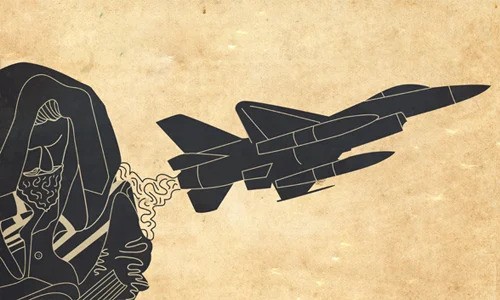
(Chabad.org) Over Chol Hamoed Pesach this year, the world waited with bated breath. For 24 agonizing hours, every news outlet reported on the most-high stakes rescue operation the world had seen in decades. In a remote mountainous region of southwest Iran, a wounded American airman was hiding out, waiting to be rescued. US Special Forces, the CIA and Iranian Revolutionary Guard commandos were scrambling to reach him first after the pilot’s F-15 was shot down and he ejected into enemy territory. Local armed tribesmen were offered a massive bounty to take the downed pilot prisoner.
Dozens of US aircraft and hundreds of military personnel – from pilots to intelligence operatives to ground forces – threw themselves into the effort to bring this one man home. In what President Trump called a miracle, after more than 24 hours behind enemy lines, US forces rescued the Colonel from the mountains alive on Sunday morning.
As I followed this story, I thought about what that pilot must have been thinking during those excruciating hours hiding in the rocks in hostile territory, not knowing whether he’d return home as a hero or be taken hostage. He must have been thinking about his life, his family, and a question I think about often; one made famous by a Vietnam-era Navy veteran – “Who packed my parachute?”
This question was asked by Captain Charles Plumb, who was captured and spent 2,103 days as a prisoner of war in North Vietnamese prison camps. Years after his release, Plumb was in a restaurant when a man approached his table. “You’re Plumb!” the man said. “You flew jet fighters in Vietnam. You were shot down! You parachuted out of your plane.” Plumb asked—How in the world did he know that?
“I packed your parachute,” the man replied.
That night, Plumb could not sleep. “I wonder how many times I might have seen him and not even said good morning, because I was a fighter pilot, and he was just a mere sailor,” said Plumb.
Fighter pilots get all the prestige, they get the blockbuster films, the medals of honor. Whereas sailors are the anonymous men in the bowels of the aircraft carrier packing the parachutes, cleaning the decks, and folding the sheets. While they don’t get the medals, the credit or the recognition, it is their dedication and selfless service which enables the “Top Guns” and generals to win the war.
That’s why for the past 40 years, whenever Plumb speaks to audiences, he says to them, “know who packed your parachute, and say thank you.”
This week, we celebrate the splitting of the Red Sea on the seventh day of Passover. Moses gets the credit in the famous telling with his staff raised, waters parting, a nation walking through on dry ground. But the Midrash (Sotah 37a) records that before Moses ever lifted his staff, a man named Nachshon ben Aminadav was already chest-deep in the waves, he took the first step not knowing what would happen. Nachshon had no staff, no divine instruction, no assurance that the water would do anything other than drown him. He walked in anyway, and the water climbed to his chin and then to his nostrils, and only then did the sea tear itself apart.
Nachshon was a parachute packer. He was the man in the bowels of the ship, doing the unglamorous thing that made the miracle possible, whose name almost nobody remembers. And his act of raw, irrational faith is the reason we are here 3,338 years later telling the story at all.
This profound concept is found throughout Jewish thought. Basi Legani – a foundational Hasidic text – speaks of a king at war. When the battle reaches its most desperate hour, the monarch flings open the doors to the royal coffers, revealing his most precious and hidden treasures, and distributes them to the foot soldiers and the common folk, not to the generals or the ministers as we might think. It is because they are the ones who fight and die for the cause, and therefore are deserving of the rewards.
The Sixth Lubavitcher Rebbe, Rabbi Yosef Yitzchak Schneershon, spoke about this idea in 1925. He asked why Moses, despite witnessing great miracles and speaking face-to-face with G‑d, was described by the Torah as the most humble man in history.
His answer was revolutionary. Moses, he wrote, had a divine vision, in which he foresaw a future generation of Jews whose understanding of G‑d was minimal and were far removed from the miraculous revelation at Sinai. Moses was humbled because despite all this, and despite the attempts of many generations of enemies to destroy them and their connection to G‑d, they nonetheless went to great lengths and made great sacrifices to observe the same laws and commandments that their ancestors fought and died for.
That generation – which the Previous Rebbe identifies with our own – performs the same mitzvot with so much faith, humility and raw devotion, that it humbled Moses.
It is us – who don’t part seas, speak directly to G‑d or understand the Torah’s great mysteries – who humbled Moses, history’s greatest prophet and lawgiver. It is our small acts of faithfulness – lighting candles on Friday night, putting on tefillin or having a seder, despite not entirely knowing what they mean or feeling their holiness directly – that humbled Moses.
We are the parachute packers of Jewish history. Every mitzvah, however modest, is what has kept our entire people aloft across the centuries.
As we mark the seventh day of Passover, where we celebrate the parting of the Red Sea, make sure to ask “Who packed your parachute?” and to know whose parachute you have packed knowingly or unknowingly. For the Jewish people, you are the ultimate parachute packer. Every time you do anything small, whether it’s a prayer in imprerfect Hebrew, or a partially-done seder. These are the acts that made Moses, the greatest prophet who ever lived, look into the future and feel humbled. And these are the acts that, like Nachshon’s first steps into the churning sea, will one day cause the waters to split again.
