



|
Getting your Trinity Audio player ready...
|
By: Greg Myers
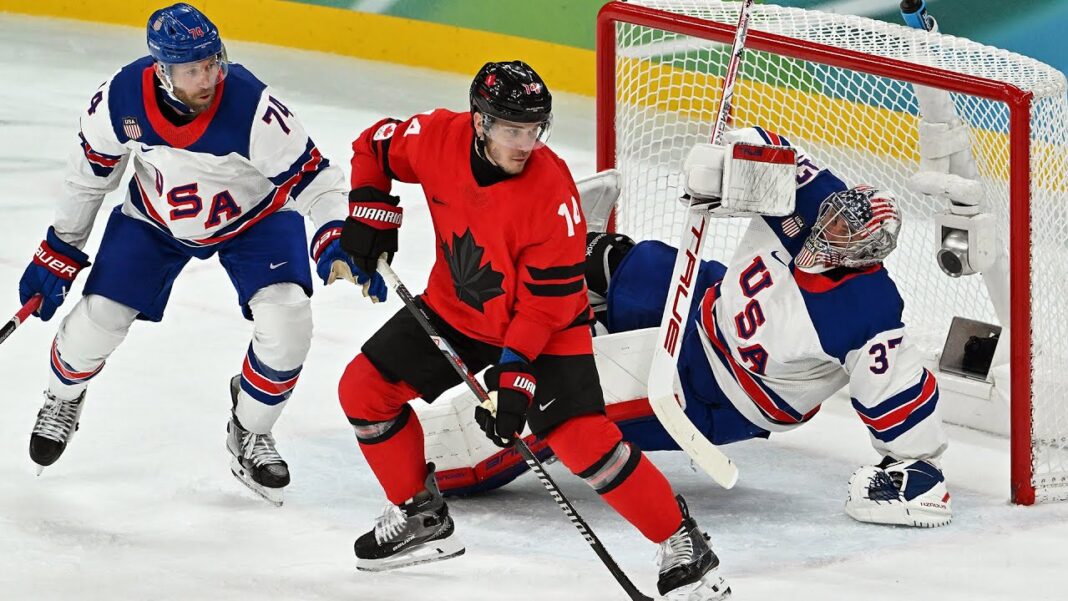
The United States’ triumph in men’s Olympic hockey in Milan was more than a sporting victory; it was an emotional and historical reckoning that fused triumph with mourning, rivalry with remembrance, and national pride with the raw vulnerabilities of human loss. When Jack Hughes carved his name into Olympic lore with a sudden-death overtime goal to defeat Canada 2–1, he did more than deliver a gold medal. He brought an end to a 46-year drought that had loomed over American men’s hockey since the epochal “Miracle on Ice” of 1980. In that instant, history folded upon itself, connecting a generation raised on the mythology of Lake Placid to a new cohort of players who, under the brightest lights of the Milan Cortina Games, fashioned their own miracle.
The significance of the victory reverberated far beyond the final score. For nearly half a century, American men’s hockey had been measured against the impossible standard set by the 1980 team. That gold medal was not merely a championship; it was a cultural artifact, a symbol of defiance and possibility in a fraught geopolitical era. The long wait that followed became a quiet burden, a narrative of near-misses and unfulfilled promise. In Milan, that narrative was finally interrupted. The United States, facing its most enduring rival in the Olympic final for the first time since the 2010 Vancouver Games, overcame Canada in the most dramatic fashion possible: sudden-death overtime, with the gold medal hanging in the balance.
The rivalry between the two North American hockey powers has always been intense, but this final carried an added layer of historical symmetry. In Vancouver, Canada had claimed gold on home ice when Sidney Crosby delivered his now-immortalized overtime winner. That moment, seared into the Canadian sporting psyche, became a touchstone of national pride. Milan offered the Americans their own echo of that memory. Jack Hughes’ “Golden Goal” was not merely an athletic feat; it was a narrative inversion, a reclaiming of a story that had once belonged to Canada. The symmetry of the two moments—overtime, Olympic gold, archrivals—imbued the Milan final with an almost mythic quality, as though the sport itself had conspired to script a mirror-image redemption.
Yet the Milan tournament unfolded amid an atmosphere far removed from the insulated purity of sport. Throughout the competition and in preceding NHL-run events, Canadian fans had loudly booed “The Star-Spangled Banner,” injecting a note of political acrimony into arenas traditionally reserved for national anthems and sporting pageantry. The hostility, widely understood to be fueled by tensions that had little to do with hockey—most notably U.S. President Donald Trump’s 2025 tariff threats and remarks about Canada’s status—cast a long shadow over the tournament. What might once have been dismissed as partisan crowd behavior became, in this context, an audible manifestation of broader geopolitical frictions.
For the American players, the jeers were neither surprising nor demoralizing. Veterans of high-stakes international competition, figures such as Zach Werenski and Matthew Tkachuk acknowledged that they had anticipated the boos and, in a paradox common to elite athletes, transmuted the hostility into motivation. The jeering crowds became a galvanizing force, a hostile chorus that sharpened focus rather than eroding it. There was a sense, palpable in the Americans’ performance, that they sought not merely to win but to assert themselves on adversarial terrain, to dominate their rivals at their own game under the weight of an antagonistic atmosphere. In this way, the anthem controversy became woven into the competitive fabric of the tournament, transforming external political tensions into an internal source of resolve.
The victory, however, was inseparable from grief. Hovering over the American locker room throughout the Games was the memory of Johnny Gaudreau, the beloved forward whose life, along with that of his brother Matthew, was cut short in August 2024 by an intoxicated driver while the two were cycling in New Jersey on the eve of their sister’s wedding. Known affectionately as “Johnny Hockey,” Gaudreau had been widely regarded as a near-certainty for the 2026 Olympic roster before his tragic death. His absence in Milan was not merely a void in talent but a rupture in the emotional continuity of the team. To honor him, his No. 13 jersey hung in the U.S. locker room throughout the tournament, a silent witness to every pregame ritual and postgame reckoning.
In the crucible of competition, that jersey became a talisman. It served as a reminder of the fragility of life and the enduring bonds that outlast individual presence. When the final buzzer sounded in Milan and the gold medal was secured, the team’s celebration took on a dimension that transcended victory. Matthew Tkachuk and Dylan Larkin carried Gaudreau’s jersey onto the ice, transforming the victory lap into a ritual of remembrance. The image of the jersey held aloft amid a storm of confetti and flashing lights was a poignant tableau, a visual assertion that the triumph belonged not only to those who skated but also to those whose absence was felt with every stride.
The most searing moment of the celebration came when the team brought Gaudreau’s widow, Meredith, and their two oldest children, Noa and Johnny Jr., onto the ice. The sight of the children—tiny figures in the vast expanse of the arena—cradled by players still clad in their battle-worn gear, lent the scene an almost liturgical gravity. That the celebration coincided with Johnny Jr.’s second birthday lent the moment an additional layer of bittersweet resonance. The team’s official gold medal photograph, taken while holding Gaudreau’s children and his jersey, became a visual testament to the idea that the team’s identity extended beyond the living roster. It was an assertion that Johnny Gaudreau remained, in some profound sense, part of the collective that had just rewritten American hockey history.
The convergence of these narratives—historic victory, anthem controversy, and personal tragedy—rendered the Milan final more than a sporting event. It became a parable of resilience, a study in how triumph is often braided with loss, and how national rivalry can be refracted through the prism of contemporary politics. The United States’ first men’s hockey gold since 1980 was not achieved in a vacuum; it was forged in a crucible of memory, antagonism, and collective mourning. The Golden Goal, in this light, was not merely a point on the scoreboard but a symbolic punctuation mark at the end of a long sentence of waiting.
In the years to come, the Milan victory will likely assume a place alongside Lake Placid in the American sporting imagination, though its meaning will be distinct. Where 1980 was a story of improbable victory against a geopolitical rival, Milan is a story of renewal amid complexity. It speaks to a generation of athletes navigating a world in which sport is inextricable from politics, where arenas echo with grievances as well as cheers, and where personal tragedy can shadow collective triumph. The gold medal, gleaming in the harsh lights of the podium, thus reflects not only athletic excellence but the intricate, often painful textures of the era in which it was won.
In the end, the United States’ victory over Canada in Milan will be remembered for its drama and its history, but also for the way it humanized the spectacle of elite sport. The Golden Goal ended a 46-year drought, but it also opened a new chapter in the narrative of American hockey, one in which victory is inseparable from vulnerability, and triumph is rendered meaningful by the memories it carries forward.
