



|
Getting your Trinity Audio player ready...
|
By: Fern Sidman
A firestorm has erupted within conservative political circles following the appointment of a controversial far-right social media personality to a senior leadership position in the largest Republican youth organization in the United States. The decision has intensified a broader debate about the ideological direction of the Republican Party’s youngest activists and raised fresh concerns about the growing influence of antisemitic rhetoric and anti-Israel narratives within segments of the American right.
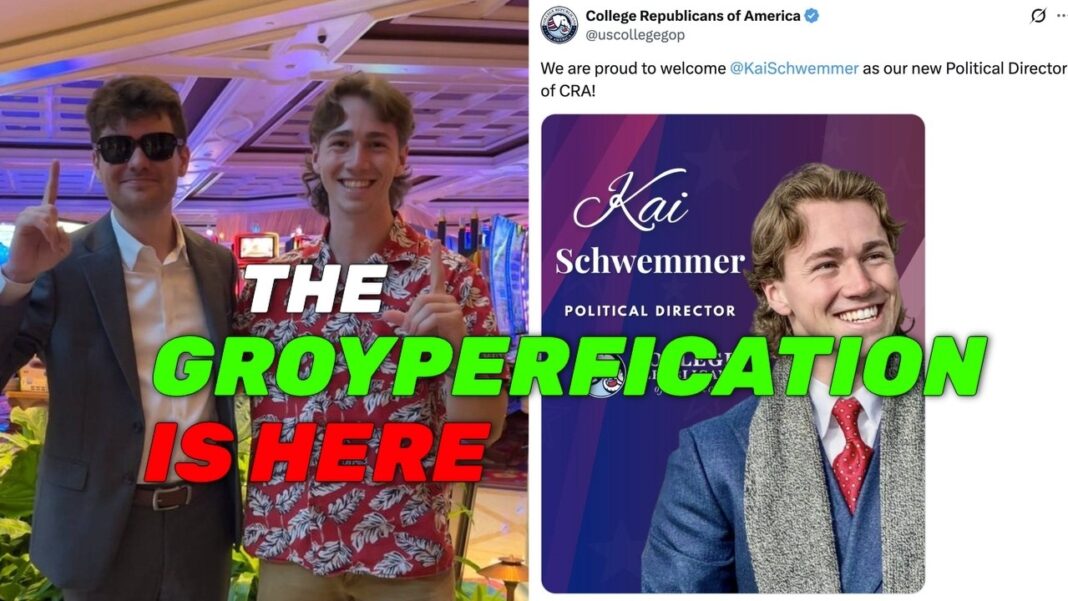
According to a report on Tuesday by The Algemeiner, College Republicans of America (CRA) announced this week that it had selected political commentator and internet streamer Kai Schwemmer to serve as the organization’s new political director. The announcement immediately provoked backlash from Jewish organizations, political analysts, and many conservative commentators who have previously criticized Schwemmer for promoting conspiratorial views about Jews and questioning the United States’ longstanding alliance with Israel.
The controversy has unfolded against the backdrop of mounting evidence that antisemitic attitudes may be gaining traction among younger conservatives—an unsettling trend that has alarmed both Jewish leaders and senior figures within the Republican Party.
College Republicans of America occupies a historically significant place within the Republican political ecosystem. Founded more than a century ago, the organization has long served as a training ground for aspiring political operatives and activists.
Over the decades, it has played a crucial role in mobilizing young voters, organizing volunteers for election campaigns, and cultivating future leaders within the party.
Several prominent figures in American conservative politics—including former House Speaker Paul Ryan and longtime Republican strategist Karl Rove—began their careers in the organization. Because of its role as a pipeline for political talent, decisions about its leadership often carry implications that extend far beyond college campuses.
For that reason, the appointment of Schwemmer has drawn particularly intense scrutiny.
As The Algemeiner noted in its report, the political director position is responsible for shaping outreach strategies, coordinating campus activism, and influencing the messaging used by the organization’s chapters nationwide.
Within hours of the announcement, critics began highlighting Schwemmer’s extensive record of controversial public statements.
The social media commentator has become known in recent years for hosting online debates and livestream discussions about geopolitics, immigration, and U.S. foreign policy. Yet it is his rhetoric concerning Israel and Jews that has provoked the greatest concern.
According to the information provided in The Algemeiner report, Schwemmer has repeatedly argued that the pro-Israel wing of the Republican Party exerts disproportionate influence over U.S. policy decisions.
During a debate earlier this year hosted by conservative commentator Michael Knowles, Schwemmer contended that Republicans who strongly support Israel are not necessarily acting in America’s national interest. He claimed that “Zionist” factions within the party allegedly promote policies that suppress free speech and silence criticism of Israel.
The remarks drew sharp condemnation from critics who said they echoed long-standing antisemitic tropes about Jewish influence over government and media institutions.
In another widely circulated debate, Schwemmer questioned whether Jewish executives within major defense companies might prioritize Israel’s interests when making business decisions.
Schwemmer suggested that Jewish executives at firms such as Boeing and Raytheon could be influenced by ethnic or religious considerations when supporting military cooperation between the United States and Israel, as was reported by The Algemeiner.
Critics quickly pointed out that such claims resemble conspiracy theories historically used to accuse Jews of manipulating global politics and financial systems. Schwemmer’s remarks sparked renewed concern that antisemitic narratives once confined to extremist fringe groups are now gaining greater visibility within mainstream conservative spaces.
Another source of alarm involves Schwemmer’s apparent connections to Nick Fuentes, a far-right activist widely condemned for promoting antisemitic and white nationalist views. Fuentes has publicly denied the Holocaust, praised authoritarian leaders, and built an online movement known as the “Groyper” movement—an extremist faction that seeks to push the Republican Party toward ethnonationalist ideology.
According to The Algemeiner report, Schwemmer has appeared on several occasions alongside Fuentes and has spoken approvingly of him in interviews and online discussions.
He has also been photographed wearing a blue “America First” baseball cap—a symbol closely associated with Fuentes’ followers. In 2022, Schwemmer reportedly appeared as a speaker at an event organized by Fuentes’ America First PAC, a political group linked to the Groyper movement.
These connections have prompted critics to argue that the appointment represents a troubling normalization of extremist influences within youth conservative circles.
Schwemmer’s association with Fuentes has already triggered protests at several public events. During a debate about Israel hosted by Turning Point USA at the University of Delaware, demonstrators distributed flyers warning that Schwemmer was closely aligned with Fuentes and his network.
The flyers described Fuentes as a Holocaust-denying white nationalist who had played a role in organizing the violent “Unite the Right” rally in Charlottesville and participated in events surrounding the January 6 attack on the U.S. Capitol, as was noted in The Algemeiner report.
The protests underscored the extent to which Schwemmer’s rise within conservative youth politics has become a flashpoint for ideological conflict.
Despite the backlash, College Republicans of America President Martin Bertao has refused to reverse the appointment. In a defiant message posted on the social media platform X, Bertao declared that he had “reflected” on the decision and concluded that he would apologize “to absolutely nobody.”
“CRA will never back down to the WOKE mob!” he wrote.
Supporters of the decision argue that criticism of Schwemmer represents an attempt to silence dissenting views about U.S. foreign policy. They contend that debates about the American-Israeli alliance should be considered legitimate political discourse rather than evidence of antisemitism. Yet critics counter that Schwemmer’s statements go far beyond ordinary policy disagreements.
The controversy has unfolded amid growing concern that antisemitic beliefs may be spreading among younger Republicans. Recent research suggests a generational divide in attitudes toward Jews and Israel within the conservative electorate.
A survey conducted by Irwin Mansdorf of the Jerusalem Center for Security and Foreign Affairs and Charles Jacobs of the Jewish Leadership Project found that 45 percent of Republicans under the age of 44 believe Jews pose a threat to the “American way of life.”
The findings, cited in The Algemeiner report, shocked many observers. Additional polling conducted by the Manhattan Institute found similar patterns. According to that research, 25 percent of Republicans under 50 expressed antisemitic attitudes—compared with just 4 percent among those over 50. Even more troubling were findings related to Holocaust denial. The poll indicated that 37 percent of GOP voters overall believed the Holocaust had been exaggerated or misrepresented by historians. Among younger male voters under 50, the figure rose to 54 percent.
Such statistics have prompted urgent discussions among Jewish organizations and Republican leaders about how to confront the spread of extremist narratives within political discourse.
The issue has been further complicated by additional controversies involving Republican youth organizations. Just last week, the Miami-Dade County Republican Party came under intense scrutiny after leaked group chats revealed racist and antisemitic comments by members.
According to accounts cited by The Algemeiner, participants in the chats used racial slurs, denigrated women, and even praised Adolf Hitler. In one message, a student leader associated with Turning Point USA reportedly joked that he would “def not marry a Jew.” Other participants used antisemitic slurs to describe Jewish people.
The revelations sparked outrage and renewed calls for Republican leadership to address extremism within youth political organizations.
Underlying much of the controversy is a broader ideological struggle over U.S. foreign policy in the Middle East. For decades, support for Israel has been a cornerstone of Republican Party doctrine. Many conservative leaders view Israel as a democratic ally and strategic partner in a region dominated by authoritarian regimes. However, some younger activists have begun questioning that consensus.
As The Algemeiner reported, Schwemmer himself has criticized Israeli military actions against Iran and suggested that conservatives should reconsider the depth of U.S. support for the Jewish state. Following Israeli strikes against Iran’s nuclear program in 2025, Schwemmer posted online questioning why conservative commentators were expressing solidarity with Israel. “What should God be blessing them for?” he wrote. “Starting a war?”
Such remarks have resonated with a segment of younger conservatives who embrace a more isolationist worldview.
The controversy surrounding Schwemmer’s appointment reflects a broader debate about the future direction of American conservatism. For some activists, the rise of populist and nationalist movements represents a necessary correction to decades of foreign policy interventionism. For others, it signals a dangerous drift toward conspiracy theories and ideological extremism.
Jewish leaders warn that the normalization of antisemitic rhetoric could have profound consequences for both American politics and Jewish communities. As The Algemeiner has emphasized in its coverage, the stakes extend beyond one controversial appointment.
They concern the values and principles that will shape the next generation of political leadership in the United States. For now, the debate continues to unfold. Whether the backlash will prompt a reconsideration of Schwemmer’s role—or whether his appointment marks the beginning of a deeper ideological shift within conservative youth politics—remains an open question.
What is certain is that the controversy has forced the Republican Party to confront a troubling reality: the struggle against antisemitism is not confined to the fringes of American politics, but increasingly appears within the ranks of those who will shape its future.
