



|
Getting your Trinity Audio player ready...
|
By: Fern Sidman
A legal and political confrontation now unfolding within New York City’s municipal government has brought questions of free expression, political accountability, and institutional consistency into sharp and highly contentious focus. At the center of the dispute is Councilwoman Vickie Paladino, a Republican representing Queens, whose pending censure over alleged inflammatory remarks has triggered a sweeping legal counteroffensive that could compel several of her ideological adversaries to testify under oath.
As detailed in a report on Saturday in The New York Post, four progressive members of the City Council—Chi Ossé, Shahana Hanif, Sandy Nurse, and Tiffany Cabán—have been served subpoenas requiring them to appear in court and provide testimony regarding the circumstances surrounding Paladino’s case. The proceedings, scheduled before Manhattan Supreme Court Judge Sabrina Kraus, are poised to scrutinize not only the conduct of Paladino but also the broader practices and standards applied within the Council itself.
Paladino’s legal challenge, as characterized in The New York Post report, is rooted in a fundamental claim: that the disciplinary action being pursued against her constitutes a violation of her First Amendment rights and reflects a pattern of selective enforcement driven by political bias. Her attorney, Jim Walden, has advanced the argument that while his client faces potential censure for controversial statements, other council members have repeatedly engaged in rhetoric that is similarly provocative—if not more so—without facing comparable consequences.
The subpoenas issued this week represent a strategic escalation in that argument. By compelling testimony from fellow lawmakers, Paladino’s legal team appears intent on establishing a record of differential treatment, thereby strengthening the contention that the Council’s disciplinary process is inconsistent and, in effect, discriminatory.
The New York Post report emphasized that failure to comply with such subpoenas carries serious legal implications, including the possibility of contempt-of-court charges, fines, or even incarceration. This reality has heightened the stakes of what might otherwise have remained an internal political dispute.
The controversy surrounding Paladino stems from a series of social media posts in which she made remarks about Muslims and immigration that critics have described as inflammatory and inappropriate for a public official. Among the most widely cited statements was her call for the expulsion of Muslims from Western countries following a terrorist incident abroad, as well as comments questioning the composition of the administration led by New York City Mayor Zohran Mamdani.
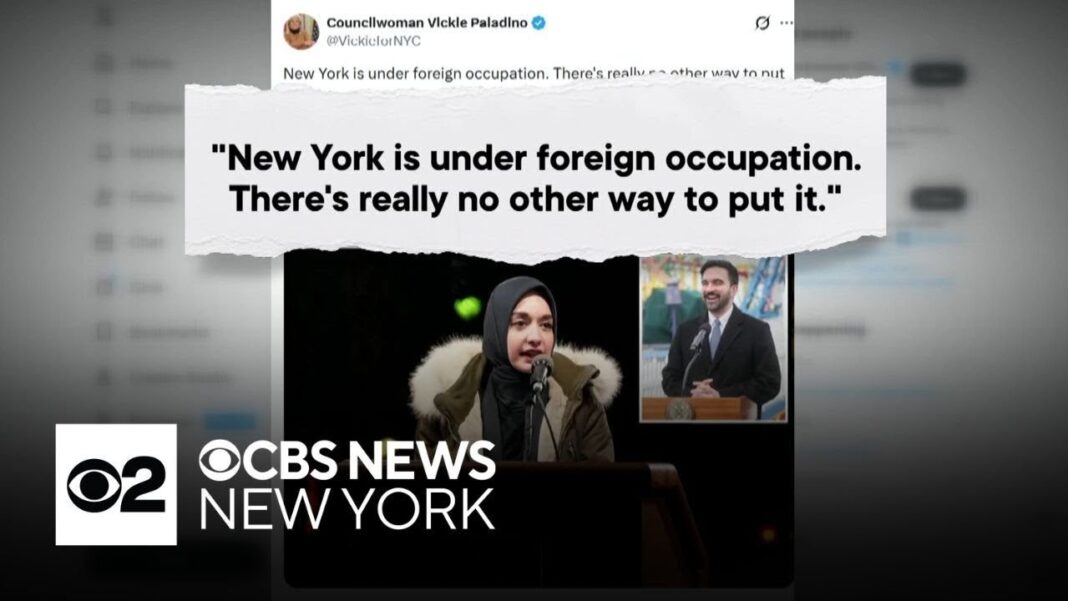
In one post, Paladino wrote that New York was “under foreign occupation,” a phrase that drew sharp criticism from colleagues and advocacy groups. The Council’s ethics panel subsequently moved to pursue charges of “disorderly behavior,” initiating a process that could result in formal censure.
However, as The New York Post has reported, Paladino’s defense hinges on the assertion that her remarks fall within the bounds of constitutionally protected speech. Her supporters argue that political discourse, particularly in an era of heightened polarization, often includes language that is provocative or hyperbolic, and that disciplining such speech sets a troubling precedent.
Central to Paladino’s case is the claim that other council members have engaged in rhetoric that is equally, if not more, contentious without facing disciplinary action. The New York Post has cataloged several examples cited by her legal team and allies, including remarks by Councilman Chi Ossé, who reportedly referred to President Donald Trump in highly derogatory terms.
In another instance, Ossé was said to have made a comment during a Council hearing suggesting that an Italian surname should have been a “red flag” in awarding a city contract—a remark that prompted an ethics complaint but ultimately did not result in formal discipline.
Similarly, statements attributed to other subpoenaed lawmakers have drawn scrutiny. Tiffany Cabán has been cited for remarks concerning policing and systemic inequality, while Shahana Hanif and Sandy Nurse have been accused of making comments that are broadly critical of certain demographic groups.
According to The New York Post report, these examples form the backbone of the argument advanced by Paladino’s legal team: that the Council has tolerated, and in some cases ignored, rhetoric from progressive members that would likely be condemned if expressed by a Republican.
The Council’s leadership has responded to the subpoenas with a measure of resistance. A spokesman for the body, Yoav Gonen, characterized the legal demands as “improper,” indicating that the city’s Law Department is actively seeking to quash them.
This response reflects a broader institutional concern about the implications of allowing internal deliberations and communications to be subject to judicial scrutiny. The New York Post report noted that such proceedings could expose sensitive political discussions and set a precedent for future legal challenges involving legislative bodies.
At the same time, the subpoenas extend beyond individual lawmakers to include Councilwoman Sandra Ung, who chairs the committee responsible for overseeing ethics matters. She has been directed to provide transcripts, records, and other materials related to the March 2 meeting at which the charges against Paladino were announced.
The scope of these requests suggests that the case may evolve into a comprehensive examination of the Council’s disciplinary mechanisms, including how decisions are made, what standards are applied, and whether those standards are enforced consistently.
The dispute has also drawn commentary from outside the immediate circle of those directly involved. Former Councilman Robert Holden, a Democrat with conservative leanings, has submitted an affidavit supporting Paladino’s position. In his filing, Holden described the potential censure as “unprecedented and hypocritical,” arguing that it reflects “bad faith and political retaliation.”
The New York Post has highlighted Holden’s intervention as indicative of broader concerns about the politicization of disciplinary processes. His affidavit reportedly includes multiple examples of statements by other council members that he characterizes as offensive or discriminatory, reinforcing the argument that Paladino is being singled out.
These dynamics underscore the deeply polarized nature of contemporary political discourse, both within New York City and nationally. The case has become a focal point for debates about free speech, accountability, and the role of elected officials in shaping public dialogue.
At its core, the legal battle raises fundamental questions about the scope and limits of the First Amendment. While public officials are not immune from consequences for their speech, the threshold for disciplinary action is often a matter of legal and constitutional interpretation.
The New York Post report repeatedly framed the case as a test of whether political bodies can impose sanctions based on the content of speech without infringing upon constitutional protections. Legal experts have noted that courts have historically been cautious in allowing governmental entities to punish speech, particularly when it pertains to political or ideological expression.
Paladino’s legal team appears to be positioning the case as a landmark challenge that could clarify these boundaries. By bringing the matter before the courts and compelling testimony from other lawmakers, they aim to demonstrate that the Council’s actions are not only inconsistent but also constitutionally suspect.
The rarity of expulsion or severe disciplinary action within the City Council adds another layer of complexity to the case. As The New York Post report noted, the only council member to have been expelled in recent history was Andy King, and that action followed multiple findings of misconduct unrelated to speech.
This precedent suggests that the threshold for severe disciplinary measures is typically high and grounded in clear violations of law or ethical standards. Whether Paladino’s remarks meet that threshold is a question that will likely be central to the court’s deliberations.
As the April court date approaches, the case promises to serve as a defining moment for New York City’s political and legal landscape. The intersection of free speech, political rivalry, and institutional authority has created a scenario in which the outcome may have far-reaching implications.
The New York Post has consistently portrayed the unfolding events as a critical test of fairness and consistency within the Council, while also highlighting the broader constitutional questions at stake. Regardless of the eventual ruling, the proceedings are likely to influence how elected officials navigate the boundaries of acceptable discourse in the years to come.
For now, the subpoenas stand as a tangible manifestation of a deeper conflict—one that extends beyond individual personalities to encompass the principles that underpin democratic governance itself. As lawmakers prepare to take the stand and the courts prepare to weigh competing claims, the city watches closely, aware that the resolution of this dispute may reshape the contours of political expression in one of the world’s most prominent urban arenas.
