



|
Getting your Trinity Audio player ready...
|
Charlie Kirk’s Final Letter to Netanyahu Counters Conspiracy Theories, Reaffirms Deep Commitment to Israel
By: Fern Sidman
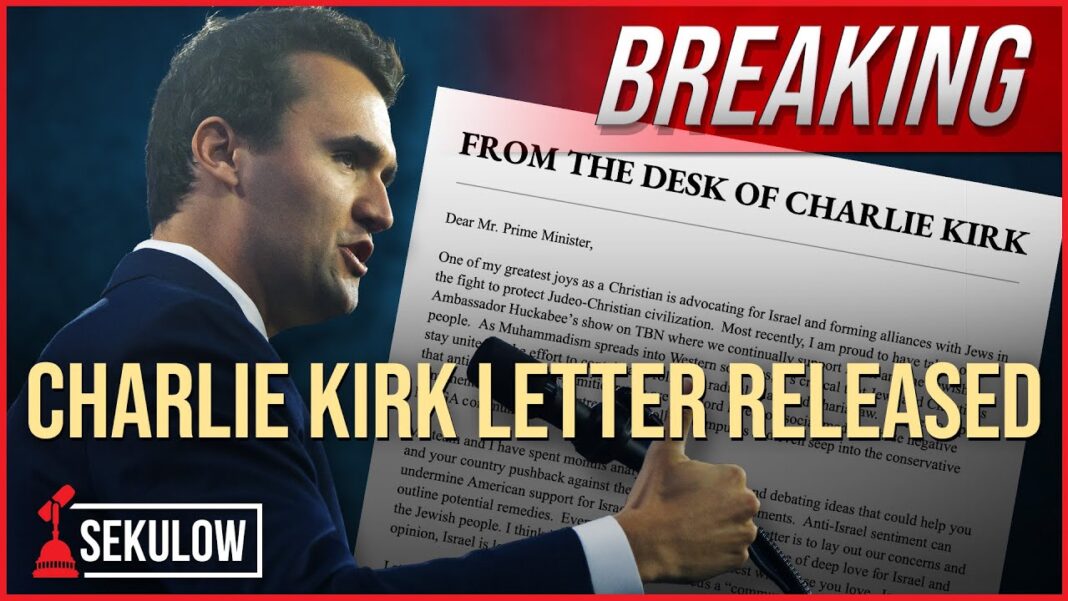
In the days following the assassination of conservative activist and podcaster Charlie Kirk, rumors and conspiracy theories spread rapidly across social media, alleging that the Turning Point USA founder had distanced himself from his longstanding support for Israel. Yet a newly published letter, addressed directly to Israeli Prime Minister Benjamin Netanyahu and reported in The New York Post and later analyzed by The Algemeiner, paints a far different picture.
The seven-page document, written earlier this year, reveals a man deeply committed to defending the Jewish state and acutely aware of the mounting challenges Israel faces in the global “information war.” Far from signaling any retreat, Kirk’s words combine personal testimony of his admiration for Israel with sharp but constructive criticism of its communications strategy, offering detailed proposals for how Jerusalem might better combat anti-Israel narratives proliferating on college campuses and online platforms.
His assassination earlier this month silenced one of America’s most influential pro-Israel voices on the political right. But the letter — candid, urgent, and at times impassioned — now serves as a rebuttal to those seeking to claim that Kirk had abandoned his cause. As The Algemeiner report on Tuesday emphasized, Kirk’s words showcase not a drift from Zionism, but rather a call for reinvigoration.
Kirk’s career as a conservative activist was marked by an unusually robust embrace of pro-Israel positions. Unlike some figures in his movement who vacillated on foreign policy matters, he consistently aligned himself with Israel’s security needs and repeatedly invoked the Jewish state as central to what he called the preservation of “Judeo-Christian civilization.”
“One of my greatest joys as a Christian is advocating for Israel and forming alliances with Jews in the fight to protect Judeo-Christian civilization,” Kirk wrote at the outset of his letter to Netanyahu. The line reflects both the personal and ideological dimensions of his commitment: a theological grounding in his Christian Zionism, and a political belief in the necessity of Jewish-Christian solidarity against radical Islamist ideologies.
As The Algemeiner report observed, Kirk’s affinity for Jewish learning also set him apart. He noted in the letter, “I spent endless hours with Dennis Prager over the years studying the Torah.” Such reflections underscore that his advocacy was not simply performative, but part of a personal intellectual and spiritual engagement with Jewish thought.
The heart of Kirk’s correspondence centers on what he described as Israel’s “five-alarm fire” in the battle for global public opinion. His vantage point came from the thousands of student interactions during his Turning Point USA campus tours, where questions about Israel increasingly dominated.
“On my recent campus tours, half the questions I get are about Israel and they’re all negative,” he lamented. He described accusations of Israel as an “apartheid state” and conspiratorial claims of Jewish manipulation of U.S. foreign policy as now mainstream talking points among young conservatives.
According to the information provided in The Algemeiner report, Kirk’s testimony was especially significant because it identified a growing fissure within the American right. He warned Netanyahu directly that anti-Israel narratives had penetrated “young MAGA circles,” eroding the once-assumed alliance between conservatives and Zionism. “Israel is losing the information war and needs a ‘communications intervention,’” he wrote.
Kirk also expressed frustration with Israel’s sluggish response to viral disinformation. He recounted that on Easter he had been “bombarded with messages about the Israeli army making it difficult for Christians to access church in Jerusalem.” With no rapid response from Jerusalem, Kirk found himself forced to fact-check in real time. “Sometimes, it feels like I’m defending Israel in public more than your own government,” he told Netanyahu.
Much of the letter reads like a political strategist’s blueprint. Drawing from his extensive experience in media and campaigning, Kirk outlined proposals to overhaul Israel’s hasbara — its traditional public diplomacy apparatus.
Among his recommendations:
Creation of an “Israel Truth Network,” a centralized hub producing original English-language content on TikTok, podcasts, and other platforms.
Deployment of rapid-response teams to counter viral misinformation.
Sending former hostages on speaking tours in the United States to humanize the Israeli experience.
Storytelling campaigns showcasing ordinary Israeli life under headlines such as “Dude, you got us wrong!”
“Israel needs to learn to fish,” Kirk urged. “Be more self-reliant when it comes to your communications strategy.”
He pointed to President Trump’s communications operation as a model, noting that Trump employed figures such as Stephen Miller and Karoline Leavitt to aggressively spar with the press daily. “Honestly, I don’t even know if you have a press secretary,” Kirk chided Netanyahu. “You are an eloquent defender of Israel, but you need a team of information warriors out there pushing back every day in real time.”
As The Algemeiner report highlighted, Kirk’s proposals were practical, rooted in his understanding of the digital landscape. He insisted that Israel must recruit young staffers who “grew up with cell phones and social media — not pay phones and TV news.”
While overwhelmingly supportive, the letter also displayed Kirk’s candor in raising sensitive criticisms. He expressed skepticism over intelligence failures and official narratives. “Our generation was also lied to by the governments of Israel and the US that COVID vaccines were safe and effective,” he wrote. “Israel intelligence missed the boat on Oct. 7, but we’re asked to trust Israeli intelligence 100 percent that Iran is on the cusp of obtaining nuclear weapons.”
Such comments reflected a broader distrust among young conservatives toward government institutions in the post-Iraq war and post-COVID era — a distrust Kirk suggested Israel must address by making its own direct case to American audiences.
Yet his criticisms never veered into rejection. “I know you’ve got a seven-front war and my kvetching pales in comparison,” he acknowledged. His overarching message remained clear: “The status quo is not working. Israel is getting crushed on social media and you are losing younger generations of Americans, even among MAGA conservatives.”
The letter’s publication has taken on outsized significance because of the conspiracy theories swirling since Kirk’s assassination. As The Algemeiner reported on Sept. 17, pro-Iran journalist Max Blumenthal published a story alleging that billionaire Bill Ackman and other pro-Israel figures staged an “intervention” to pressure Kirk into adopting more pro-Israel stances. The claim, swiftly denied by Ackman and Kirk’s longtime producer Andrew Kolvet, was nevertheless amplified by far-right voices including Candace Owens and Rep. Marjorie Taylor Greene (R-Ga.).
Days later, as The Algemeiner report detailed, former Fox News host Tucker Carlson used his eulogy for Kirk to weave antisemitic insinuations, even suggesting that Jews were responsible for both the crucifixion of Jesus and Kirk’s murder. Such rhetoric, widely condemned, underscored the very dynamics Kirk warned about: the growing normalization of anti-Jewish sentiment within right-wing discourse.
In this context, the letter serves as an unambiguous rebuttal. Far from drifting away from Israel, Kirk was actively strategizing with its leadership on how to strengthen advocacy, expose antisemitic lies, and preserve support among conservative youth.
Netanyahu’s government has long faced criticism for its lack of effective public diplomacy, a theme Kirk echoed with urgency. As The Algemeiner has frequently argued in its coverage, Israel’s military victories often fail to translate into diplomatic or public relations gains, leaving the Jewish state vulnerable to delegitimization campaigns.
Kirk’s proposals — from rapid-response teams to storytelling initiatives — were designed to close that gap. His recognition that social media platforms such as TikTok, often dismissed by older officials, are central battlegrounds in the generational divide Israel must overcome.
He framed the challenge in political terms familiar to any campaign strategist: “Right now, there’s essentially a massive negative ad campaign spreading on social media. These negative ads are defining this candidate. Like any campaign, the first task is to define the candidate.”
Kirk’s closing paragraphs are striking for their combination of political urgency and spiritual devotion. “The Holy Land is so important to my life, and it pains me to see support for Israel slip away,” he wrote. “Everything written here is from a place of deep love for Israel and the Jewish people.”
It was a statement of faith as much as politics — a testament to the Christian Zionist ethos that animated Kirk’s career. For pro-Israel advocates, the letter has now become a document of enduring significance, a final testament from an ally who refused to waver even under the strain of criticism.
The publication of Charlie Kirk’s letter to Benjamin Netanyahu has shifted the narrative surrounding his legacy. Far from abandoning Israel, Kirk was doubling down, offering hard-nosed advice to strengthen its communications and warning of the dangers posed by antisemitic disinformation.
As The Algemeiner report observed, the letter offers “a powerful rejoinder to those who would seek to distort Kirk’s record.” It highlights both his unwavering support and his willingness to challenge Israel to do better in defending itself on the world stage.
For the Jewish state, the letter is both a gift and a challenge: a reminder of the steadfast allies it has among America’s conservatives, and a roadmap for how it might preserve that support in a changing political landscape. For Kirk’s admirers, it is a poignant coda to a life cut short — one that affirms his devotion to Israel remained unbroken until the very end.
