



|
Getting your Trinity Audio player ready...
|
Warnings Ignored? Bolton Rebukes Trump as Iran Conflict Spirals Into Regional Crisis
By: Jerome Brookshire
As the conflict between the United States, Israel, and Iran deepens into its third week, a sharp and highly consequential dispute has emerged within the American political and national security establishment. At its center lies a fundamental question: whether the escalation and its cascading consequences were foreseeable—and, if so, whether critical warnings were overlooked at the highest levels of leadership.
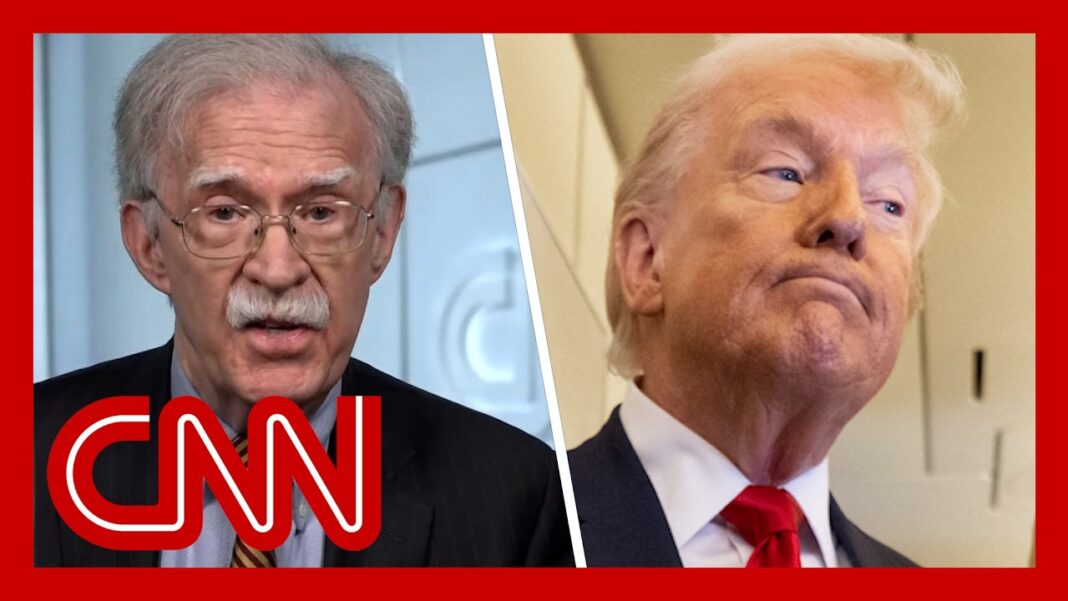
Former National Security Adviser John Bolton has forcefully challenged President Donald Trump’s recent assertion that Iran’s retaliation against neighboring countries came as a shock. In a pointed television appearance, Bolton contended that such scenarios were not only predictable but had been explicitly discussed during Trump’s first term in office.
According to a report at The Hill on Wednesday, Bolton’s remarks have intensified scrutiny of the administration’s strategic planning and raised broader concerns about the conduct and direction of the ongoing conflict.
President Trump’s statements, delivered in recent days, have sought to portray Iran’s retaliatory actions as unexpected. Speaking at a White House event, he suggested that Tehran’s decision to strike targets across the Middle East—including countries such as Qatar, Saudi Arabia, the United Arab Emirates, Bahrain, and Kuwait—had taken experts by surprise.
“Nobody expected that. We were shocked,” Trump said, according to accounts reported by The Hill.
He reiterated this position when pressed further, insisting that even the most seasoned analysts had not anticipated such moves. His remarks framed the escalation as an unforeseen development, implying that the administration had acted based on reasonable expectations that were subsequently upended.
Bolton, however, offered a starkly different account.
Appearing on CNN, Bolton directly contradicted the president’s claims, stating that he had personally briefed Trump on the likelihood of Iranian retaliation in multiple scenarios. These included potential attacks on shipping in the Strait of Hormuz—a critical artery for global oil transport—as well as strikes against regional allies.
“I know for a fact that he was aware of those potentials,” Bolton said, as cited by The Hill. “I raised the option of regime change in Iran several times during my tenure, and each time it was accompanied by discussions of the risks involved.”
According to Bolton, those risks were not abstract or speculative. They formed a consistent and central component of strategic deliberations, with particular emphasis on the possibility of Iran targeting oil infrastructure and disrupting maritime traffic.
“If you’re going to embark on such a course, you need to have answers to these challenges,” Bolton explained. “Closing the Strait of Hormuz was always one of them, as were attacks on Gulf states.”
His remarks suggest that the current developments are not anomalies but rather the realization of long-anticipated contingencies.
The Strait of Hormuz, through which a significant portion of the world’s oil supply passes, has long been recognized as a focal point in any potential conflict with Iran. Its narrow waterways and strategic location make it both a vital economic corridor and a potential flashpoint.
Recent reports indicate that Iranian actions have indeed disrupted shipping in the region, targeting tankers and contributing to the effective closure of the strait. As The Hill has highlighted, such developments carry profound implications for global energy markets and international stability.
The targeting of this critical passage underscores the broader strategy attributed to Iran: leveraging its geographic advantages to exert pressure on both regional and global actors.
Beyond the immediate question of predictability, the conflict itself has come under increasing scrutiny. Critics argue that the administration entered the war with shifting objectives and without a clearly defined endgame.
Initially framed as an effort to neutralize Iran’s military capabilities and nuclear ambitions, the campaign has evolved into a broader confrontation with uncertain parameters. As reported by The Hill, the lack of a coherent strategy has drawn criticism from both political opponents and some members of the administration.
The human and material costs of the conflict are also mounting. Thirteen American service members have been killed, and at least 200 others have sustained injuries. These losses have intensified calls for a reassessment of the mission’s objectives and trajectory.
The growing unease within the administration was underscored by the resignation of Joe Kent, the national counterterrorism director. In a letter to the president, Kent expressed his opposition to the conflict, arguing that Iran did not pose an imminent threat to the United States.
His resignation marks the first high-level departure directly linked to the war, signaling a potential widening of internal divisions. As noted in coverage by The Hill, Kent’s departure has added a new dimension to the debate, raising questions about consensus within the national security apparatus.
Iran’s retaliatory actions have not been confined to isolated incidents. The targeting of multiple countries in the region has expanded the scope of the conflict, drawing in actors that had previously maintained a more neutral stance.
This development has complicated diplomatic efforts and increased the risk of a broader regional escalation. Countries that were once peripheral to the conflict now find themselves directly affected, with implications for alliances and security arrangements.
As The Hill report observed, the widening scope of the conflict underscores the interconnected nature of Middle Eastern geopolitics, where actions in one arena can quickly reverberate across the region.
At the heart of the current controversy lies a question of accountability: whether the administration adequately considered the risks associated with its actions and whether it acted on the best available information.
Bolton’s remarks suggest that the potential consequences were clearly outlined, raising the possibility that warnings were either underestimated or disregarded. This interpretation stands in contrast to the president’s assertion that the developments were unforeseen.
The divergence between these perspectives has fueled a broader debate about decision-making processes and the role of expertise in shaping policy.
As the conflict continues, the administration faces a series of difficult decisions. Balancing the need to respond to Iranian actions with the imperative to avoid further escalation will require careful calibration.
President Trump has indicated that the United States is not yet ready to withdraw but has suggested that an exit may be forthcoming. “If we left right now, it would take them ten years to rebuild,” he said, according to reporting by The Hill.
This statement reflects both confidence in the impact of the campaign and uncertainty about its duration and ultimate goals.
The unfolding dispute between John Bolton and President Trump encapsulates a broader moment of reckoning within American foreign policy. It highlights the complexities of strategic planning, the challenges of interpreting intelligence, and the consequences of decisions made under conditions of uncertainty.
As detailed by The Hill, the questions raised by this controversy extend beyond individual statements or personalities. They touch on fundamental issues of governance, accountability, and the conduct of war.
In the weeks ahead, the trajectory of the conflict—and the answers to these questions—will continue to shape not only the immediate situation but also the broader contours of international relations. Whether the administration can reconcile competing narratives and chart a coherent path forward remains to be seen.
What is clear is that the stakes are extraordinarily high, and the consequences of miscalculation could be felt far beyond the region itself.
