



|
Getting your Trinity Audio player ready...
|
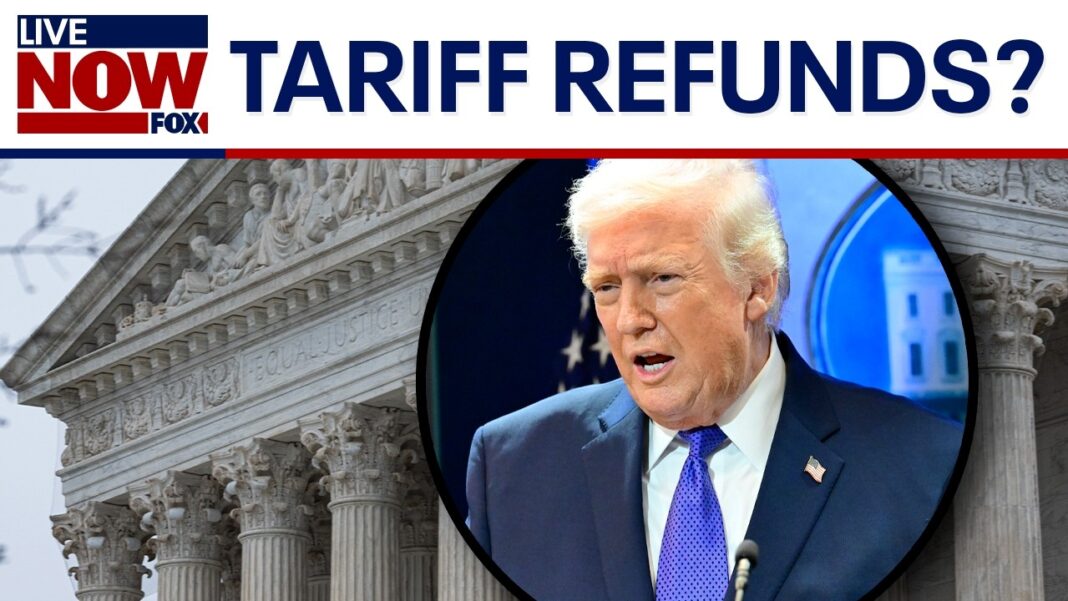
(TJV NEWS) More than $175 billion in tariff revenue collected under President Donald Trump’s emergency trade powers could be subject to refunds if the U.S. Supreme Court rules against the administration, according to new economic estimates. Bloomberg reported that researchers at the Penn-Wharton Budget Model (PWBM) calculated the potential exposure at the request of Reuters.
The analysis focuses on tariffs imposed under the International Emergency Economic Powers Act (IEEPA), a law Trump has used to justify sweeping trade duties since February 2025. Bloomberg reported that the Supreme Court could issue a decision on the legality of those tariffs as soon as Friday. If the justices invalidate them, importers may seek reimbursement from U.S. Customs and Border Protection (CBP) for duties paid over the past year.
Lysle Boller, a senior economist with PWBM — a nonpartisan fiscal research group at the University of Pennsylvania — said the team built its estimate using a detailed forecasting model. Bloomberg reported that the model analyzes tariff rates by product and country, drawing on U.S. Census Bureau data covering roughly 11,000 import categories identified by eight-digit tariff codes across 233 countries.
Based on that modeling, PWBM estimates that about $500 million per day has been collected under IEEPA-related tariffs. As of Thursday, total revenue gathered under that authority had reached approximately $179 billion, Bloomberg reported. Using a separate method — extrapolating from CBP data on IEEPA assessments as a share of overall Treasury customs receipts — the group arrived at a similar figure, between $175 billion and $176 billion.
For context, Bloomberg noted that a $175 billion refund would exceed the combined fiscal 2025 budgets of the U.S. Department of Transportation ($127.6 billion) and the U.S. Department of Justice ($44.9 billion). That comparison underscores the scale of the potential financial impact if the court rules against the administration.
The most recent publicly available CBP data on IEEPA-based duties, published in mid-December, showed $133.5 billion in assessments since the first such tariffs were imposed. However, net collections can be somewhat lower because assessments are often adjusted, resulting in partial refunds.
Bloomberg reported that the PWBM model is designed to quickly account for shifts in tariff policy, including sudden changes stemming from trade negotiations. For example, U.S. tariff rates on South Korean goods were reduced from 25% to 15% in November. The model also reflects changes in punitive duties, such as the 40% tariff imposed on Brazil last August over the prosecution of former President Jair Bolsonaro, as well as the subsequent removal of tariffs on Brazilian coffee, beef and cocoa in November.
Treasury Secretary Scott Bessent told Reuters in January that the Treasury Department could manage any required refunds and remains confident that the Supreme Court will uphold the IEEPA-based tariffs. Bloomberg reported that the Treasury is maintaining substantial cash balances in its borrowing plans — projecting $850 billion at the end of March and $900 billion at the end of June — in part to preserve flexibility.
Meanwhile, customs revenue has surged. Bloomberg reported that Treasury data show customs receipts running roughly $20 billion higher per month than in the year before the tariffs were implemented, including about $27.7 billion collected in January alone.
Administration officials have indicated that if the court invalidates the IEEPA tariffs, they are prepared to pivot to alternative statutory authorities to reinstate similar trade measures.
