



|
Getting your Trinity Audio player ready...
|
By: Ariella Haviv
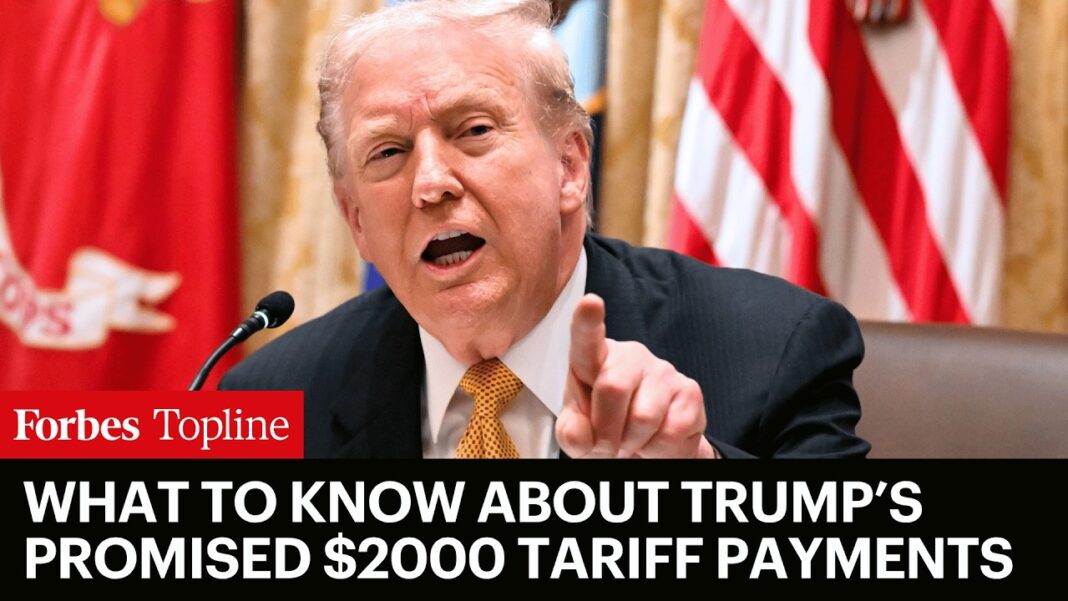
President Donald Trump announced Sunday that he plans to deliver $2,000 payments to most American adults, a sweeping new economic proposal he described as a “dividend” funded entirely from revenue generated by U.S. tariffs — one of the cornerstones of his administration’s trade policy. The declaration, made on his Truth Social platform and reported by CBS News on Monday, immediately sparked debate among economists, lawmakers, and fiscal analysts over its feasibility, legality, and potential economic repercussions.
The president framed the initiative as both a reward for American workers and a vindication of his tariff strategy, which he said had helped fuel “record investment” in U.S. manufacturing and brought billions into federal coffers. “A dividend of at least $2,000 a person (not including high income people!) will be paid to everyone,” Mr. Trump wrote, calling the policy “a victory for American labor over global freeloaders.”
According to the information provided in the CBS News report, the White House did not immediately respond to requests for clarification on how such payments would be implemented or which income brackets would qualify. While the announcement electrified Trump’s populist base, the absence of details — particularly concerning congressional authorization and the use of tariff revenue — left many observers uncertain about whether the proposal could move forward under existing law.
As the CBS News report noted, the president’s announcement comes as his tariff authority faces a major legal test before the U.S. Supreme Court, where justices recently heard arguments over his administration’s use of the 1977 International Emergency Economic Powers Act (IEEPA) to levy broad-based import duties. Several justices expressed skepticism about the scope of executive power under that statute, raising the possibility that parts of Trump’s tariff framework could be curtailed or overturned.
If the Court ultimately rules that the IEEPA tariffs were unlawful, importers could be entitled to substantial refunds — a decision that would not only complicate Trump’s plan but potentially wipe out much of the revenue intended to fund these $2,000 payments. “If that happens, the pool of money the president is counting on could evaporate almost overnight,” one trade analyst told CBS News.
Currently, U.S. Customs and Border Protection data show that importers have paid nearly $89 billion in tariffs imposed under the IEEPA, with total customs duties reaching $195 billion for the fiscal year ending September 30, according to the U.S. Department of the Treasury. By contrast, distributing $2,000 to an estimated 150 million adults earning under $100,000 would cost roughly $300 billion, according to Erica York, vice president of federal tax policy at the Tax Foundation, in comments reported by CBS News.
“New tariffs have raised about $120 billion so far,” York explained. “That’s less than half of what would be required to fund the president’s proposed rebates — and that’s before accounting for the offsetting revenue losses caused by higher prices and reduced imports.”
The CBS News report highlighted that such payments would almost certainly need to be processed through the tax code, requiring new legislation to authorize the Treasury Department to issue checks. Historically, the only precedent for similar payments was the trio of pandemic-era stimulus checks — all of which were approved by Congress and signed into law by Presidents Trump and Biden.
Economists interviewed by CBS News questioned whether Trump could legally bypass Congress to issue what he has termed a “dividend.” “The IEEPA grants tariff authority, not fiscal spending authority,” said one legal scholar. “Without congressional appropriation, there’s no mechanism for the Treasury to disburse funds directly to citizens.”
However, Treasury Secretary Scott Bessent, speaking on Fox News Sunday and cited in the CBS News report, suggested that the administration might pursue creative alternatives. “The dividend could come in lots of forms,” he said. “It could mean additional tax cuts — no tax on tips, no tax on overtime, no tax on Social Security income, deductibility for auto loans. The president is exploring multiple avenues to get money back to the American people.”
Trump’s aides have reportedly discussed using unspent tariff revenue as an offset in the upcoming budget reconciliation package, thereby linking the payments to broader tax reforms rather than direct checks.
Critics of the proposal warn that sending new checks to tens of millions of households could reignite inflationary pressures, which have already begun to edge upward after a brief period of stabilization. As the CBS News report noted, economists widely agree that the pandemic-era stimulus payments, though critical in preventing economic collapse, contributed between one and three percentage points to the 2022 inflation surge — the highest in four decades.
“Injecting another $300 billion into the consumer economy without a matching increase in supply would be inflationary by definition,” York told CBS News. “Even if the intent is to reward Americans for tariff policy success, the near-term impact would likely push prices higher.”
The Trump administration, however, dismissed those warnings. A senior White House official, quoted by CBS News, said the inflation concerns were “speculative and premature,” arguing that the administration has yet to finalize the structure or timing of the plan. “What’s clear,” the official said, “is that Americans deserve to share directly in the benefits of tariffs that have strengthened domestic industry and created millions of jobs.”
Still, economists point out that tariffs themselves tend to raise consumer prices, as importers pass on a portion of those costs to end buyers. “If tariffs push prices up and the rebate then injects more spending, you have a twofold inflationary impulse,” one analyst said. “That’s the contradiction in the policy.”
The proposal underscores how central tariffs have become to Trump’s populist economic doctrine, which portrays trade duties not as a burden on consumers but as a patriotic mechanism for wealth redistribution. “Tariffs are no longer a tax,” Trump wrote on Truth Social. “They are a dividend for the American people.”
As the CBS News report observed, the president’s rhetoric frames the new policy as an economic equalizer — a way to make foreign exporters and global corporations “pay their fair share” while providing tangible benefits to working-class Americans. The plan also dovetails with Trump’s ongoing push for a “Made in America” industrial revival, which he claims has already spurred “record investments in U.S. steel, autos, and microchips.”
However, the CBS News report noted that the timing of the announcement — amid Supreme Court scrutiny and early jockeying for the 2026 election cycle — suggests a political dimension as well. Offering a $2,000 “tariff dividend” allows Trump to revive the populist appeal of his 2018-2020 tariff wars while recasting them as direct income benefits for ordinary voters.
If implemented, the policy could serve as a dual message: vindication of Trump’s long-criticized tariff strategy and a populist challenge to the Democratic Party’s dominance over middle-class economic issues.
The numbers, however, tell a more sobering story. As CBS News reported, while customs duties brought in $195 billion last fiscal year, that total must fund a wide array of government activities and cannot simply be reallocated to household payments without congressional approval. Moreover, tariffs have indirect costs: they reduce import volumes and domestic competition, which can ultimately erode income and payroll tax revenues.
“The math gets worse when you account for the full fiscal feedback loop,” York told CBS News. “Every dollar of tariff revenue offsets roughly 24 cents in income and payroll taxes. Adjusting for that, the net revenue gain from tariffs is closer to $90 billion — barely a third of what’s needed to fund the president’s plan.”
On Monday, Trump doubled down, posting on Truth Social that any “money left over” from the dividend would go toward paying down the national debt — a claim analysts described to CBS News as “fiscally implausible.”
Whether the “tariff dividend” ever materializes remains to be seen. What is clear, as the CBS News report emphasized, is that the proposal represents one of the boldest — and most politically charged — economic gambits of Trump’s presidency.
To his supporters, the promise of $2,000 checks funded by trade duties embodies the essence of Trumpism: nationalism fused with economic populism, rewarding “forgotten Americans” while punishing foreign competitors. To critics, it is a dangerous blend of fiscal fantasy and political opportunism, one that risks stoking inflation, deepening debt, and undermining trade stability.
As the Supreme Court weighs the limits of executive tariff authority, the question remains whether Trump’s audacious proposal will stand as an innovative reimagining of economic populism — or merely another rhetorical flourish in an already turbulent political era.
Either way, as the CBS News report noted, the president’s message is unmistakable: America’s trade wars are no longer just about tariffs — they’re about dividends, dollars, and the power of economic nationalism itself.

The president needs to focus on paying down our national debt.