



|
Getting your Trinity Audio player ready...
|
By: Fern Sidman
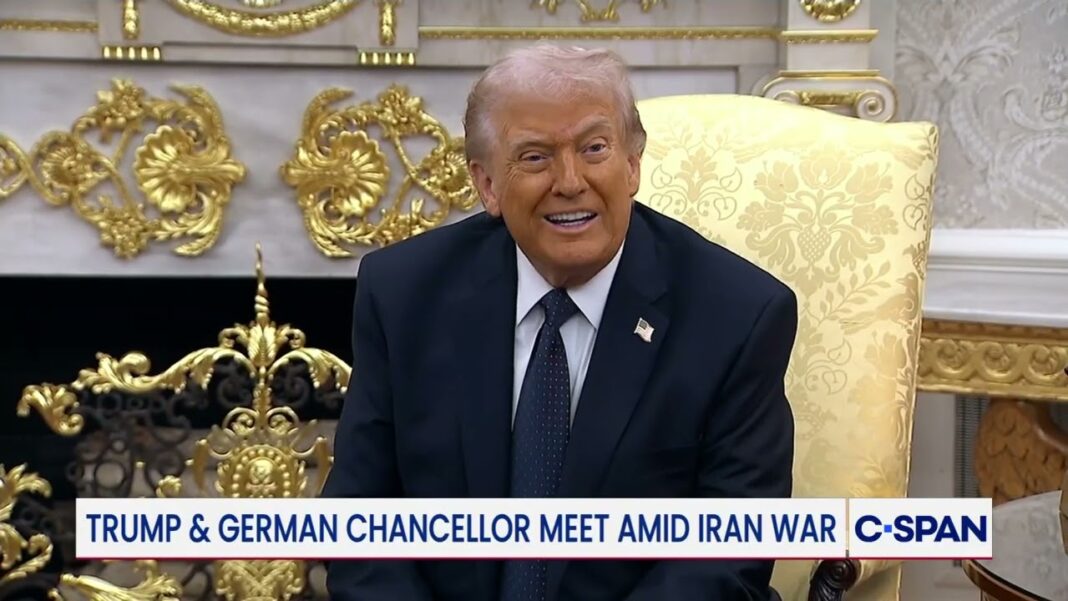
President Donald Trump delivered a scathing denunciation of Iran’s leadership at the White House this week, characterizing the regime in Tehran as “sick people” and asserting that decisive American action has forestalled what he described as a looming nuclear catastrophe.
The remarks, delivered in the midst of escalating tensions over Iran’s nuclear ambitions and expanding regional influence, underscored the administration’s hardened posture toward the Islamic Republic. According to a report on Tuesday at VIN News, which closely followed the President’s comments, Trump framed the current U.S. strategy not merely as a matter of geopolitical necessity but as an urgent intervention to prevent catastrophic global conflict.
“They are mentally ill, angry, crazy, and sick,” Trump said in reference to Iran’s ruling authorities. “If we weren’t doing what we’re doing now, a nuclear war would have broken out. They would have wiped out many countries.”
The language was unusually blunt even by Trump’s often forceful rhetorical standards. Yet as VIN News reported, the President appeared intent on conveying both moral condemnation and strategic justification. His remarks reflected a broader narrative advanced by the administration: that Iran’s nuclear program and ballistic missile capabilities represent not only a regional threat but an existential danger to global stability.
For years, the Iranian regime has insisted that its nuclear program is intended for peaceful purposes. However, Western intelligence agencies and international watchdogs have repeatedly raised concerns about enrichment levels, research activities, and the regime’s compliance with international agreements. The VIN News report detailed how these concerns intensified following the collapse of previous diplomatic frameworks designed to constrain Tehran’s nuclear ambitions.
Trump’s assertion that “a nuclear war would have broken out” without current U.S. actions suggests that the administration believes Iran was nearing a decisive threshold. While he did not elaborate on specific intelligence assessments, the implication was clear: the combination of nuclear development, missile proliferation, and aggressive regional posture created conditions that could have spiraled into widespread conflict.
The President’s warning that Iran “would have wiped out many countries” echoed longstanding fears among U.S. allies, particularly Israel and several Gulf states, that Tehran’s strategic objectives extend beyond deterrence. VIN News has frequently reported on concerns that an emboldened, nuclear-armed Iran could alter the balance of power in the Middle East and potentially trigger a cascade of proliferation among neighboring nations.
Trump’s comments also come at a time when tensions in the region remain elevated due to ongoing military operations, proxy confrontations, and diplomatic deadlock. Iran’s support for armed groups across the Middle East has long been cited by Washington as evidence of destabilizing intent. VIN News has covered the administration’s argument that these proxy networks—ranging from militia forces in Iraq to armed factions in Lebanon and Yemen—are part of a broader strategy to expand Iranian influence and pressure U.S. interests.
By describing Iran’s leaders as “mentally ill” and “crazy,” Trump sought to underscore ideological extremism at the highest levels of the regime. Critics may view such rhetoric as incendiary, but supporters argue it reflects frustration with decades of intransigence and hostility.
The President’s framing of current U.S. policy as a preventive measure aligns with the doctrine of preemption that has periodically shaped American foreign policy. The logic holds that waiting for an adversary to cross a definitive threshold—such as deploying nuclear weapons—could prove catastrophic. In this view, early and decisive action is not aggression but prudence.
Administration officials contend Iran’s recent actions, including advances in uranium enrichment and expanded missile testing, accelerated the timeline for confrontation. Trump’s comments suggest that he views the present strategy as both defensive and necessary to avert greater calamity.
Diplomatic observers note that rhetoric of this intensity serves multiple purposes. Domestically, it reinforces the administration’s argument that firm measures are warranted. Internationally, it signals resolve to allies and adversaries alike. The President’s stark language may also be intended to dissuade Tehran from further escalation by conveying that Washington perceives the stakes as existential.
At the same time, the broader geopolitical landscape remains complex. European governments have historically favored diplomatic engagement to manage Iran’s nuclear program, while regional actors have expressed varying degrees of concern and support for U.S. initiatives. The VIN News report highlighted the delicate balance between deterrence and diplomacy, noting that public rhetoric can influence perceptions and negotiations.
Trump’s remarks did not specify the precise scope of “what we’re doing now,” though the context suggests a reference to intensified sanctions, military readiness, and coordinated actions with regional partners. Administration officials have emphasized that the objective is to ensure Iran does not acquire a nuclear weapon and to curtail its capacity to project destabilizing power.
The specter of nuclear war, invoked by the President, remains a powerful motivator in public discourse. Since the dawn of the atomic age, the prevention of nuclear proliferation has been a cornerstone of U.S. national security policy. Trump’s assertion that current measures have averted such a scenario reflects his administration’s belief that the threat was both imminent and severe.
As tensions continue to evolve, the durability of this strategy will depend on multiple factors: the effectiveness of deterrence, the cohesion of allied coalitions, and the response of Iran’s leadership. The VIN News report observed that the administration’s messaging emphasizes both strength and inevitability—the idea that firm action now prevents catastrophic consequences later.
In the White House briefing room, Trump’s words were unambiguous and uncompromising. Whether history ultimately judges the present moment as the turning point he describes remains to be seen. For now, the President has staked his position firmly: that without current American intervention, the world might already be on the brink of nuclear conflict.
As the VIN News report observed, one thing is clear—the stakes, as articulated by the President, could scarcely be higher.
