



|
Getting your Trinity Audio player ready...
|
By: Chaya Abecassis
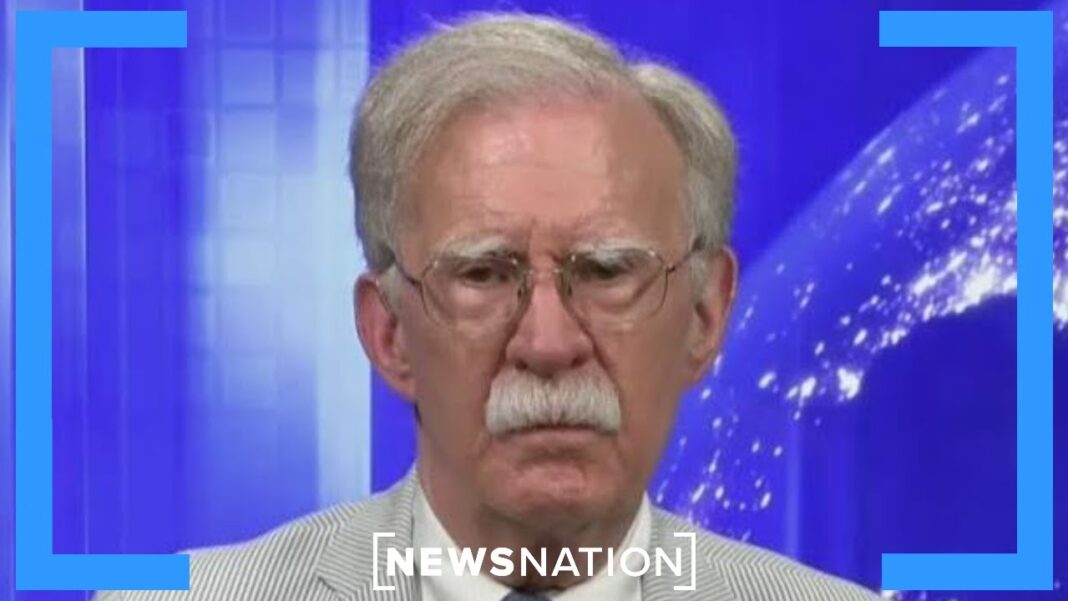
The already fraught relationship between former National Security Adviser John Bolton and President Trump reached a new inflection point last week, after FBI agents conducted raids on Bolton’s Bethesda, Maryland, home and his Washington, D.C., office as part of a federal investigation into classified documents. While the probe itself remains in its early stages, Bolton’s reaction has been as pointed as it is politically explosive: in his first public statement since the raid, he used the moment to launch a fierce critique of Trump’s Ukraine strategy, describing it as “incoherent,” “hasty,” and “unrealistic.”
As VIN News reported on Tuesday, the convergence of these two narratives — Bolton’s legal entanglements and his harsh appraisal of Trump’s foreign policy — has once again brought into focus the profound fissures in U.S. security policymaking, as well as the personal animosity between the president and his former adviser.
According to sources cited by VIN News, FBI agents arrived unannounced at Bolton’s Bethesda residence and Washington office last week, seizing boxes of material believed to be connected to the handling of classified documents. The precise scope of the investigation has not been disclosed, but federal officials have suggested it relates to sensitive national security information, echoing similar disputes over document retention that have dominated headlines in recent years.
Bolton, a longtime conservative hawk with decades of experience in U.S. foreign policy, confirmed the raids in his remarks but offered little about the substance of the investigation, focusing instead on policy differences with Trump.
For his part, Trump appeared visibly surprised by the development. “I saw it on television this morning,” the president told reporters. He added pointedly: “I wasn’t a fan of John Bolton,” before noting that he himself had endured a raid on his Mar-a-Lago estate in 2022 under the Justice Department’s classified documents probe.
Bolton used the opportunity to sharpen his critique of Trump in an opinion piece for the Washington Examiner, excerpts of which were widely circulated and discussed by outlets including VIN News. In his column, Bolton characterized Trump’s Ukraine policy as a patchwork of confused impulses, lacking the coherence and strategic foresight required for high-stakes diplomacy.
“Trump’s Ukraine policy is incoherent,” Bolton wrote. “The president has acted in confusion and haste, proposing solutions that are unworkable and at times counterproductive.”
The former adviser specifically cited Trump’s recent meetings including the president’s high-profile encounter with the Russian leader failed to produce any form of ceasefire agreement, a setback that Bolton said revealed Trump’s lack of preparation and overestimation of his negotiating prowess.
Following the Alaska meeting, Trump floated proposals for a trilateral summit with both Putin and Zelensky. Bolton dismissed the idea as “unrealistic,” warning that it risked leaving the U.S. “further from a resolution” while emboldening Russia and undermining Ukraine.
According to Bolton, Trump’s handling of Ukraine reflects a broader pattern of ad hoc policymaking, where decisions are driven less by strategy than by optics and improvisation.
The renewed clash between Bolton and Trump is the latest chapter in a relationship that has been marked by intense friction and public recriminations.
In September 2019, Trump asked Bolton to resign as National Security Adviser, citing deep policy disagreements.
Shortly afterward, Bolton published his memoir, The Room Where It Happened, in which he alleged widespread misconduct and poor judgment within the Trump administration.
Trump sought to block publication of the book on the grounds that it contained classified material. While the legal battle was contentious, investigations into Bolton’s book were later dropped under the Biden administration.
Now, with the FBI once again scrutinizing Bolton’s handling of sensitive documents, the dispute has reignited at a politically sensitive moment, with both men leveraging the narrative to their advantage.
Trump, characteristically blunt, framed the raid as part of a pattern of government overreach but refrained from directly defending Bolton. Instead, he used the opportunity to cast doubt on his former adviser’s credibility.
“I wasn’t a fan,” Trump said, adding that Bolton’s commentary on Ukraine was irrelevant compared to his own record. The president pointed to his prior insistence that Europe contribute more robustly to Ukraine’s defense, portraying himself as the architect of a burden-sharing model that, in his view, corrected decades of American overextension.
As the report at VIN News noted, Trump’s attempt to separate the raid from his own foreign policy record suggests he is keenly aware of the political resonance of Ukraine — an issue that has increasingly shaped both domestic debates and U.S. alliances abroad.
Vice President JD Vance addressed the raids in remarks to reporters, emphasizing that the investigation was still in its infancy. “This is in the very early stages,” Vance said. “What I can say is that this is about the national interest and the law, not about political retribution.”
Vance’s statement reflects the administration’s effort to insulate the inquiry from charges of politicization — a recurring theme in disputes involving high-profile political figures and classified documents. Still, as VIN News reported, the perception of selective enforcement remains a potent talking point across the political spectrum.
Bolton’s latest broadside fits within a long tradition of hawkish skepticism toward Trump’s foreign policy. As a neoconservative figure, Bolton has consistently favored strong U.S. engagement abroad, including military pressure on adversaries such as Russia and Iran.
By contrast, Trump’s approach has often blended transactional diplomacy with skepticism of U.S. entanglements overseas. His proposals for dramatic summits and bold, sometimes theatrical diplomacy have been criticized by traditionalists like Bolton as reckless improvisation.
Bolton’s argument, as highlighted in the VIN News report, is that Trump’s desire for quick fixes risks leaving U.S. interests compromised — particularly in Ukraine, where Russia’s aggression continues to challenge both NATO unity and global stability.
The FBI raids and Bolton’s editorial together call attention to the political volatility of national security policy in the United States today.
For Bolton, the raids risk tarnishing his credibility at a moment when he is positioning himself as a principled critic of Trump’s leadership.
For Trump, the controversy provides a new opportunity to paint himself as a victim of government overreach, while casting Bolton as both untrustworthy and embittered.
For Washington at large, the dispute underscores the fragility of consensus on Ukraine, as political leaders struggle to balance domestic concerns, alliance commitments, and the imperative of countering Russia.
As the VIN News report noted, the episode illustrates how questions of classified documents, foreign policy, and personal rivalries remain deeply intertwined in American politics.
The raids on John Bolton’s home and office have opened yet another chapter in the long-running saga between the former national security adviser and President Donald Trump. But rather than focus solely on his legal predicament, Bolton used the moment to deliver a sharp critique of Trump’s Ukraine policy, accusing the president of incoherence and recklessness.
Trump, for his part, dismissed Bolton’s remarks and reiterated his skepticism of his former aide. Meanwhile, Vice President JD Vance sought to reassure the public that the investigation was based on law, not politics.
As the VIN News report emphasized, the dual narrative of legal jeopardy and foreign policy dispute reveals the profound ways in which personal rivalries continue to shape the broader debate over America’s role in Ukraine and beyond. In this sense, the Bolton-Trump clash is not only about two men but about the very direction of U.S. national security in an era of mounting global instability.
