



|
Getting your Trinity Audio player ready...
|
By: Fern Sidman
On the second anniversary of Hamas’s October 7, 2023 massacre—the deadliest single day for Jews since the Holocaust—Israel marks a solemn milestone while prosecuting two parallel battles: a military campaign to dismantle Hamas’s war-fighting system in Gaza and a political-information struggle to defend its legitimacy amid a global surge in antisemitism.
Two years on, the picture is stark but clarifying. Hamas’s leadership cadre has been pummeled; its underground networks and command infrastructure have taken heavy losses; and Israel has expanded operational control across most of the Strip. At the same time, Iran’s nuclear ambitions—long the keystone of Israel’s wider security doctrine—have driven a broader confrontation, even as the United States has re-centered maximum pressure on Tehran and intensified support for Israel’s defense.
Israel’s strategy since October 7 has been methodical: eliminate Hamas’s senior leadership, shatter its battalion-level formations, and render its subterranean logistical complex unusable. Over the past two years, Israeli operations have removed key figures—including the Sinwar brothers and Mohammed Deif—while repeatedly disrupting command-and-control nodes and weapons manufacturing sites.
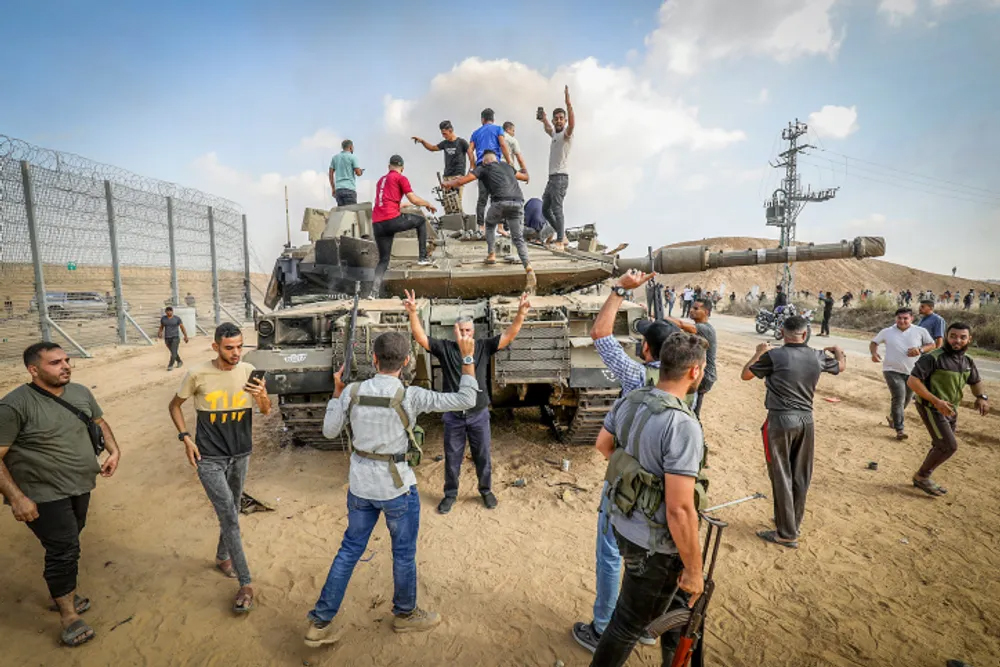
The cumulative effect has been to degrade Hamas from a quasi-conventional force into a more atomized insurgency: dangerous, adaptive, but increasingly fragmented and dependent on guerrilla cells rather than fielded brigades. Independent assessments and Israeli statements converge on this basic picture, even as they note that pockets of Hamas fighters and tunnel segments persist. Recent reporting and Israeli releases have detailed the destruction of dozens of kilometers of tunnels in Khan Yunis and elsewhere, alongside continued raids targeting remaining cells and rocket stocks.
Data-focused monitors similarly describe a battlefield where Israel’s ground dominance has expanded while Hamas adapts with dispersed ambushes and IEDs, a transition consistent with the group’s loss of centralized leadership and massed formations. That shift is why periodic flare-ups—in Jabaliya, Rafah, and Gaza City—continue even after major clearing operations. Analysts caution that “vanquishing” a networked movement is not a single event but the cumulative result of attrition, leadership decapitation, and denial of sanctuary over time—precisely the arc Israel has pursued since late 2023.
For Jerusalem, Hamas’s war machine is inseparable from Iran’s regional project and nuclear program. In 2025, the confrontation widened as Israel struck Iranian military and nuclear-linked sites in a bid to set back capabilities that Israeli leaders argue are designed to put an existential sword over Israel’s neck. Reporting from the summer detailed Israeli air operations across Iran against missile factories, senior commanders, and nuclear-associated facilities—part of an overt campaign to deny Tehran a weapons pathway. The strikes were paired with tightened international censure of Iran’s enrichment advances and renewed U. S. pressure.
The nuclear dossier remains sobering. Recent IAEA-based assessments found that Iran continues to stockpile uranium enriched up to 60% U-235—far above civilian needs and a short sprint from weapons-grade—while expanding advanced centrifuge capacity. The International Atomic Energy Agency’s leadership has warned repeatedly that visibility into key sites must be restored urgently. These facts underpin Israel’s insistence that rolling back Iran’s program is not optional statecraft but core self-defense.
In parallel with Israel’s intensified operations, the United States has moved to reinforce deterrence against Iran and materially back Israel’s fight against Hamas. This year, the administration reinstated “maximum pressure” authorities targeting Tehran’s revenue streams and proliferation networks, while notifying Congress of multi-billion-dollar arms sales to replenish Israel’s precision munitions, aviation assets, and armored mobility—capabilities that directly affect Israel’s ability to prosecute urban warfare while limiting exposure of its forces. U. S. mediation has also framed ceasefire-hostage tracks even as the White House presses for the dismantlement of Hamas’s war-making capacity as a non-negotiable predicate for any durable arrangement.

If the kinetic battlefield is subterranean tunnels and drone-swept streets, the political battlefield is algorithmic, ambient, and relentless. Since October 7, misinformation has circulated at industrial scale—fabricated images, recycled footage, and miscaptioned scenes—often erasing Hamas agency or laundering its narratives into mainstream discourse.
Fact-checkers and public broadcasters have documented the churn: viral claims of “crisis actors,” recycled photographs falsely linked to current events, and staged or decontextualized clips treated as evidence. The net effect has been a steady corrosion of the public’s ability to perceive Hamas’s war crimes in full, and a softening of accountability for a movement that launched a pogrom-style assault and entrenched itself behind civilians as a shield.
That distortion has found fertile ground on campuses, where a protest movement—diverse in makeup but too often permissive of eliminationist sloganeering—has grown since late 2023. Empirical tallies show thousands of arrests across dozens of U. S. universities amid encampments and building seizures, with administrations struggling to balance expression and safety as Jewish students report harassment and exclusion.
Academic-freedom advocates, human rights organizations, and crowd-monitoring consortia have all chronicled the scope and tempo of these actions since the war began. The broader norm that “speech is not violence” has been strained where protests tip into intimidation and where boycotts bleed into collective punishment of Israelis and Jews.
The social consequences are measurable. A major 2025 survey by the Anti-Defamation League and Jewish Federations found that a majority of American Jews reported experiencing antisemitism in the prior year, with nearly half taking new security precautions for daily life. This normalization of bias—on campuses, in city streets, and across digital platforms—has hardened the sense among many Jews that public spaces have become newly conditional for them.
The timing of those findings, released on the eve of this anniversary, underscores how the information war is not an abstraction; it lands on actual communities with palpable fear.
One of the most contested fronts of narrative and policy has been the role of UNRWA, the UN agency operating in Gaza. Substantiated allegations about staff complicity with Hamas or participation in the October 7 crimes triggered donor suspensions, internal UN probes, litigation, and political backlash. Courts have recently affirmed the UN’s immunity against certain suits, even as internal reviews documented instances of staff misconduct and recommended reforms.
What, then, does “vanquishing” Hamas mean at year two? Militarily, it points to an enduring counterinsurgency that prevents Hamas from regenerating battalion-scale formations, denies it cross-border strike capacity, and shrinks its leadership bench faster than it can recruit and train.
That requires continued precision raids, tunnel neutralization, and interdiction of smuggling lines—alongside a credible plan for Gaza’s civilian governance that locks Hamas out of security, finance, and education. Politically, it means a sustained campaign to rebut propaganda with verifiable fact, to separate humanitarian relief from terror capture, and to insist that any diplomatic architecture—Arab or international—contains ironclad mechanisms for disarmament and enforcement.
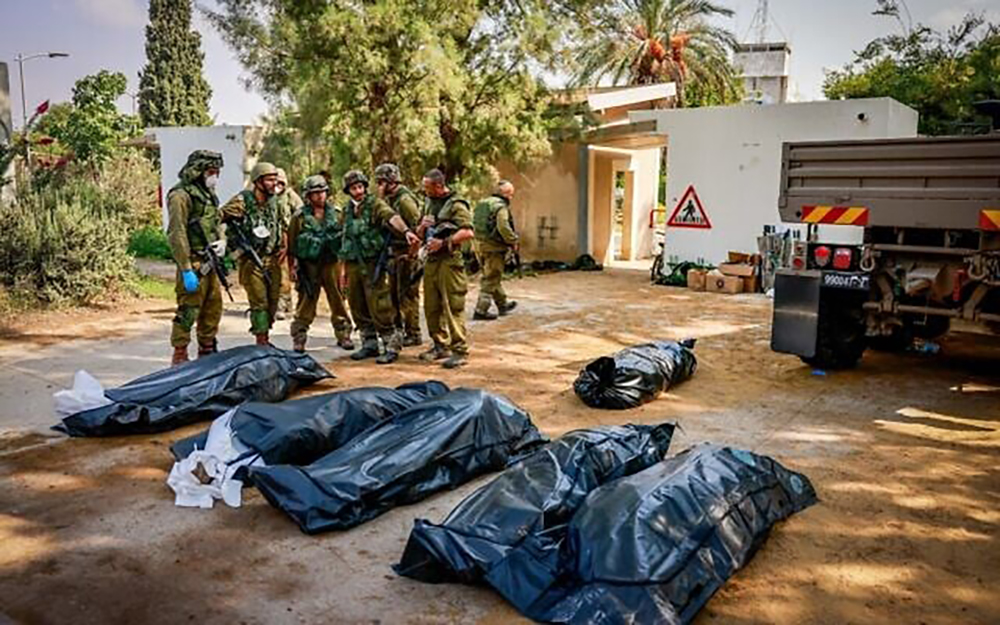
It also means keeping focused on the fulcrum: Iran’s nuclear and regional programs. As long as Tehran pushes enrichment to near-weapons levels and exports weapons, money, and doctrine to its proxies, Israel will calibrate its deterrence to the highest setting—through covert disruption, defensive layers at home, and, when necessary, direct action. The international system cannot pretend these tracks are separate; in the Middle East, the tunnels under Khan Yunis and the centrifuges at Fordow are political siblings.
Finally, there is the public square. Israel’s survival does not hinge on likes or hashtags, but legitimacy matters. On this anniversary, the facts should be unambiguous: Hamas initiated this war with a mass atrocity; it embedded its military assets among civilians by design; and it continues to bargain with the lives of Israeli hostages and Gazan noncombatants alike. A free society under arms can be judged by how it fights—not whether it fights when attacked. The work of defeating Hamas is kinetic and civic in equal measure—and on both fronts, two years on, Israel shows no sign of relinquishing its claim to survive.
The Missing October 7th Files
Two years after the darkest day in modern Jewish history, Israel has unveiled a digital archive intended to preserve the memory of the atrocities of October 7, 2023, and to confront the forces of denial, distortion, and propaganda that continue to swirl around them.
On Monday, the Israeli Ministry of Diaspora Affairs and Combating Antisemitism announced the launch of a new website, “The Missing October 7th Files,” offering an unprecedented glimpse into the organizational, ideological, and operational machinery that enabled the Hamas-led massacre of 1,200 people in southern Israel.
According to a detailed report on Monday at The Jewish News Syndicate (JNS), the website houses original documents retrieved by Israel’s security forces during the course of the war in Gaza, including handwritten orders from slain Hamas leader Yahya Sinwar, tactical instructions advising gunmen to capture live “selfie” footage during attacks, and religious rulings (fatwas) purporting to justify the murder of Jews.
“This site presents the Missing October 7 Files documents and evidence that reveal the engineered terror behind the massacre,” the ministry’s announcement declared.
The content of the new digital repository shines a spotlight on what Israel has argued since the morning of October 7: that the mass infiltration and slaughter was neither spontaneous nor haphazard. Rather, as JNS reported, the evidence points to a campaign meticulously designed, rehearsed, and ideologically framed over many years.
“Far from being a spontaneous eruption of violence, the attack was the product of years of indoctrination, meticulous planning, and systematic exploitation of civilians,” the ministry noted.
The documents show an extraordinary degree of preparation: instructions on how to penetrate Israeli border defenses, orders to target children and families to maximize psychological impact, and detailed logistical guidance for the abduction of hostages. The inclusion of directives on how to film killings and kidnappings suggests a calculated effort to weaponize imagery for propaganda and psychological warfare.
“Through manuals, orders, and hidden intelligence, these files expose the organized evil that turned October 7 into one of the darkest days in modern history,” the ministry added in its statement.
The statistics remain seared into Israeli memory. According to Israel National News and confirmed in the JNS report, more than 6,000 armed men — including fighters from Hamas, Palestinian Islamic Jihad, and Fatah, as well as unaffiliated Gazan civilians — flooded into Israel in coordinated waves. They stormed kibbutzim, music festivals, and military outposts. By the end of the day, some 1,200 Israelis were murdered, thousands more wounded, and 251 people abducted across the border into Gaza.
Two years later, 48 hostages remain in captivity. Israeli intelligence believes that roughly 20 of them are still alive. For families of the abducted, every anniversary brings renewed anguish, but the new digital archive offers a sense of vindication: clear proof that their loved ones were victims of a premeditated and orchestrated campaign, not of chance or chaos.
The timing of the archive’s launch is not accidental. In the two years since the massacre, Hamas and its sympathizers have invested heavily in narratives downplaying or denying the atrocities. Claims that the massacres were exaggerated, fabricated, or provoked have circulated widely online.
As documented in the JNS report, the display extends 20 meters in width and rises to 3.5 meters in height. It projects onto a massive screen the names, ages, and photographs of victims, updated regularly to reflect new confirmations. Visitors can stand before the wall, confronting both private grief and collective trauma, and join in what the library calls “communion with the common pain of us all.”
The project has since expanded beyond the library’s walls. Responding to requests from Jewish communities worldwide, the institution has made the wall digitally accessible. Communities marking Yom HaZikaron, Yom HaShoah, or October 7 memorial services can now incorporate the wall into their ceremonies. The files are downloadable free of charge through the library’s official website, ensuring that remembrance is not confined to Jerusalem but can be shared across the Jewish diaspora.
The Ministry of Diaspora Affairs emphasized that the “Missing October 7th Files” are intended not only for Israeli audiences but for Jewish and non-Jewish communities abroad. The JNS report noted that the site was launched with the explicit aim of equipping diaspora leaders, educators, and community activists with verified materials to counter antisemitic disinformation and defend the truth of October 7 in the global public square.
For diaspora Jews — many of whom have faced intensified antisemitism since the massacre — the ability to access original documents and evidence is invaluable. Community leaders can now respond to denial not merely with testimony but with hard proof.
Any discussion of October 7 inevitably turns to the fate of the hostages. While Israel has succeeded in rescuing or negotiating the release of many, 48 remain unaccounted for. The new archive highlights not only the massacre itself but the strategic intent behind hostage-taking, reinforcing what Israeli officials and family advocates have long argued: that abductions were not opportunistic, but planned in detail as leverage for future negotiations.
JNS has frequently reported on the plight of hostage families, many of whom see the second anniversary not only as a day of mourning but as an urgent call for action. For them, the “Missing October 7th Files” is another reminder that the story of October 7 is unfinished until every hostage — alive or deceased — is returned.
The launch of the new website is also a recognition that in modern conflicts, memory itself is a battlefield. As the JNS report observed, Israel has long struggled against the erosion of sympathy in the international arena, where focus often shifts rapidly from Israeli suffering to Palestinian casualties.
By institutionalizing October 7’s memory, Israel is engaging in a form of strategic communication: embedding the massacre into public consciousness in ways that cannot be erased by shifting headlines. The decision to highlight not only atrocity but also the cold planning behind it serves to remind the world that October 7 was not a singular eruption, but part of an enduring ideology and infrastructure of terror.
The unveiling of the “Missing October 7th Files” comes at a time of intense geopolitical debate. International institutions, including the United Nations, have been sharply critical of Israel’s conduct in Gaza since the war began. Several European countries have moved toward recognition of Palestinian statehood without preconditions.
For future generations, “The Missing October 7th Files” will serve not only as a digital museum but also as a civic defense: a permanent reminder of the dangers of ideological fanaticism, of the vulnerability of the Jewish people, and of the resilience required to endure.
For Israel, for the Jewish diaspora, and for the global community, the lesson is clear. October 7 is not only a date in history but a warning etched into the present: that evil, when denied or underestimated, can return. And memory — meticulously preserved, fiercely defended — is the most powerful shield against its resurgence.

Hamas is supposed to be entirely disbanded as part of this “deal”. So what does this mean:
“What, then, does “vanquishing” Hamas mean at year two? Militarily, it points to an enduring counterinsurgency that prevents Hamas from regenerating battalion-scale formations, denies it cross-border strike capacity, and shrinks its leadership bench faster than it can recruit and train.”
Is TJV assuming that Hamas is going to be permitted to remain as a viable entity in Gaza? The Hamas Muslim monsters in Gaza appeared to think so, since they are celebrating in the street! If Hamas does not completely disarm and disband, the IDF must quickly go back in and destroy it entirely!