



|
Getting your Trinity Audio player ready...
|
Published reports confirm elimination of senior IRGC and army commanders in an unprecedented operation
By: Fern Sidman
As tensions between Israel and Iran reach a dramatic and unprecedented escalation, published reports now confirm that Israeli forces have successfully eliminated a staggering number of senior Iranian military leaders in a series of precision strikes deep within Iranian territory. According to multiple published accounts, the list of confirmed casualties includes the highest echelons of both the Iranian Armed Forces and the Islamic Revolutionary Guard Corps (IRGC), signaling what analysts are calling a potentially transformative blow to the Islamic Republic’s military infrastructure.
Among the most prominent officials eliminated, published reports repeatedly highlight the deaths of Gholamali Rashid and Major General Mohammad Hossein Bagheri, the Chief of Staff of the Iranian Armed Forces. Bagheri, long considered one of the most influential architects of Iran’s regional military strategy, played a central role in coordinating operations with Iran’s network of proxies across the Middle East. His removal is seen by security analysts as a seismic loss for the Iranian defense establishment.
Amir Mousavi, another key figure and commander of the Iranian Army, was also reportedly killed in the strikes, along with Amir Shahram Irani, head of the Iranian Navy, and Ali Reza Pourdastan and Kioumars Heydari, both high-ranking commanders of Iran’s Ground Forces. According to sources, these individuals formed the backbone of Iran’s conventional military deterrent.
The Air Force was not spared. Published reports note that Nasirzadeh, commander of the Iranian Air Force, was killed during the early wave of strikes.
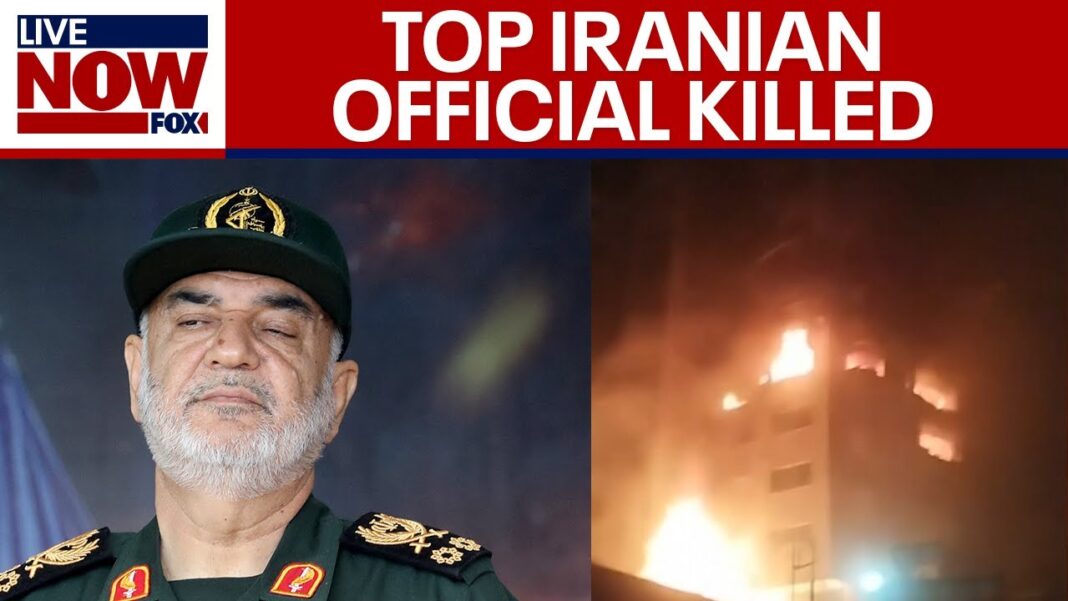
Perhaps most significant are the confirmed casualties within the IRGC, the ideological military arm of the Islamic Republic. Major General Hossein Salami, the commander-in-chief of the IRGC, has reportedly been killed—news that, if confirmed, would mark one of the most devastating losses to the clerical regime’s internal power structure in decades. Published reports also identify other high-ranking IRGC casualties, including Mohammad Pakpour (Ground Forces), Ali Reza Tangsiri (Navy), and Ahmad Ali Hajizadeh, who headed the IRGC Aerospace Force—critical to Iran’s ballistic missile development.
Additionally, Esmail Qaani, successor to Qassem Soleimani as head of the Quds Force, and Ali Reza Soleimani, commander of the Basij paramilitary force, are both reported dead, further gutting the command structure of Iran’s transnational military operations.
In a fiery statement issued Friday, the Iranian Armed Forces condemned what they described as “aerial aggression” by the “bloodthirsty and vicious Zionist regime,” vowing to retaliate with force. The statement, widely circulated in published reports, declared:
“We had not wanted to open the path to war until now, but the Islamic Republic’s Army, along with the Revolutionary Guard Corps, will not tolerate the aggression of these filthy child murderers… Our dear people must maintain their composure… The combat forces of the army and the IRGC are busy fighting in the sky.”
Despite these strong declarations, Iran has yet to provide verifiable evidence of a coordinated military response. However, according to several published accounts, the regime has placed its armed forces on the highest alert, and Iranian Supreme Leader Ayatollah Ali Khamenei is said to be preparing a nationwide address.
Israel, meanwhile, has maintained a tight operational silence on the specific details of the strikes, though Prime Minister Benjamin Netanyahu confirmed in a nationally televised statement that Operation “Rising Lion” is intended to “eliminate the existential threat” posed by Iran’s nuclear ambitions and regional belligerence.
“We struck at the heart of Iran’s nuclear and military apparatus,” Netanyahu declared. “This campaign will continue for as long as necessary.”
The Times of Israel and other outlets have reported that Israel’s defense ministry has declared a nationwide state of emergency, bracing for potential Iranian retaliation via missiles or drones. According to published reports, Israeli civilians have been instructed to remain in protected areas and avoid public gatherings.
Analysts are now grappling with the strategic implications of Israel’s bold offensive. The elimination of such a vast swath of Iran’s top military leadership in a single coordinated strike may create a temporary vacuum within the Islamic Republic’s defense establishment. Some published sources suggest that the blow to Iranian morale and capability could delay or derail Iran’s nuclear timetable, though retaliatory strikes cannot be ruled out.
As the situation remains fluid and highly volatile, the global community watches with alarm. Yet one point remains indisputable: Israel’s strike has upended decades of strategic calculus in the Middle East and thrust the region into an entirely new—and profoundly dangerous—phase of confrontation.

The bottom line is that Israel has not, and cannot without US military involvement, destroy Iran’s primary underground nuclear weapons program and facilities. Israel is betrayed by Trump (and the Democrats continue to be Israel’s enemies).
Trump has now removed American personnel and weapons leaving Israel on its own. This is simply a delay, not a resolution, and Trump continues to “negotiate” away Israel‘s military safety.