



|
Getting your Trinity Audio player ready...
|
By: Fern Sidman
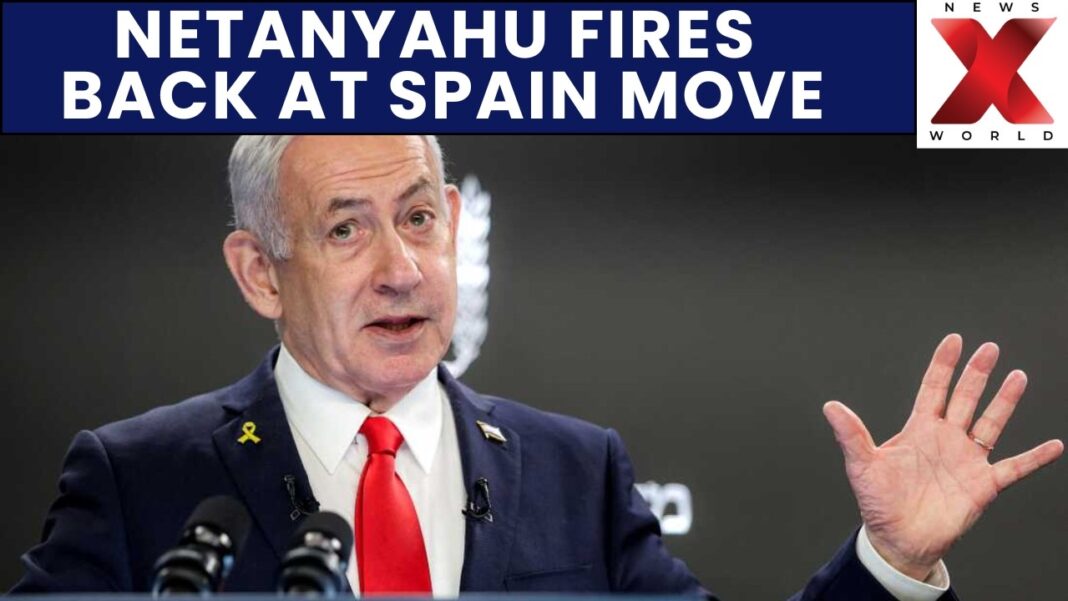
In a dramatic escalation of diplomatic tensions that underscores the widening fissures within the Western alliance over Middle Eastern policy, the Israeli government has formally barred Spain from participation in a key multinational coordination body tied to President Donald Trump’s regional peace framework. The decision, announced by Foreign Minister Gideon Sa’ar in concert with Prime Minister Benjamin Netanyahu, marks a decisive and unmistakable rebuke of Madrid’s recent posture toward Israel and its military operations.
According to a report on Friday by Israel National News, Spain will no longer be permitted to participate in the Civil-Military Coordination Center (CMCC) located in Kiryat Gat, a facility conceived as a cornerstone of operational cooperation under the broader peace initiative advanced by Washington. The expulsion is not merely procedural; it represents a significant recalibration of Israel’s diplomatic boundaries in an increasingly volatile geopolitical landscape.
The CMCC in Kiryat Gat occupies a pivotal role in the architecture of regional coordination envisioned under the Trump peace plan. Designed as a nexus for synchronizing civilian and military efforts among allied states, the center facilitates intelligence sharing, logistical planning, and operational deconfliction across a spectrum of security initiatives.
Spain’s removal from this framework, therefore, carries implications that extend far beyond symbolic censure. It effectively excludes Madrid from a critical channel of influence and cooperation at a time when coordination among Western and allied nations is regarded as essential to managing the evolving security environment in the Middle East.
As the Israel National News report emphasized, the decision was reached after careful consultation with the United States, underscoring the alignment between Jerusalem and Washington on this matter.
At the heart of the decision lies what Israeli officials have described as an entrenched pattern of hostility emanating from the government of Spanish Prime Minister Pedro Sánchez. The Israeli Foreign Ministry characterized Madrid’s approach as an “anti-Israel obsession,” alleging that it has inflicted tangible harm on both Israeli and American strategic interests.
Foreign Minister Sa’ar was unequivocal in his assessment. In remarks cited by Israel National News, he asserted that the Sánchez government’s bias had reached such an extreme level that it could no longer function as a constructive participant in implementing the peace plan or contributing meaningfully to the CMCC’s operations.
This language reflects a broader frustration within Israeli leadership circles, where Spain’s recent actions have been interpreted not merely as policy disagreements but as deliberate efforts to undermine Israel’s security objectives.
Prime Minister Netanyahu amplified this message with a series of pointed statements that left little room for ambiguity. As reported by Israel National News, he framed the expulsion as a necessary response to what he described as Spain’s repeated attacks on Israel’s legitimacy and its armed forces.
“Israel will not remain silent in the face of those who attack us,” Netanyahu declared, emphasizing the government’s unwillingness to tolerate what he characterized as defamation of the Israel Defense Forces. He further described the IDF as “the most moral army in the world,” a formulation that has long been central to Israel’s defense of its military conduct.
The prime minister’s rhetoric extended beyond mere defense of national honor. He articulated a broader doctrine of reciprocal accountability, warning that countries engaging in what he termed a “diplomatic war” against Israel would face immediate consequences.
“I am not willing to tolerate this hypocrisy and hostility,” Netanyahu stated, signaling a willingness to impose costs on states that challenge Israel’s policies while, in his view, failing to adequately confront terrorist actors.
The rupture between Israel and Spain has been building over several weeks, driven by a series of policy decisions and public statements from Madrid that have placed it at odds with Jerusalem and Washington.
Prime Minister Sánchez has emerged as one of Europe’s most vocal critics of Israel’s military operations, particularly in the context of the ongoing conflict involving Iran and its regional proxies. He has repeatedly characterized the joint United States-Israel campaign as unlawful and destabilizing, calling instead for a renewed emphasis on diplomatic engagement.
These criticisms have been accompanied by concrete actions. Spain has reportedly refused to allow the United States to utilize its military bases for operations related to strikes on Iran, a move that Israeli officials view as a direct impediment to allied military coordination. Additionally, restrictions on airspace access for aircraft involved in such missions have further strained relations.
From Israel’s perspective, these measures constitute more than mere expressions of policy disagreement; they represent a tangible withdrawal of support at a critical juncture.
While Israeli officials have framed Spain’s actions as evidence of bias and hostility, the Spanish government has offered a markedly different interpretation. Madrid has consistently rejected accusations that it is siding with Iran, instead asserting that its policies are guided by a commitment to international law and a desire to prevent further escalation.
Spanish officials have also voiced concern about the humanitarian consequences of military operations in the region, particularly in Lebanon and Gaza. Sánchez has warned that continued escalation could lead to widespread destruction, drawing parallels to previous conflicts that have inflicted significant civilian suffering.
This divergence in narratives highlights the broader challenge facing Western alliances: reconciling differing perspectives on how best to address complex and deeply rooted conflicts in the Middle East.
The exclusion of Spain from the CMCC raises important questions about the future of the Trump peace plan and the degree of international support it can command. The initiative, which seeks to reshape regional dynamics through a combination of security arrangements and economic incentives, relies heavily on the participation of allied nations.
Spain’s departure from the coordination framework may not, in itself, derail the plan. However, it underscores the difficulties inherent in maintaining a unified coalition in the face of divergent national interests and policy priorities.
As the Israel National News report noted, the decision to remove Spain was communicated to the United States in advance, suggesting that Washington is prepared to proceed without Madrid’s involvement. Nevertheless, the episode highlights the potential for further fractures within the coalition.
The expulsion of Spain from the CMCC can also be viewed as part of a broader shift in Israeli diplomatic strategy. Under Netanyahu’s leadership, Israel has increasingly demonstrated a willingness to respond assertively to perceived slights or challenges from international partners.
This approach reflects a belief that deterrence is not only a military concept but also a diplomatic one. By imposing consequences on states that adopt adversarial positions, Israeli officials aim to discourage similar behavior from others.
At the same time, this strategy carries risks. It may deepen existing divisions and complicate efforts to build consensus on critical issues. The balance between firmness and flexibility will likely remain a central challenge for Israeli policymakers in the months ahead.
The decision to bar Spain from the CMCC represents a defining moment in the evolving relationship between Israel and its European partners. It is a stark illustration of how quickly diplomatic alignments can shift in response to changing circumstances and competing priorities.
As reported extensively by Israel National News, the episode encapsulates the tensions that arise when strategic imperatives collide with differing interpretations of law, morality, and national interest.
For Israel, the message is clear: cooperation is contingent upon alignment, and divergence will not go unanswered. For Spain, the challenge will be to navigate its position within a complex and often contentious international landscape.
And for the broader international community, the incident serves as a reminder that the path to peace is seldom linear. It is shaped by a constant interplay of diplomacy, power, and the enduring quest for security in an uncertain world.
