



|
Getting your Trinity Audio player ready...
|
By: Fern Sidman
The reverberations of Iran’s expanding missile campaign were felt acutely in Jerusalem on Sunday night, where six people were wounded following an impact in the northern neighborhood of Ramat Shlomo. The attack, part of an ongoing barrage launched from Iranian territory, underscored the widening geographic reach of the conflict and intensified public anxiety in a city accustomed to tension yet unaccustomed to sustained long-range missile fire.
According to a report on Sunday by VIN News, emergency responders from Magen David Adom were dispatched swiftly to at least one confirmed impact site in the capital. Initial assessments indicated five casualties, though that figure later rose to six as search and rescue teams combed adjacent areas for additional victims. One of the injured was listed in moderate condition, while the remaining casualties were reported to have sustained lighter wounds.
Magen David Adom spokesperson Zaki Heller told VIN News that medical crews were treating the injured on scene and conducting methodical sweeps of the surrounding area to ensure no one had been overlooked. “Teams are continuing to search additional locations in the Jerusalem area,” he said, reflecting the uncertainty that often accompanies nighttime missile strikes, when debris can scatter across rooftops and courtyards.
The impact in Ramat Shlomo came against the backdrop of heightened alarm nationwide. Throughout the evening, sirens echoed across multiple regions of the country, prompting residents to rush into protected spaces. Israeli authorities, citing guidance from the Home Front Command, urged civilians to remain near reinforced shelters and adhere strictly to emergency instructions.
The latest injuries in Jerusalem followed a far deadlier strike earlier in the day in Beit Shemesh, where a ballistic missile made a direct hit on what had been described as a reinforced shelter. Nine people were killed in that incident, an outcome that stunned the public and prompted urgent questions about air defense efficacy. The names of three out of the nine victims killed in the missile strike have been cleared for publication. They are Sarah Elimelech, her daughter Ronit Elimelech and Oren Katz. VIN News reported that Israeli defense officials were investigating what appeared to be a failed interception, seeking to determine whether a malfunction or an overwhelming saturation attack allowed the projectile to penetrate defensive systems.
The Beit Shemesh tragedy has intensified scrutiny of Israel’s layered air defense architecture, which includes systems designed to intercept both short-range rockets and long-range ballistic missiles. While these systems have intercepted a substantial proportion of incoming threats during the current conflict, Sunday’s fatal strike highlighted the sobering reality that no defense network can guarantee complete impermeability.
Military officials have reiterated that operations targeting Iran’s missile infrastructure will continue unabated. The Israeli Air Force has conducted repeated sorties aimed at degrading launch capabilities and command centers within Iran, seeking to blunt the tempo of retaliatory fire. The strategy, defense analysts note, rests on a dual premise: diminish the adversary’s ability to sustain launches while maintaining domestic resilience in the face of inevitable impacts.
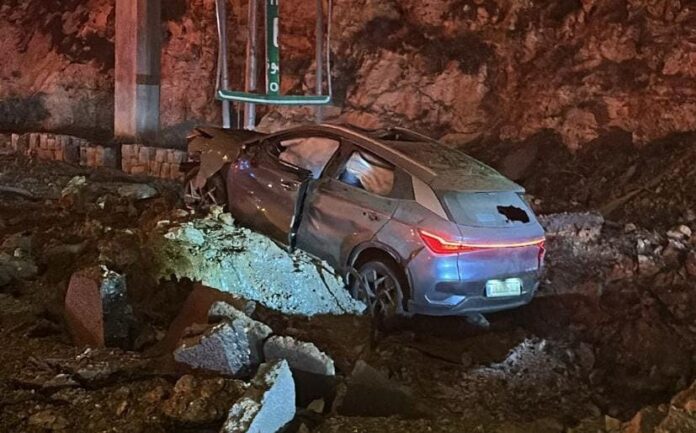
In Jerusalem, the human toll of the latest strike was evident in scenes of shattered glass and scorched facades in Ramat Shlomo, a predominantly residential neighborhood characterized by dense apartment blocks and bustling family life. Residents described the sequence of events to VIN News: the abrupt wail of sirens, the hurried descent into stairwells and shelters, and the thunderous detonation moments later. Though structural damage appeared localized, the psychological reverberations were far broader.
Emergency responders worked through the night under floodlights, assessing debris fields and ensuring that gas lines and electrical systems posed no secondary hazards. The VIN News report documented the coordinated effort between Magen David Adom, police units and municipal services, reflecting the intricate choreography required to manage missile aftermaths in urban environments.
Authorities emphasized that adherence to shelter protocols likely mitigated casualties in Jerusalem. The one individual reported in moderate condition was transported to a nearby hospital for further evaluation, while others received treatment for shrapnel injuries and shock. Medical officials noted that the psychological strain of repeated alarms and near-miss events has begun to manifest in increased reports of anxiety-related symptoms.
The broader strategic landscape remains fraught. Iranian missile launches have targeted multiple Israeli cities in recent days, and Israel’s retaliatory strikes have expanded in scope and intensity. Defense officials believe that Iran retains significant stockpiles of ballistic and cruise missiles, though ongoing operations aim to disrupt supply chains and command nodes.
In the capital, the juxtaposition of routine urban rhythms with the specter of missile fire has become increasingly jarring. Schools have adjusted schedules, public transportation has instituted contingency protocols, and community leaders have organized support networks for families coping with displacement or trauma. Local officials have urged residents to check on elderly neighbors and ensure that vulnerable individuals have access to safe rooms.
The Home Front Command has reiterated that early compliance with siren warnings remains the most effective means of minimizing harm. Officials stressed that even reinforced shelters are not invulnerable, as evidenced by the Beit Shemesh strike, yet timely entry into protected spaces dramatically increases survival odds. In Jerusalem, most injuries Sunday night were attributed to shrapnel and secondary debris rather than direct structural collapse.
Defense analysts observe that the current exchange represents one of the most sustained episodes of direct confrontation between Israel and Iran. While previous tensions often played out through proxies or covert actions, the present phase involves overt missile barrages and publicly acknowledged air campaigns. The VIN News report highlighted the unprecedented nature of the hostilities, noting that both sides appear prepared for a protracted engagement.
As dawn approached over Jerusalem, municipal workers began clearing debris from sidewalks and roadways, striving to restore a semblance of normalcy. Yet the sense of precariousness lingered. Residents kept mobile phones within reach, anticipating further alerts. Hospitals maintained surge readiness, and security officials monitored radar screens for additional launches.
The interplay between offense and defense now defines daily life. Israel continues to strike Iranian missile infrastructure, asserting that sustained pressure is essential to curbing the threat. Iran, in turn, signals determination to persist with retaliatory fire. In this dynamic, cities like Jerusalem become both symbols and battlegrounds.
The wounded in Ramat Shlomo are emblematic of a broader reality: that geopolitical confrontation ultimately unfolds in residential streets and family apartments.
For now, authorities maintain vigilance. Residents are urged to heed instructions, remain near protected spaces and support one another through the strain. As investigations proceed into the failed interception in Beit Shemesh and as air defenses brace for further tests, the capital stands watchful beneath a sky that has become an arena of missiles and interceptors.
The events of Sunday night reaffirm that the conflict’s trajectory remains volatile. While the military calculus unfolds at the highest levels, the immediate concern in Jerusalem is more elemental: safeguarding lives, tending to the wounded and enduring the next siren’s call.
