



|
Getting your Trinity Audio player ready...
|
By: Fern Sidman
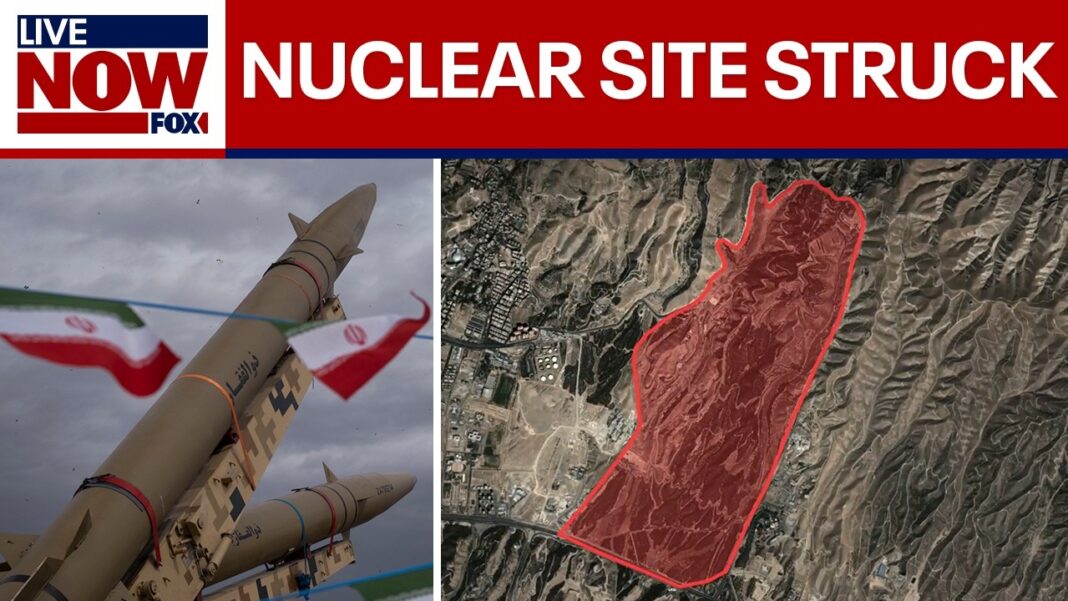
In a development that significantly escalates Israel’s campaign against Iran’s strategic military infrastructure, the Israel Defense Forces confirmed Tuesday evening that it carried out a precise strike on a clandestine nuclear-related installation known as “Minzadehei,” a covert underground facility where, according to military intelligence, the Iranian regime had continued advancing components essential to nuclear weapons development.
Brigadier General Effie Defrin, the IDF Spokesperson, disclosed the operation in a detailed briefing, describing Minzadehei as a secret site where Iranian nuclear scientists were working discreetly to develop a critical element necessary for the production of a nuclear weapon. Israel National News, which closely followed the announcement, reported that the strike forms part of a broader and intensifying effort to dismantle Iran’s nuclear and missile capabilities under the ongoing framework of Operation “Roaring Lion.”
The disclosure marks one of the most consequential revelations of the campaign thus far. According to the IDF, despite sustaining heavy damage during the earlier phase of hostilities known as Operation “Rising Lion,” the Iranian regime did not suspend its nuclear ambitions. Instead, military officials said, Tehran continued to advance weaponization capabilities while relocating sensitive infrastructure to hardened underground sites designed specifically to withstand aerial bombardment.
“Despite the severe damage [in Operation Rising Lion], the Iranian terror regime did not cease nuclear weapon activities,” the IDF stated. The statement further emphasized that Iranian authorities had shifted key elements of their program into subterranean complexes shielded against conventional airstrikes, an effort intended to preserve continuity of research and development even amid sustained Israeli military pressure.
At Minzadehei, the IDF reported, a small group of nuclear scientists operated covertly, focusing on a crucial component required for weaponization. While officials did not publicly specify the precise nature of that component, defense analysts suggest it may have related to either warhead miniaturization, high-explosive lens design, or advanced triggering mechanisms—technical domains that represent the threshold between theoretical enrichment capability and operational nuclear armament.
The Israel National News report highlighted the intelligence dimension underpinning the strike. According to the IDF, Israeli intelligence services maintained persistent surveillance of the scientists involved in the project, tracking their movements and ultimately identifying the underground location to which operations had been transferred. That intelligence continuity enabled what military officials described as a “precise strike” on the covert compound, effectively neutralizing what they termed a “key component” of Iran’s pathway to nuclear weapon capability.
The IDF characterized the operation not as an isolated act, but as part of a systematic campaign aimed at dismantling Iran’s broader nuclear and missile infrastructure. The strike on Minzadehei, officials asserted, joins a series of targeted actions conducted during Operation “Rising Lion” that were deemed essential to eliminating the Iranian nuclear threat. Israel National News reported that military leaders view the cumulative effect of these strikes as strategically transformative, eroding Tehran’s capacity to reconstitute its program in the near term.
The assault on Minzadehei unfolded amid an extraordinary tempo of Israeli air operations across the region. In the past 24 hours alone, hundreds of fighter jets and aircraft reportedly struck hundreds of targets simultaneously in both Iran and Lebanon. The scale of the air campaign underscores the dual-front reality confronting Israel, as it confronts not only Iranian state infrastructure but also the proxy capabilities of Hezbollah in Lebanon.
The Israeli Air Force continues to execute successive waves of strikes against Iran’s ballistic missile arrays and integrated air defense systems. Since the launch of Operation “Roaring Lion,” the IAF has dismantled approximately 300 Iranian missile launchers. This figure, the IDF emphasized, is the result of more than 1,600 sorties conducted in a relentless, round-the-clock effort to locate and destroy launchers and missile stockpiles, thereby reducing the volume and lethality of fire directed at Israel’s civilian population.
The missile campaign has become a defining element of the current conflict. Iranian ballistic capabilities, long viewed as a central pillar of its deterrence doctrine, have been systematically degraded. By targeting launchers before and after deployment, Israeli forces have sought to disrupt both operational momentum and logistical sustainment.
Amid this operational intensity, IDF Chief of Staff Lieutenant General Eyal Zamir visited the 947th Battalion of the Air Defense Array, accompanied by senior commanders. Israel National News reported that Zamir used the occasion not merely to inspect readiness but to reinforce the strategic narrative guiding the campaign.
“We are operating in parallel on two fronts,” Zamir declared. “We are operating in Iran and against Hezbollah in Lebanon. These are two major adversaries of ours, and they share many characteristics. This is one axis—the Shiite Axis, the Iranian axis and its proxies—and at this very moment we are working to neutralize threats to the residents of the State of Israel.”
His remarks framed the conflict not as discrete engagements but as a confrontation with an integrated regional architecture of hostility, linking Tehran’s strategic ambitions with the operational capabilities of its proxies. The Israel National News report emphasized that the Chief of Staff described Israeli fighter jets striking over Tehran’s skies, actively hunting missile launchers that might otherwise target Israeli cities.
“Our fighter jets are striking over the skies of Tehran,” Zamir stated. “We are hunting launchers there. Some of the launchers that you are tasked with countering are now being engaged by UAVs and fighter jets to reduce the threats to our homefront.”
This synergy between offensive and defensive elements defines Israel’s approach. Air defense units intercept incoming projectiles while offensive aircraft dismantle the infrastructure enabling their launch. The integration of intelligence, surveillance, reconnaissance, unmanned systems, and precision strike capabilities reflects a doctrinal evolution shaped by years of preparing for precisely such a contingency.
Zamir also issued an unequivocal warning to Hezbollah, which has entered the fray alongside Iran. “Hezbollah made a very serious mistake,” he said. “It chose to join the offensive. We were prepared for this and we are now striking it with significant force. We are determined to eliminate the threat Hezbollah poses and will not stop until the terror organization is disarmed.”
Israel National News has reported extensively on the expanding Lebanese front, noting that Israeli forces are targeting Hezbollah’s command nodes, missile stockpiles, and cross-border infiltration infrastructure. The IDF’s posture suggests an intention not merely to repel immediate attacks but to alter the strategic balance in northern Israel in a lasting way.
Yet amid the kinetic intensity of operations, the Chief of Staff also underscored the importance of civilian resilience. “Our civilian homefront is very strong,” Zamir observed. “It is resilient, giving us support and breathing room. The people of the country understand what we are fighting for, and in this sense, the resilience of the homefront is a central component of this operation.”
Israel National News has frequently noted the symbiotic relationship between military effectiveness and civilian fortitude. Air raid shelters, early warning systems, and disciplined adherence to Home Front Command instructions form an indispensable layer of national defense. Zamir’s remarks acknowledged that confidence in the armed forces contributes to societal endurance.
Turning directly to the troops, Zamir expressed unambiguous confidence. “I have full trust in you,” he said. “I am confident in the IDF’s ability to complete this mission, and I want to thank you for all your efforts and the exceptional work you are doing. Keep it up.”
The strike on Minzadehei thus represents more than a tactical success; it symbolizes a broader strategic intent. By penetrating a hardened underground nuclear facility and eliminating a critical component of weaponization capability, Israel has signaled both reach and resolve. As Israel National News has reported, the cumulative effect of sustained strikes against nuclear, missile, and proxy infrastructures may reshape the regional security equation for years to come.
Whether the campaign ultimately compels a recalibration in Tehran or intensifies confrontation remains uncertain. What is clear, however, is that Israel has committed itself to a doctrine of active prevention. In the words of its military leadership, the objective is unambiguous: neutralize the threats emanating from the Iranian axis before they mature into irreversible realities
