



|
Getting your Trinity Audio player ready...
|
By: Fern Sidman
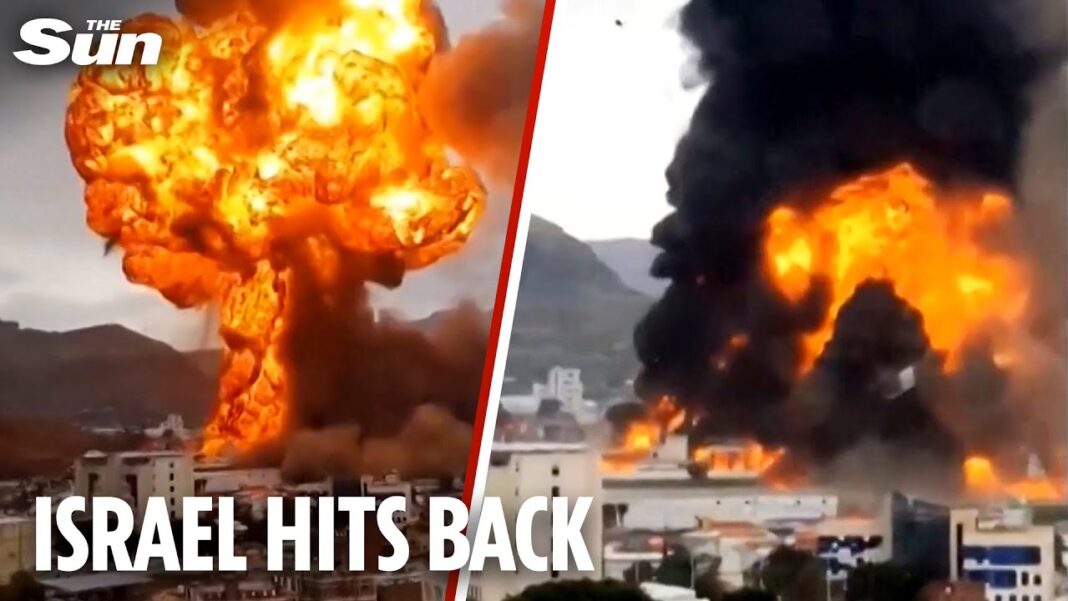
On Sunday, the Israeli Air Force (IAF) executed a meticulously planned long-range operation, striking four sites in Yemen’s Houthi-controlled capital of Sana’a. The raids, carried out nearly 1,800 kilometers from Israeli territory, were a direct response to a barrage of projectiles launched by the Iran-backed Houthis, including a ballistic missile tipped with a cluster bomb warhead that landed in central Israel just two days earlier. According to a report that appeared on The Times of Israel, the IAF deployed around a dozen aircraft, including refueling tankers, in what marked Israel’s fifteenth strike against the Houthis since the group began targeting Israeli cities and infrastructure in late 2023.
This operation was more than an act of retaliation. It demonstrated Israel’s growing willingness to strike across vast distances to neutralize threats before they metastasize, while simultaneously underscoring the increasingly complex role Yemen has assumed in Tehran’s strategy of encirclement.
The immediate impetus for Sunday’s strikes was a missile attack late Friday night that, for the first time, saw the Houthis employ a warhead equipped with cluster munitions. According to the information provided in The Times of Israel report, the projectile disintegrated in midair, scattering multiple bomblets across central Israel. One of these submunitions landed in the yard of a home in Ginaton, causing damage but miraculously sparing the resident, Ilana Hatoumi, who had taken shelter.
Hatoumi later described the terrifying moments to Israeli media. “I heard a boom, everything exploded… The glass is gone. All the windows, all the floor was filled with glass,” she recalled in a Channel 12 interview. Her words painted a harrowing picture of how close Israel came to civilian casualties.
The IDF emphasized that this was the first confirmed Houthi use of a cluster bomb warhead against Israel, though Iran had already employed such technology in earlier missile attacks during June’s twelve-day conflict. The Times of Israel report noted that these weapons are particularly insidious because they disperse dozens of submunitions over a wide area, many of which may fail to detonate immediately, posing a long-term hazard to civilians.
In response, the IAF targeted four sites on Sunday:
A military compound containing Yemen’s presidential palace – identified by Israel as a command center for Houthi operations. While some Yemeni outlets suggested the palace had been abandoned, the IDF insisted it remained part of a functioning military complex.
A major fuel depot – essential to the Houthis’ logistical network, supporting both their battlefield operations and long-range strike capabilities.
The moment Israeli jet fighter bomb the #Yemenite presidential palace pic.twitter.com/DvcT7OblfC
— The Jewish Voice (@TJVNEWS) August 24, 2025
Two power stations – which, according to Israeli intelligence, provided electricity for Houthi military activities. The IDF pointed to these sites as evidence of the group’s consistent use of civilian infrastructure for military purposes.
The raids were devastatingly precise: some 35 munitions were dropped by Israeli fighter aircraft. As The Times of Israel reported, the IAF conducted multiple aerial refuelings to sustain the mission, an extraordinary logistical undertaking that underscores the challenge of projecting Israeli power to such distant theaters.
Houthi health authorities reported at least two fatalities and 35 wounded in the strikes. While casualty claims could not be independently verified, the civilian toll inevitably adds fuel to regional debates about proportionality and the humanitarian consequences of Israel’s expanding campaign.
The operation carried particular symbolic weight. Prime Minister Benjamin Netanyahu, Defense Minister Israel Katz, and IDF Chief of Staff Lt. Gen. Eyal Zamir were physically present in the IAF’s command center at Tel Aviv’s Kirya military headquarters during the strike. According to the report in The Times of Israel, their joint presence was meant to highlight both the gravity of the mission and the political-military consensus behind escalating against the Houthis.
Netanyahu’s government has repeatedly framed the Yemeni front as an extension of Israel’s existential confrontation with Iran. Striking Sana’a, therefore, was not simply punitive—it was strategic signaling aimed at both Tehran and its network of regional proxies.
Since November 2023, the Houthis—long aligned with Iran and notorious for their sectarian slogan, “Death to America, Death to Israel, a Curse on the Jews”—have launched waves of ballistic missiles, cruise missiles, and explosive drones at Israel.
By the IDF’s count, more than 70 ballistic missiles and at least 23 drones have been fired from Yemen since March 2025, many during Israel’s renewed offensive in Gaza. While Israel’s multi-layered air defense system—anchored by Arrow, David’s Sling, and Iron Dome—has intercepted the majority, several projectiles have penetrated, causing casualties and damage. One Houthi missile in July killed a civilian in Tel Aviv, prompting Israel’s first naval strike against Yemen.
The Times of Israel report indicated that the Houthis are not acting in isolation but as a southern prong in Iran’s encirclement strategy. By threatening Israel from nearly 2,000 kilometers away, Tehran forces Jerusalem to divert military resources and heightens the psychological burden on Israeli society.
The Houthis’ use of cluster munitions has intensified concerns among Israeli defense officials. These weapons differ from traditional warheads in that they spread dozens of smaller bomblets over a large area, vastly increasing the risk of civilian harm. The Times of Israel report highlighted that cluster munitions are banned under a 2008 international treaty signed by 112 countries, which classifies them as inherently indiscriminate and a long-term impediment to reconstruction. Neither Iran nor Israel are signatories.
Israeli officials point to the danger of unexploded ordnance, which can remain lethal for years after an attack. As one military source told The Times of Israel in June, cluster warheads are “a threat to a much wider area than Iran’s other warheads,” even though each bomblet carries a smaller charge.
For Israel, the Houthi use of this technology signifies not only an escalation but also an unmistakable transfer of advanced weaponry from Tehran to its Yemeni proxy.
Sunday’s mission showcased the IAF’s unique ability to mount long-range precision operations far beyond its borders. The flight to Yemen required multiple in-air refuelings, careful coordination of strike packages, and exact timing to ensure simultaneous hits on all four targets.
According to the information contained in The Times of Israel report, this was the fifteenth time Israel has struck the Houthis, though only the second instance in which the Israeli Navy was involved. The overwhelming reliance on airpower reflects both Israel’s geographic constraints and its technological edge.
The use of around 12 aircraft—including advanced strike fighters and tanker planes—also illustrates the strain such missions place on Israel’s relatively small fleet of aerial refuelers. The acquisition of KC-46 Pegasus tankers from the United States, long delayed, is now viewed as critical to sustaining such operations into the future.
Houthi officials quickly decried the strikes as attacks on civilian infrastructure, pointing to the damage inflicted on Sana’a’s electricity grid. The IDF countered that the power plants were being used for military purposes, a claim consistent with Israel’s broader narrative that Tehran’s proxies routinely embed their operations within civilian sites.
Human rights groups are likely to scrutinize both the Houthi use of cluster munitions and Israel’s strikes on dual-use infrastructure. The Times of Israel report noted that such debates are central to the legal and diplomatic front of Israel’s current multi-theater war, as adversaries attempt to cast Jerusalem as a violator of international norms even as it fends off missile attacks on its civilian population.
The strikes in Yemen highlight the geographic widening of Israel’s conflict since October 7, 2023. Initially focused on Hamas in Gaza, the confrontation has since expanded to Lebanon with Hezbollah, to Syria with Iranian militias, and southward to Yemen with the Houthis.
For Netanyahu’s government, the message is unequivocal: any territory from which Israel is attacked will be considered a legitimate theater of war. By targeting Sana’a itself, Israel sought to impose costs not only on Houthi military capacity but also on the perception of sanctuary enjoyed by the group’s leadership.
The Times of Israel report suggested that Sunday’s operation could mark a turning point in Israel’s willingness to consistently project power deep into Yemen, even at the risk of exacerbating tensions with other regional actors.
Israel’s strike on Sana’a was both a tactical response to a novel threat and a strategic demonstration of resolve. By deploying the IAF’s long-range assets to dismantle Houthi infrastructure, Israel reaffirmed its red line: no attack on its civilians, whether by Hamas rockets, Hezbollah barrages, or Houthi ballistic missiles, will go unanswered.
As The Times of Israel report emphasized, this was not merely about neutralizing four targets in Yemen. It was about signaling to Tehran that Israel is prepared to reach wherever its adversaries operate, regardless of distance.
Yet the risks are profound. Each retaliatory cycle risks broadening into an even more entangled regional war, where the Houthis, Hezbollah, and Hamas act as interlocking arms of Iran’s campaign. Cluster munitions, naval strikes, and long-range bombing runs all point to a new phase in which Israel is compelled to fight across multiple theaters simultaneously.
For now, Sunday’s strike stands as a stark reminder of the volatility of the Middle East’s shifting battlefield. It also reflects Israel’s determination—backed by the full weight of its military and political leadership—to confront its enemies wherever they arise, even in the skies over Sana’a, nearly 2,000 kilometers away.

Not enough!!! Make Houthi land look like Dresden. That is the only way – period.
I agree with Neal !!!