



|
Getting your Trinity Audio player ready...
|
By: Yisroel David
The fragile calm that had held along Israel’s northern frontier since the November 2024 ceasefire shattered in the early hours of Monday morning, when Hezbollah launched rockets toward Israeli territory and the Israel Defense Forces responded with sweeping airstrikes across Lebanon. The renewed confrontation marks the first direct missile fire from the Iranian-backed organization since the ceasefire took effect, and it threatens to widen an already volatile regional conflict.
According to a report on Monday at Israel National News, sirens sounded shortly after 1:00 a.m. in Haifa and surrounding communities, as well as in towns situated near the Lebanese border. The alarms came without prior warning, jolting residents awake and sending families rushing into protected spaces. The IDF later confirmed that three rockets had been launched from Lebanon toward Israel. One was intercepted, while the other two landed in open areas, causing no reported injuries.
Magen David Adom, Israel’s national emergency medical service, stated that no casualties were recorded as a result of the barrage. Yet the symbolic weight of the attack far exceeded the physical damage. The interception was carried out for the first time using the “Or Eitan” laser system, a next-generation defensive platform designed to neutralize incoming threats with precision and reduced operational cost. Defense officials described the successful use of the system as a significant technological milestone, even as they acknowledged the gravity of Hezbollah’s decision to resume hostilities.
Israel National News reported that the IDF swiftly launched retaliatory strikes, targeting positions associated with Hezbollah across Lebanon. In a statement issued by the IDF Spokesperson’s Unit, the military declared that it was striking Hezbollah targets “in response to Hezbollah’s projectile fire toward the State of Israel.” The statement characterized the Lebanese-based group as operating “on behalf of the Iranian regime” and emphasized that Israel would not permit the organization to pose a threat to civilians in the north.
“The Hezbollah terrorist organization is operating on behalf of the Iranian regime, opening fire against the State of Israel and its civilians,” the statement said, as cited by Israel National News. “The IDF will operate against Hezbollah’s decision to join the campaign and will not enable the organization to constitute a threat.”
The language signaled not merely a tactical response but a broader strategic warning. Israeli defense officials, speaking through Israel National News, suggested that Hezbollah’s move to open a northern front would be met with what they termed an “especially harsh response.”
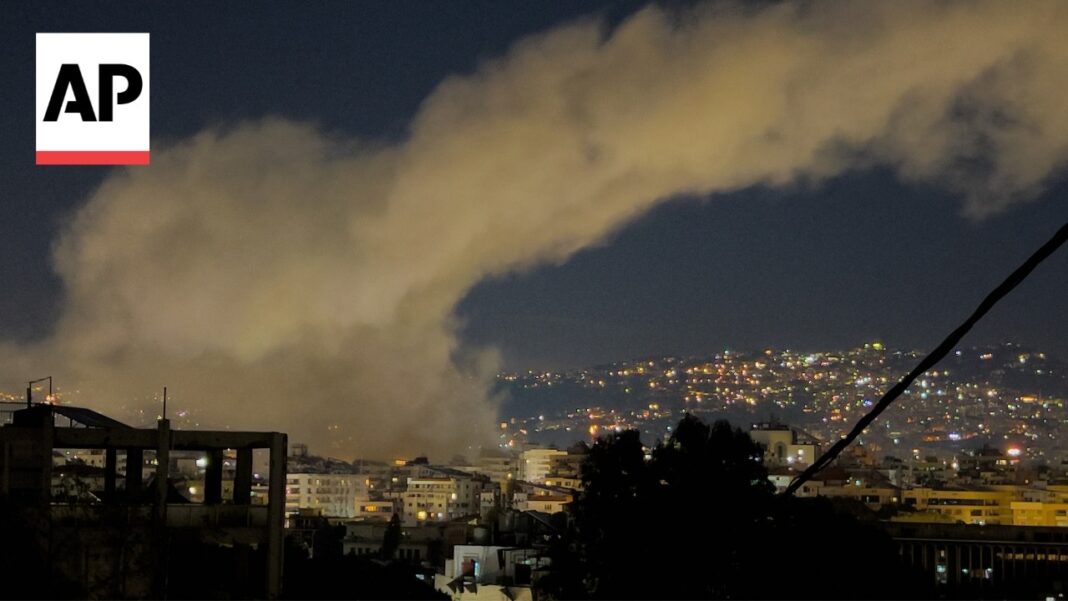
As the night progressed, reports from Lebanon indicated that Israeli Air Force jets struck targets in Beirut, with explosions heard in the Dahieh suburb — a Hezbollah stronghold in the southern part of the capital. Israel National News later confirmed that the IDF had targeted senior Hezbollah operatives in the Beirut area as well as a central figure in southern Lebanon.
In an unusual and pointed move, the IDF’s Arabic-language spokesperson, Ella Waweya, issued an evacuation warning directed at civilians in 53 villages in southern Lebanon. In a video message circulated on social media and reported by Israel National News, Waweya urged residents to leave their homes immediately and move at least 1,000 meters away from villages into open areas. “Hezbollah’s activity is forcing the IDF to act against it. The IDF does not wish to harm you,” she said, adding that proximity to Hezbollah operatives or facilities placed civilians at risk.
Such evacuation warnings reflect Israel’s attempt to differentiate between Hezbollah’s military infrastructure and Lebanon’s civilian population. Yet they also underscore the potential humanitarian consequences of renewed fighting in densely populated regions.
IDF Chief of Staff Lt. Gen. Eyal Zamir convened a situational assessment with the General Staff following the rocket fire. According to the Israel National News report, Zamir approved future operational plans and ordered preparations for continuous offensive and defensive activity. “Hezbollah opened a campaign against Israel overnight and is fully responsible for any escalation,” Zamir said during the assessment. “Any enemy that threatens our security will pay a heavy price.”
The flare-up occurs against the backdrop of Israel’s broader military campaign against Iranian targets, known as Operation “Roaring Lion.” Hezbollah claimed responsibility for launching both UAVs and rockets toward Israeli territory, stating that the action was in response to Israeli strikes and the elimination of Iran’s Supreme Leader, Ali Khamenei. The organization declared that it had targeted a military site south of Haifa.
This development is particularly significant given Hezbollah’s prior public posture. As the Israel National News report noted, a Hezbollah official told AFP last week that the group would not intervene if the United States conducted “limited” strikes on Iran. However, that official warned that any attack on Khamenei would constitute a “red line.” The elimination of the Iranian leader in joint U.S.-Israeli operations over the weekend appears to have triggered the organization’s entry into active confrontation.
The November 2024 ceasefire, brokered with U.S. mediation, had been intended to de-escalate tensions along Israel’s northern border. As part of the agreement, Hezbollah was to lay down its arms in southern Lebanon and reduce its military footprint near the frontier. Yet the group has repeatedly condemned the Lebanese government’s disarmament plan and vowed to retain its weapons. Israel National News has reported ongoing skepticism among Israeli defense officials regarding Hezbollah’s compliance with ceasefire terms.
Monday’s rocket fire effectively signals the collapse of that uneasy truce. The IDF’s response — encompassing strikes on leadership targets in Beirut and operational infrastructure in southern Lebanon — indicates that Israel views Hezbollah’s actions not as isolated provocations but as the opening salvo of a coordinated campaign.
Regional observers warn that the reactivation of the northern front could have far-reaching implications. Hezbollah possesses a vast arsenal of rockets and missiles, and its integration into the broader Iran-led axis raises the specter of multi-front conflict. Israel’s mobilization under Operation “Roaring Lion” includes preparedness for “all-fronts” scenarios.
For residents in northern Israel, the renewed hostilities revive memories of past conflicts that disrupted daily life and inflicted substantial damage. Though Monday’s barrage caused no injuries, the sudden sirens and nocturnal alarms serve as a stark reminder of the volatility along the border.
In Lebanon, the potential for escalation poses acute risks to an already fragile state grappling with economic collapse and political paralysis. The IDF’s evacuation warnings suggest that further strikes are anticipated, and the targeting of Hezbollah operatives in Beirut marks a significant intensification.
As Israel National News reported, the trajectory of the conflict remains uncertain. Hezbollah’s decision to intervene following Khamenei’s elimination has effectively broadened the theater of operations. The IDF’s swift and forceful retaliation underscores Israel’s determination to deter further attacks, even at the risk of widening the war.
Whether the confrontation stabilizes through deterrence or spirals into sustained multi-front hostilities will depend on calculations in Beirut, Tehran and Jerusalem. For now, the northern skies once again echo with the sound of rockets and interceptors, and the fragile equilibrium that had prevailed since November has given way to a new and perilous phas
