



|
Getting your Trinity Audio player ready...
|
By: Fern Sidman
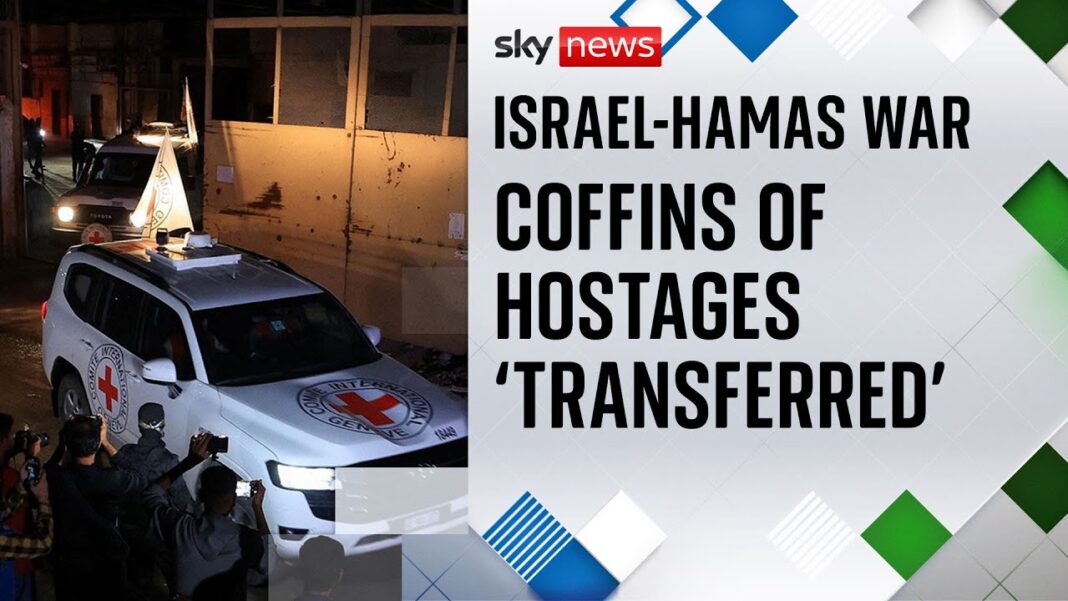
In a somber development marking yet another painful chapter in Israel’s long struggle to recover the remains of its citizens from Gaza, Hamas late Saturday night transferred the bodies of two Israeli hostages to the Israel Defense Forces (IDF), through the mediation of the International Committee of the Red Cross. The exchange, which occurred in the southern Gaza Strip, came following hours of uncertainty and heightened diplomatic tension, as Hamas delayed the transfer that had been promised earlier in the evening.
As Israel National News (INN) reported late on Saturday, the terrorist organization’s Izz ad-Din al-Qassam Brigades announced shortly before 10:00 p.m. local time that it would release the remains of two Israeli captives as part of ongoing commitments under the U.S.-brokered ceasefire agreement. However, the actual handover took place nearly an hour later, around 10:50 p.m., when the IDF confirmed that Red Cross vehicles were en route to the designated meeting point to retrieve “several coffins” believed to contain the deceased hostages.
In an official statement, the IDF urged the public to “act with sensitivity” and await formal identification of the bodies, which will first be communicated to the families. “Hamas is required to uphold the agreement and take the necessary steps to return all the deceased hostages,” the statement emphasized, echoing growing frustration among Israeli officials that the terror group continues to manipulate the process for political gain.
According to the information contained in the Israel National News report, Hamas has claimed that the bodies were only located earlier on Saturday — a statement viewed in Israel as implausible and deeply cynical, given the organization’s extensive control of Gaza’s tunnel networks and intelligence on the captives’ whereabouts. Israeli security officials maintain that Hamas “definitely knows” the locations of several additional deceased hostages and could release them at once if it so desired.
The Hostages and Missing Families Forum, which represents relatives of those still held or missing in Gaza, called the partial handover a step forward but criticized the government for not applying stronger pressure on Hamas. “At the same time, the Israeli government must not rely on the mediators — it must show a strong position against Hamas and demand the return of all 18 hostages, with no exceptions,” the organization said in a statement quoted in the INN report.
The forum also urged that Israel suspend its participation in ongoing aspects of the ceasefire implementation until Hamas complies fully with the agreement’s humanitarian provisions, including the return of all deceased hostages. The group cited the Trump peace framework, under which Israel was to secure the repatriation of all bodies and the restoration of hostages’ remains as a non-negotiable term of any stabilization deal in Gaza.
“This cannot be an open-ended process,” one family spokesperson told Israel National News. “Every day of delay is another day of cruelty — not only toward our families, but toward the principles of humanity this agreement was supposed to represent.”
Intelligence sources cited in the INN report suggest that Hamas’s decision to release two bodies may have been tactical — an attempt to demonstrate nominal compliance with ceasefire terms while retaining leverage through the continued withholding of the remaining deceased hostages.
According to IDF assessments, at least 16 additional bodies are still in Hamas’s possession, while intelligence estimates indicate that eight more could be released “immediately” if the group were willing. The remaining hostages’ fates remain uncertain, with several presumed dead and others possibly buried beneath the rubble of collapsed tunnels and destroyed compounds.
“This is Hamas’s pattern,” an Israeli defense official told INN on Sunday morning. “They use human remains as bargaining chips, to extract concessions, to prolong negotiations, and to maintain relevance. It’s a deliberate strategy of psychological warfare against the families and the entire nation.”
The official added that Israeli intelligence teams, in coordination with American and Egyptian intermediaries, are tracking Hamas’s internal communications and logistical movements in Gaza to verify whether further transfers are planned in the coming days.
Earlier on Saturday, frustration over Hamas’s delays prompted a decisive response from Jerusalem. The Prime Minister’s Office announced that the Rafah Crossing, Gaza’s southern gateway to Egypt, will remain closed until further notice, halting the entry of humanitarian aid and trade convoys pending Hamas’s compliance.
“The crossing’s opening will be weighed in accordance with the way Hamas implements its part in the return of the deceased hostages and in the implementation of the agreed-upon plan,” the Prime Minister’s Office said in a statement quoted in the Israel National News report.
The move calls attention to Israel’s growing willingness to leverage economic and logistical pressure to compel Hamas to act. The Rafah terminal, which has been central to international relief efforts and aid deliveries, is also one of the key transit points for Hamas’s leadership and its smuggling operations.
“This is a clear signal that Israel will not tolerate further manipulation of the ceasefire framework,” said retired IDF Brigadier General Amir Avivi, speaking to INN. “If Hamas wishes to benefit from any humanitarian or political concessions, it must first fulfill its basic moral and legal obligation — the return of the bodies.”
The episode has also exposed tensions among the ceasefire guarantors — particularly Egypt and Qatar — both of which serve as intermediaries in communications between Hamas and Israel. Diplomatic sources told Israel National News that U.S. State Department officials had earlier expressed concerns about Hamas’s “pattern of noncompliance,” warning that any deliberate delay in returning hostages or bodies could be interpreted as a violation of the truce.
American envoy Mike Waltz, who has overseen aspects of the ceasefire’s monitoring mechanism, reportedly conveyed to his Egyptian counterparts that Hamas’s behavior “risks unraveling the fragile progress” achieved through months of negotiations.
In Washington, a senior administration official told INN that while the U.S. welcomed the limited handover, it was “insufficient and inconsistent with the spirit of the ceasefire.” The official reiterated that the U.S. remains committed to ensuring “the full return of all hostages and the bodies of the deceased” as part of a broader effort to stabilize Gaza.
The grim return of two bodies highlights the persistent humanitarian dimension of the Gaza conflict. For Israelis, the recovery of remains — however tragic — carries profound national and spiritual significance. The principle of “bringing every son and daughter home” is deeply rooted in Israeli military and cultural ethos.
As Israel National News emphasized in its coverage, the public’s reaction to each handover reflects both collective grief and resolve. In communities across Israel, vigils have been held nightly, with families lighting candles and holding photos of their loved ones still trapped or missing in Gaza.
“Even in death, we bring them home,” said one participant at a Tel Aviv rally, speaking to INN. “It’s not about closure — it’s about dignity, about saying to our enemies that we don’t forget and we don’t abandon.”
While the return of the two bodies may serve as a symbolic gesture, it also exposes how delicate the current ceasefire remains. Each delay or partial compliance by Hamas further erodes trust in a process already under strain from competing demands, regional politics, and humanitarian crises.
As INN reported, Israeli officials privately fear that Hamas’s leadership — now fractured between military and political wings — may be divided over whether to honor the agreement. Intelligence assessments suggest that some factions within Hamas view renewed confrontation as inevitable and are using the hostages’ remains as both shield and leverage.
For now, the IDF continues its grim coordination with international mediators and the Red Cross, preparing for what it hopes will be further transfers in the coming days. But within Israel, public sentiment is hardening. Many view the slow, piecemeal handovers as yet another act of cruelty by an organization long accustomed to exploiting tragedy for political theater.
As one commentator told Israel National News, “Hamas can return bodies, but it cannot restore the humanity it has destroyed.”
Until the last hostage — living or dead — is brought home, the promise of peace in Gaza will remain only that: a fragile promise, waiting to be honored.
