



|
Getting your Trinity Audio player ready...
|
Fire Over Tehran: IDF Launches Assault on IRGC Command Centers
By: Chaya Abecassis
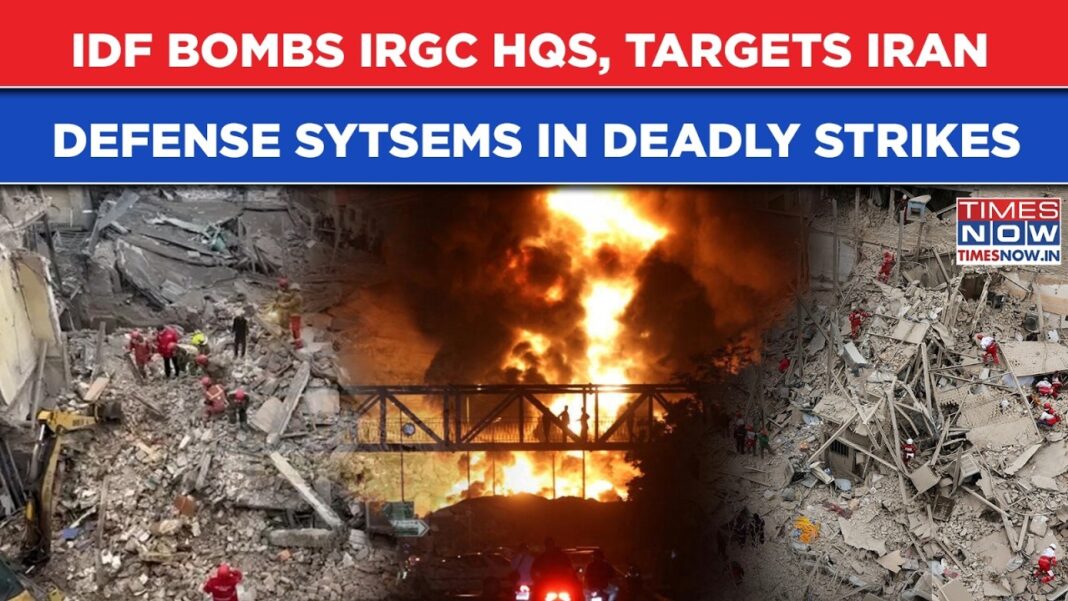
In a sweeping and strategically calibrated escalation, the Israeli Air Force conducted a series of precision strikes deep within Tehran on Tuesday, targeting critical infrastructure tied to Iran’s military, internal security apparatus, and ballistic missile capabilities. The operation, executed under the direction of the Israel Defense Forces Intelligence Directorate, marks a significant intensification of Israel’s campaign to degrade what officials describe as the “core systems” of the Iranian regime.
According to detailed reporting by Israel National News on Wednesday, the strikes were not isolated or symbolic in nature. Rather, they formed part of a broader operational phase aimed at systematically dismantling the institutional and military foundations that underpin Iran’s regional influence and domestic control.
The strikes focused on a carefully selected set of high-value targets within Iran’s capital. Among them was the headquarters of the Islamic Revolutionary Guard Corps (IRGC) Security Unit, a body widely regarded as instrumental in suppressing domestic dissent and maintaining regime stability.
Also targeted was a maintenance facility belonging to the General Logistics and Support Department of Iran’s Internal Security Forces. This infrastructure plays a vital role in sustaining the operational readiness of units tasked with internal enforcement and control.
Perhaps most significantly, Israeli forces struck a command center associated with Iran’s ballistic missile array—a critical component of the country’s strategic deterrence and offensive capabilities. As the Israel National News report emphasized, such systems are central to Iran’s ability to project power across the region.
In parallel with these strikes, Israeli aircraft also engaged multiple air defense systems, a move designed to expand aerial superiority and reduce the risk to subsequent operations. By degrading Iran’s defensive capabilities, the Israeli Air Force aims to create a more permissive environment for continued attacks.
The operation reflects a deliberate shift toward what Israeli officials describe as a campaign of systemic disruption. Rather than focusing solely on immediate threats, the strategy seeks to weaken the underlying structures that enable Iran’s military and political power.
As reported by Israel National News, this phase of the campaign is intended to “deepen the damage” inflicted on the regime’s core systems. This includes not only military assets but also institutions responsible for internal repression and logistical support.
The targeting of the IRGC Security Unit, in particular, underscores the dual nature of the campaign. While the ballistic missile array represents an external threat, the security apparatus embodies the regime’s capacity to maintain control within its own borders.
A key component of Tuesday’s strikes was the neutralization of Iranian air defense systems. By targeting radar installations and missile batteries, the Israeli Air Force sought to establish greater freedom of movement over Iranian airspace.
This effort is not merely tactical but strategic. Air superiority enables sustained operations, allowing for repeated strikes against high-value targets with reduced risk to personnel and equipment. It also complicates Iran’s ability to respond effectively, as its defensive capabilities are progressively degraded.
According to the report at Israel National News, the success of these operations represents a significant achievement in a complex and contested environment.
The developments in Tehran are unfolding against a broader regional backdrop, where tensions remain high and multiple fronts are active. In this context, the role of Hezbollah—a powerful armed group based in Lebanon—has taken on renewed significance.
Israeli Minister of Culture and Sports Miki Zohar addressed this dimension in a series of remarks that reflect the government’s broader strategic outlook. Speaking in an interview, Zohar emphasized Israel’s determination to confront Hezbollah with decisive force. We intend to put an end to the story called Hezbollah,” he stated, signaling a clear intent to eliminate the group as a meaningful military threat.
Zohar acknowledged that while Hezbollah may not be entirely eradicated, its capabilities can be significantly reduced. He suggested that the group could be left with only limited weaponry and diminished operational capacity.
One of the key objectives outlined by Zohar involves pushing Hezbollah forces away from Israel’s northern border, particularly beyond the Litani River. This geographic buffer is seen as essential to preventing direct and short-range attacks on Israeli communities. “We will not agree to have them positioned before the Litani River,” Zohar said, emphasizing the importance of distance in mitigating threats. By increasing the separation between Hezbollah forces and Israeli territory, the government aims to reduce the risk of immediate confrontation.
As the Israel National News report noted, such measures are part of a broader effort to reshape the security landscape along Israel’s northern frontier.
Zohar also articulated a broader vision in which Hezbollah’s influence within Lebanon is significantly curtailed. He suggested that the weakening of the group could create conditions for the Lebanese government to assert greater control and reduce the presence of non-state armed actors. It is very possible that what we want to happen in Iran will also happen with Hezbollah,” he said, drawing a parallel between the campaigns targeting both entities.
This vision reflects a strategic ambition that extends beyond immediate military objectives, aiming instead at long-term structural changes in the region.
Central to Israel’s strategy is its relationship with the United States, which Zohar described as a “very important partner.” He expressed confidence in President Trump and the current American leadership, suggesting that it shares Israel’s commitment to addressing the threats posed by Iran and its allies.
As reported by Israel National News, Zohar credited this partnership with influencing the course of recent events, including the conclusion of a prior round of conflict. “The people of Israel should thank God for every moment he (Trump) is president,” Zohar said, underscoring the alignment between the two nations.
Zohar’s remarks also shed light on the timing of previous hostilities, including the 12-day war that took place in June. He suggested that the cessation of that conflict was not solely driven by Israeli preferences but also by broader strategic considerations involving international partners. I believe he (Trump) has made up his mind to finish the job,” Zohar said, implying that further developments may be on the horizon. This statement reflects a sense of continuity in the current campaign, with Tuesday’s strikes representing not an endpoint but a beginning in an ongoing effort.
The convergence of these developments has placed the region in a state of heightened tension. The strikes in Tehran, the ongoing threat from Hezbollah, and the broader geopolitical dynamics all contribute to a volatile environment in which the potential for escalation remains significant.
As Israel National News has consistently reported, the situation is fluid, with multiple variables influencing the trajectory of events.
For Israel, the challenge lies in balancing the need for decisive action with the risks inherent in confronting a network of adversaries. For Iran and its allies, the strikes represent a direct challenge to their capabilities and influence.
The Israeli airstrikes in Tehran mark a defining moment in the evolving conflict between Israel and Iran. By targeting the core elements of Iran’s military and security infrastructure, the operation signals a willingness to confront threats at their source.
At the same time, the statements of Israeli officials highlight a broader strategy that encompasses not only Iran but also its regional proxies. The goal, as articulated by Zohar, is not merely to respond to immediate threats but to reshape the strategic landscape in a way that enhances long-term security.
As the situation continues to develop, the implications of these actions will be closely watched by governments, analysts, and communities around the world. The outcome of this phase of the conflict may well determine the contours of regional security for years to come.
In the words of observers cited by Israel National News, the events of Tuesday are not just another chapter in an ongoing struggle—they are a turning point, one that could redefine the balance of power in the Middle East.
