



|
Getting your Trinity Audio player ready...
|
By: Fern Sidman
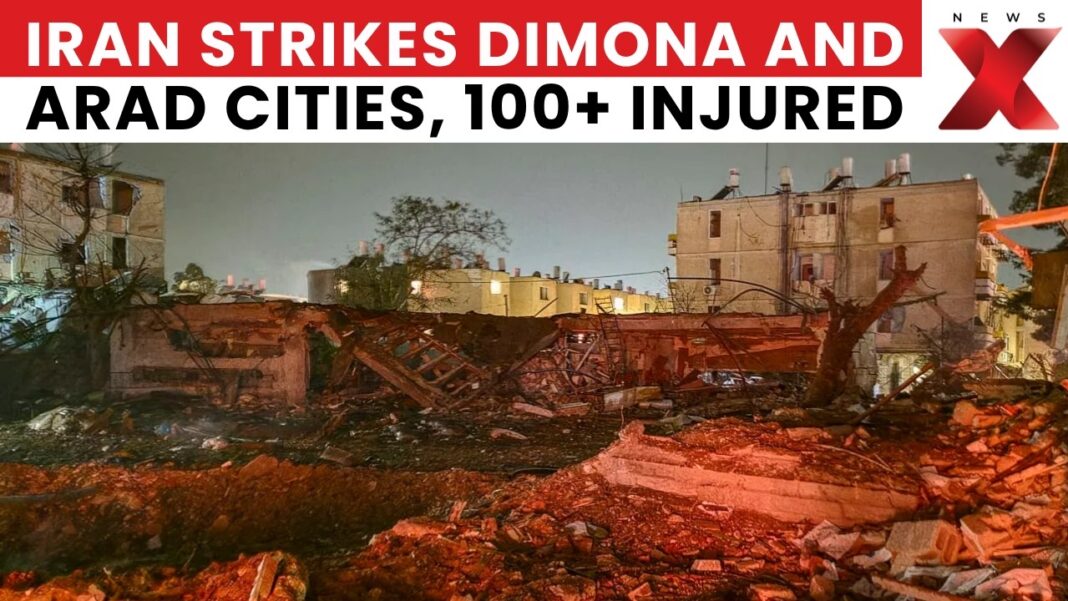
In a development that has sent shockwaves across the international community and reignited fears of a catastrophic regional conflagration, an Iranian missile on Saturday struck the Israeli town of Dimona—home to one of the most sensitive and closely guarded nuclear facilities in the world. The attack, which Tehran has described as a calculated act of retaliation, marks a dangerous new phase in an already volatile conflict involving Iran, Israel, and the United States.
According to Iranian state media, the strike was aimed at Israel’s nuclear research infrastructure near Dimona, a site long associated with the country’s undeclared nuclear capabilities. The missile reportedly landed within the town itself, causing widespread damage and injuring dozens. Israeli authorities confirmed a direct hit on a building, with emergency services treating at least 39 individuals, including a young boy who sustained serious shrapnel wounds. Scenes from the aftermath, described by first responders as chaotic and devastating, underscored the human toll of this escalating confrontation.
As reported on Saturday by The Guardian, the attack comes in response to what Iran alleges was a coordinated assault earlier in the day on its Natanz uranium enrichment facility. Tehran has pointed the finger squarely at both the United States and Israel, although Israeli officials have denied any involvement, and Washington has yet to publicly confirm or refute the accusation. Despite the intensity of the alleged strike on Natanz, Iranian authorities stated that no radioactive leakage had occurred, a detail that may have prevented an even more severe international crisis.
The Dimona facility, formally known as the Shimon Peres Negev Nuclear Research Center, has long been at the center of speculation regarding Israel’s nuclear ambitions. While Israel maintains a policy of deliberate ambiguity—neither confirming nor denying the existence of nuclear weapons—analysts widely believe that Dimona plays a pivotal role in its strategic deterrence capabilities. The targeting of such a site, even indirectly, represents a significant escalation, raising concerns not only about military retaliation but also about the potential for nuclear miscalculation.
The Guardian has repeatedly highlighted the precariousness of striking or even threatening nuclear infrastructure, noting that such actions carry risks that extend far beyond immediate military objectives. The head of the United Nations’ nuclear watchdog, Rafael Grossi, echoed these concerns in the wake of the Natanz incident, urging all parties to exercise restraint to avoid triggering a nuclear accident. His warning now appears all the more urgent, given the apparent willingness of both sides to engage in direct attacks on strategically sensitive sites.
The Israeli military reported that interception attempts were made as the incoming missiles were detected, though at least one projectile managed to evade defenses and strike its target. Footage circulating in Israeli media showed a high-speed object descending from the sky before impact, a stark visual testament to the evolving capabilities of Iran’s missile arsenal. This capacity for long-range precision strikes has been a growing concern among Western and regional defense planners, as emphasized in recent analyses by The Guardian.
Meanwhile, Israel has not remained passive. The Israeli military announced that it had conducted its own strike on a facility embedded within a university in Tehran, alleging that the site was being used for the development of nuclear weapon components and ballistic missile technology. Such claims, while difficult to independently verify, align with longstanding Israeli assertions that Iran’s nuclear program has military dimensions—a contention that Tehran vehemently denies.
The broader strategic context only deepens the gravity of the situation. For three weeks, sustained bombardment by US and Israeli forces has targeted various Iranian military and nuclear-related assets. Yet, as The Guardian has observed, these efforts appear to have done little to diminish Iran’s capacity to retaliate. Indeed, Tehran has demonstrated an ability to launch missile and drone attacks across multiple fronts, signaling a resilience that complicates any straightforward military calculus.
The conflict has also begun to spill beyond the immediate Israel-Iran axis. The United Arab Emirates reported aerial attacks following Iranian warnings against allowing its territory to be used for strikes on contested islands near the Strait of Hormuz. This vital maritime corridor, through which roughly one-fifth of the world’s crude oil passes during peacetime, has become a focal point of strategic tension. Iran’s effective closure of the strait has drawn sharp condemnation from a coalition of nations, including the United Kingdom, France, Germany, and others.
In a joint statement, these countries denounced what they described as the “de facto closure” of the strait and expressed their readiness to ensure safe passage. The Guardian has underscored the economic implications of such disruptions, noting that any sustained interference with global energy supplies could have far-reaching consequences for markets and geopolitical stability alike.
Adding to the complexity, the United States has intensified its military operations in the region. Admiral Brad Cooper, head of US Central Command, revealed that American warplanes had conducted a significant strike on an underground Iranian facility along the coast. The target reportedly housed anti-ship cruise missiles, mobile launchers, and critical intelligence infrastructure used to monitor maritime traffic. According to Cooper, the operation has “degraded” Iran’s ability to threaten shipping in the Strait of Hormuz, though it is unlikely to eliminate the risk entirely.
The rhetoric accompanying these actions has been equally striking. President Trump criticized NATO allies as “cowards” and urged them to take a more active role in securing the strait. Such statements, widely covered by The Guardian, reflect a broader debate within Western alliances about burden-sharing and the appropriate response to escalating threats in the Middle East.
At its core, the current crisis represents a convergence of long-standing tensions, strategic miscalculations, and immediate provocations. The mutual targeting of nuclear-related sites—whether confirmed or alleged—introduces a level of risk that transcends conventional warfare. As The Guardian has repeatedly warned, the margin for error in such scenarios is vanishingly small, and the consequences of misjudgment could be catastrophic.
The human dimension of the conflict, often overshadowed by strategic considerations, remains starkly evident. The injured in Dimona, the civilians living under the constant threat of missile strikes, and the communities affected by disruptions to essential services all bear the brunt of decisions made far above their heads. The image of a wounded child, caught in the crossfire of geopolitical rivalry, serves as a poignant reminder of what is truly at stake.
Looking ahead, the prospects for de-escalation appear uncertain. Diplomatic channels remain strained, and mutual distrust runs deep. Yet, as The Guardian has emphasized in its coverage, the urgency of renewed dialogue cannot be overstated. The alternative—a continued spiral of retaliation and counter-retaliation—risks drawing in additional actors and transforming a regional crisis into a global one.
In this fraught moment, the international community faces a critical test. The ability to balance deterrence with diplomacy, to address legitimate security concerns while avoiding reckless escalation, will determine whether this crisis can be contained or whether it will mark the beginning of a far more dangerous chapter in Middle Eastern history.
For now, the skies over Dimona stand as a stark symbol of a world teetering on the edge—where the line between conventional conflict and something far more devastating grows ever thinner.
