



|
Getting your Trinity Audio player ready...
|
By: Fern Sidman
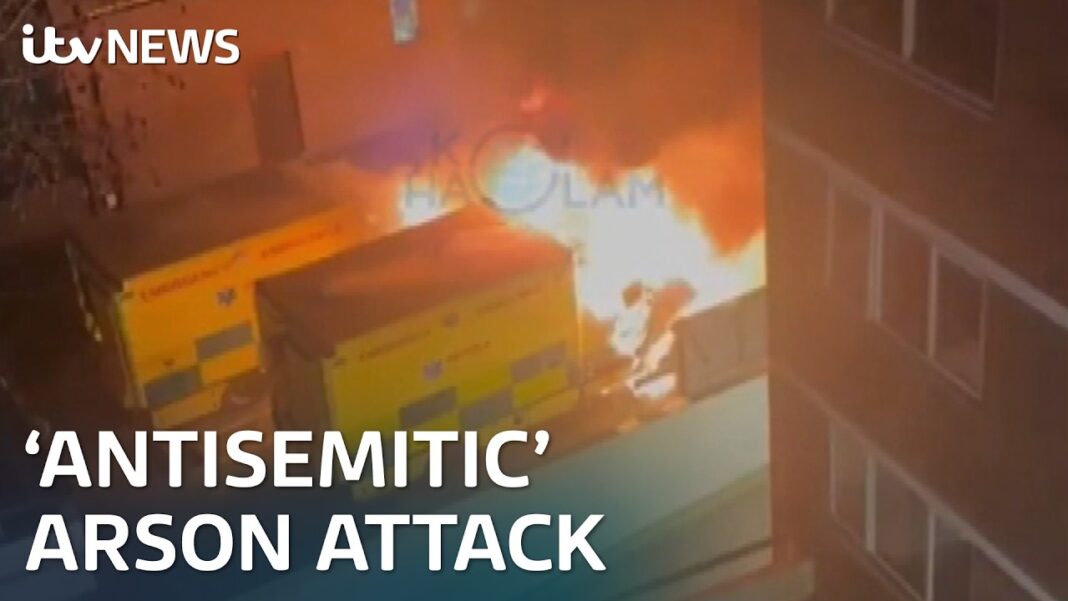
The early hours of a quiet Monday morning in north London were shattered by an act of calculated malice that has since reverberated across the United Kingdom and beyond. In Golders Green, a neighborhood long associated with vibrant Jewish communal life, four volunteer ambulances belonging to the Hatzolah emergency service were deliberately set ablaze outside a synagogue. The attack, now under investigation by counter-terrorism police, has become a grim symbol of a broader and deeply troubling resurgence of antisemitism within British society.
As reported by Israel National News, the incident has not only alarmed the Jewish community but has also prompted a stark acknowledgment from senior government officials that the threat is both real and escalating. British Home Secretary Shabana Mahmood, in remarks delivered shortly after the attack, described the arson as an “abhorrent crime” that compels the nation to confront an uncomfortable and urgent reality: that many Jewish citizens now live in a climate of fear.
The attack occurred at approximately 1:30 a.m., when three individuals—captured on surveillance footage—approached the ambulances parked along Highfield Road and ignited them in what authorities have characterized as a premeditated act of hate. The vehicles, operated by Hatzolah, serve as a critical volunteer-based emergency response network within the Jewish community, often providing rapid medical assistance in life-threatening situations. Their destruction was therefore not merely symbolic but also operationally significant, undermining a vital layer of communal infrastructure.
Israel National News has emphasized that the targeting of such an organization represents a particularly insidious form of hostility. Unlike attacks directed at political institutions or public demonstrations, this incident struck at a service dedicated to saving lives, regardless of background or affiliation. In doing so, it has intensified concerns that antisemitic aggression in the United Kingdom is becoming both more brazen and more indiscriminate.
In her address to the Community Security Trust, Mahmood delivered one of the most candid assessments of the situation to date. She spoke of a “wider societal failure” to confront the forces that allow antisemitism to persist and evolve, warning that the current trajectory echoes some of the darkest chapters in European history. Her words, widely cited by Israel National News, conveyed a sense of urgency that transcended conventional political rhetoric.
“History has repeatedly screamed its warning at us,” she said. “And yet, here we are again… with the oldest hatred rising once more.” Mahmood went on to describe the lived reality of many British Jews, who now feel compelled to conceal visible expressions of their identity, to exercise caution in public spaces, and to navigate daily life with an undercurrent of apprehension.
Such testimony is not merely anecdotal. Israel National News has documented a steady increase in antisemitic incidents across London and other major cities, ranging from vandalism and harassment to more organized and potentially violent acts. The Golders Green arson attack, while particularly dramatic, is thus part of a broader pattern that has been unfolding over several years.
The investigation into the attack has taken on added complexity following reports that the perpetrators may be linked to an extremist organization with ties to Iran. According to sources cited by Israel National News, a group identifying itself as Harakat Ashab al-Yamin al-Islamia released an online video appearing to claim responsibility. While authorities have not yet confirmed the authenticity of this claim, its implications are deeply concerning, suggesting the possibility of foreign influence or coordination in acts of domestic terrorism.
In response to the attack, Metropolitan Police Commissioner Mark Rowley announced a series of enhanced security measures aimed at protecting Jewish communities across London. These include the deployment of additional armed officers, the assignment of 264 neighborhood officers to vulnerable areas, and the use of undercover specialists to monitor and counter emerging threats, including those involving drones or other advanced tactics.
Rowley’s remarks to the Community Security Trust, also highlighted by Israel National News, underscored the seriousness with which law enforcement is treating the situation. “The threat is serious,” he stated, emphasizing the need for sustained operational commitment and visible action. His assurance that authorities “stand with” the Jewish community was intended to convey solidarity, but it also reflected the magnitude of the challenge at hand.
Mahmood, for her part, framed the attack as an assault not only on a specific community but on the nation as a whole. “Jewish life in this country is indivisible from our national life,” she declared, reinforcing the principle that the safety and dignity of Jewish citizens are integral to the broader fabric of British democracy. Israel National News has repeatedly highlighted this dimension of the discourse, noting that the government’s response seeks to position the fight against antisemitism as a matter of national identity and cohesion.
To that end, Mahmood outlined a series of policy initiatives aimed at addressing both the immediate and underlying drivers of antisemitism. These include new legislative efforts to combat online hate, the strengthening of Home Office mechanisms to prevent the entry of extremist preachers, and a comprehensive review of public order and hate crime laws. The objective, she stated, is to “keep hatred and intimidation off our streets” and to dismantle the permissive environments in which such sentiments can flourish.
Yet the effectiveness of these measures remains an open question. Israel National News has pointed to a series of recent incidents that illustrate the persistence—and in some cases escalation—of antisemitic activity. In one notable episode, a Jewish-owned bakery in London was vandalized following a protest that accused the business of supporting Israel. In another, demonstrators targeted an Israeli-owned establishment, while protests near synagogues have raised concerns about the safety of worshippers.
Academic institutions have not been immune. Israel National News reported on a disruption at City St. George’s, University of London, where an Israeli academic’s lecture was interrupted by activists who shouted accusations and threats. Such incidents suggest that antisemitism is not confined to any single domain but permeates various sectors of public life, from commerce to education.
The cumulative effect of these developments is a growing sense of vulnerability within the Jewish community. While official statements and increased security measures provide some reassurance, they also serve as reminders of the scale of the threat. The presence of armed officers outside synagogues and community centers, while necessary, underscores a reality that many find deeply unsettling.
At a broader level, the situation raises fundamental questions about the resilience of liberal democratic societies in the face of resurgent extremism. The United Kingdom, with its long tradition of pluralism and tolerance, now finds itself grappling with forces that challenge these very principles. Israel National News has framed this as a test not only of policy but of national will—a question of whether the country can effectively confront and reverse the tide of antisemitism.
As the investigation into the Golders Green attack continues, the immediate priority remains the identification and prosecution of those responsible. Mahmood has pledged that the perpetrators will be “pursued and made to face the consequences of their vile actions,” a commitment that reflects both the gravity of the crime and the determination to deliver justice.
Yet beyond the pursuit of accountability lies a more complex and enduring challenge: the need to address the cultural, ideological, and social dynamics that enable such acts to occur. This will require not only legislative action and law enforcement but also sustained efforts in education, community engagement, and public discourse.
In the final analysis, the flames that consumed the Hatzolah ambulances in Golders Green illuminate more than a single act of destruction. They cast light on a broader crisis—one that demands vigilance, resolve, and a reaffirmation of the values that define an open society. As Israel National News continues to chronicle these developments, the message is unmistakable: the time for complacency has passed, and the imperative for decisive action has never been greater.
