



|
Getting your Trinity Audio player ready...
|
By: Fern Sidman
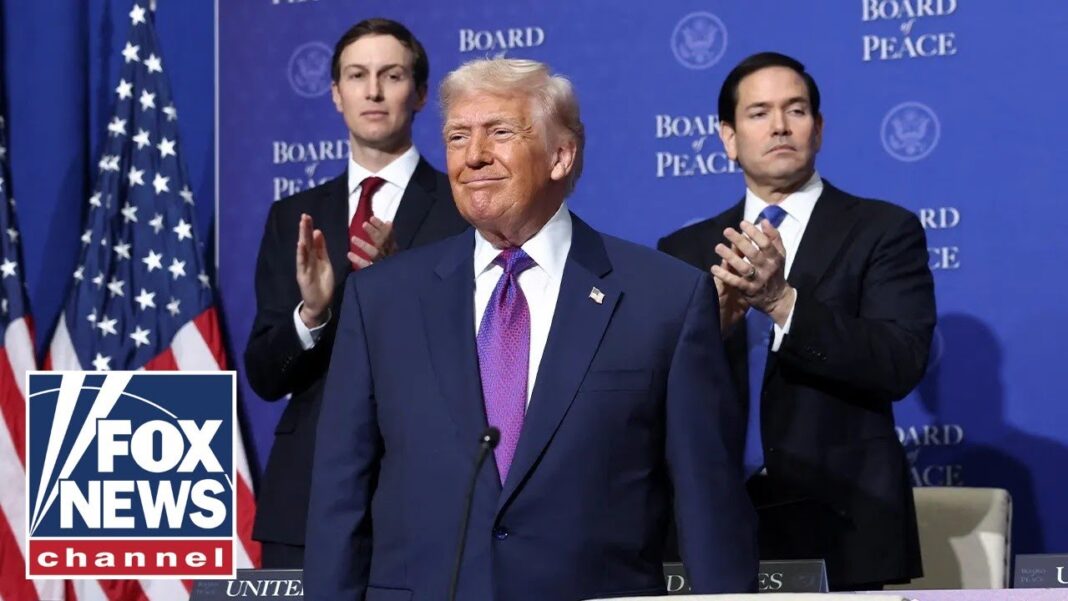
In a moment choreographed for both symbolism and substance, President Donald Trump opened the inaugural session of the “Board of Peace,” a new international body he described in sweeping terms as the most powerful and prestigious diplomatic forum ever assembled. Speaking on Thursday morning before representatives of 48 nations, with additional leaders participating remotely, Trump framed the Washington gathering as an audacious attempt to impose structure, authority, and resolve upon a global landscape that has long been defined by inertia and endless conflict.
According to a report on Thursday on Israel National News, the president presented the Board not as another ceremonial conference, but as an instrument of consequence—an arena in which power, prestige, and political will would converge to produce tangible outcomes rather than familiar diplomatic platitudes.
From the outset, Trump leaned into the contrast between the simplicity of the word “peace” and the formidable complexity of achieving it. The Board of Peace, he insisted, exists to narrow that gap. Israel National News reported that the president cast the initiative as the culmination of a diplomatic philosophy he has advanced since returning to office: that peace is not merely a moral aspiration but a strategic and economic imperative. War, he argued, is ruinously expensive, devouring resources and human lives at a scale that dwarfs the investments required to construct durable political settlements. In his formulation, peace is not only ethically superior; it is fiscally prudent.
The centerpiece of Trump’s remarks concerned Gaza, a theater of conflict he characterized as uniquely intricate, layered with historical grievances and contemporary security dilemmas. He publicly lauded the efforts of US Special Envoy Steve Witkoff and Jared Kushner, crediting them with playing decisive roles in securing and sustaining the ceasefire between Israel and Hamas. Trump’s praise of these envoys was not merely ceremonial. He cast their work as emblematic of the Board of Peace’s ethos: relentless diplomacy backed by leverage, coordination, and the willingness to impose consequences when commitments are violated.
Trump’s language suggested a belief that the Gaza war, which he described as raging with no end in sight when he took office, has been reduced to embers. “There are little flames,” he conceded, acknowledging that violence has not vanished entirely, but he insisted that the overarching war is over. Israel National News reported that Trump framed this shift as evidence of the potency of sustained diplomatic pressure, combined with the strategic posture of the United States and its partners. The Board of Peace, he argued, would now institutionalize that approach, extending it beyond Gaza to other flashpoints in the Middle East and, eventually, to conflicts around the world.
Central to Trump’s vision was a demand for the demilitarization of Hamas. He stated his belief that the organization has pledged to relinquish its weapons, but he coupled that assertion with an unmistakable warning. Should Hamas fail to fulfill that promise, he said, the consequences would be severe. The language was deliberately stark, underscoring Trump’s conviction that peace agreements are meaningless unless backed by credible enforcement mechanisms. The Israel National News report emphasized that this posture reflects a broader Trump doctrine: diplomacy must be accompanied by the capacity and willingness to impose costs on actors who defy the terms of negotiated settlements.
The president’s remarks also ventured into the realm of US-Iran relations, where he claimed that American airstrikes in Iran in June 2025 had contributed to “peace in the Middle East.” While acknowledging that further action might be necessary, Trump left open the possibility of a negotiated agreement with Tehran. He suggested that the coming days would be decisive, intimating that Iran faces a stark choice between accommodation and confrontation. Israel National News reported that Trump’s rhetoric on Iran balanced threat with invitation, projecting both the readiness to escalate and the openness to conclude a deal if Tehran alters its course.
In a move that underscored the personal and political dimensions of the initiative, Trump announced that Jared Kushner would be elevated to the role of Special Envoy. The promotion was framed as recognition of Kushner’s prior efforts in navigating complex diplomatic terrain. This decision reflects Trump’s preference for envoys he regards as loyal and effective, individuals he believes can operate within the unique blend of transactional diplomacy and high-stakes negotiation that defines his foreign policy style.
Perhaps the most striking moment of the address came with Trump’s announcement that the United States would commit $10 billion to the Board of Peace. He juxtaposed this figure against the astronomical costs of war, describing the sum as a modest investment when measured against the financial and human toll of sustained conflict. Israel National News reported that Trump presented the funding as both a moral statement and a strategic calculation: an upfront expenditure designed to forestall far greater losses. The contribution, he suggested, would enable the Board to move beyond rhetoric, funding reconstruction, stabilization, and the mechanisms necessary to translate agreements into lived realities for civilian populations.
Trump’s insistence that the Board of Peace is defined by action rather than talk was a recurring refrain. He portrayed the body as an engine of implementation, capable not only of convening leaders but of devising and executing solutions. The report at Israel National News noted this emphasis as a deliberate departure from what Trump characterized as the performative diplomacy of prior international forums, which produced communiqués and photo opportunities but little durable change. The Board of Peace, he asserted, would be judged not by the eloquence of its declarations but by the permanence of the peace it secures.
The spectacle of 48 nations assembling under the aegis of a single initiative carried its own symbolism. Trump described the Board as unprecedented in both scope and stature, suggesting that the constellation of leaders who had agreed to participate conferred upon it a legitimacy and authority unmatched by existing institutions. The implication was that the Board of Peace would operate as a parallel architecture of global governance, one less constrained by the procedural inertia and political fragmentation that often hamper multilateral organizations.
Critics may question the durability of such an ambitious construct, noting that international bodies are only as effective as the consensus and enforcement capabilities that sustain them. Yet Trump appeared undeterred by skepticism. His rhetoric was suffused with a confidence that borders on audacity: a conviction that determined leadership can reorder political realities long thought immutable. The Israel National News report observed that this belief animates much of Trump’s foreign policy narrative, in which personal resolve and strategic pressure are posited as catalysts capable of breaking longstanding deadlocks.
The Gaza ceasefire, in Trump’s telling, stands as proof of concept. By framing the cessation of large-scale hostilities as the product of “unrelenting diplomacy,” he sought to demonstrate that even the most entrenched conflicts can be de-escalated through a combination of negotiation and leverage. This narrative positions the Board of Peace as both a culmination of recent diplomatic efforts and a platform for their expansion, an attempt to systematize a method Trump claims has already yielded results.
At the same time, the president’s remarks betrayed an awareness of fragility. The acknowledgement of “little flames” in Gaza, the conditional language regarding Hamas’s disarmament, and the ambivalence surrounding Iran’s next steps all point to an understanding that peace is provisional, contingent upon compliance and enforcement. Israel National News reported that Trump’s vision of peace is not one of naïve optimism but of managed equilibrium, sustained through vigilance and the credible threat of reprisal.
In the end, the inaugural session of the Board of Peace was as much a declaration of intent as a diplomatic milestone. Trump cast the body as an instrument through which the United States and its partners could project stability, reshape regional dynamics, and, in his words, bring “lasting harmony to a region tortured by centuries of war.” Whether the Board of Peace will fulfill these lofty ambitions remains an open question, one that will be answered not by speeches but by the resilience of ceasefires, the demilitarization of militant actors, and the willingness of rival states to subordinate immediate advantage to long-term stability.
For now, the Board of Peace stands as a bold experiment in international diplomacy, infused with the distinctive imprint of Trump’s leadership. It embodies a wager that concentrated authority, strategic funding, and unapologetic pressure can succeed where diffuse consensus has faltered. In an era marked by geopolitical fragmentation and proliferating conflicts, Trump’s initiative seeks to impose a new grammar of peace—one written not in the abstractions of idealism, but in the hard currency of power, persuasion, and consequence.
