



|
Getting your Trinity Audio player ready...
|
Trump to Erdogan: Stop Funding Putin’s War —WH Summit Pits Hostages, Jets, and Russia Against U.S. Demands
By: Fern Sidman
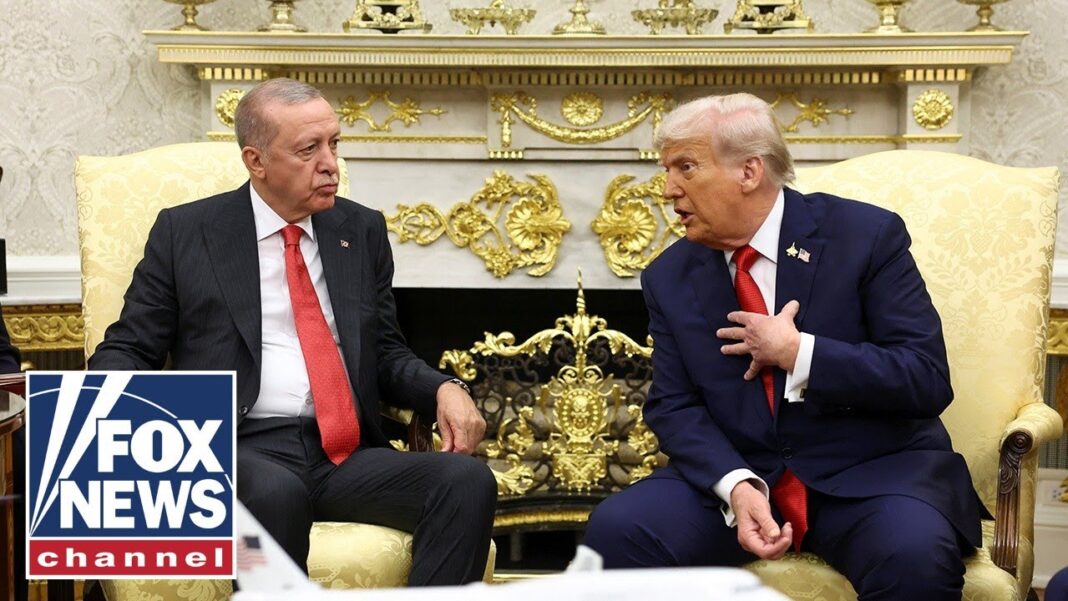
In a high-stakes meeting at the White House on Thursday morning, President Donald Trump and Turkish President Recep Tayyip Erdogan confronted a tangle of pressing issues that cut to the core of Middle Eastern security, U.S.-Turkey relations, and the broader struggle for leverage in the region. According to a report that appeared on Thursday on Israel National News, the encounter, timed to follow Trump’s intensive talks with other world leaders during the United Nations General Assembly, was defined by the urgency of the war in Gaza, the fate of Israeli hostages, and Ankara’s long-standing demands for advanced American F-35 fighter jets.
Speaking alongside Erdogan, President Trump told reporters that his recent meetings with Middle Eastern leaders had been “great” and suggested that progress was being made on one of the most sensitive diplomatic files currently before his administration: the safe return of hostages still held by Hamas. “I think we’re close to getting some kind of a deal done,” Trump said. “We want to get the hostages back. I have to get the hostages back.”
As the Israel National News report underscored, Trump’s words highlight how hostage recovery has become a central test of his leadership at a moment when Israel continues its military campaign to dismantle Hamas infrastructure inside Gaza. For many Israelis, the question of hostages remains an open wound, with families pressing Jerusalem and Washington alike to secure the return of their loved ones. Trump’s statement was widely seen as an assurance to both the American and Israeli public that this humanitarian crisis remains at the top of his agenda.
When asked directly if he and Erdogan were aligned on the Gaza conflict, Trump offered a strikingly candid response: “Well I don’t know his stance, I can’t tell you about that.” According to the information provided in the Israel National News report, this remark pointed to the gap between Washington and Ankara on the war. Erdogan, who has often positioned himself as a vocal critic of Israeli operations in Gaza, has been walking a fine line between his support for Palestinian causes and his desire to preserve some degree of working relations with Washington.
For Israel, Erdogan’s posture remains a cause for suspicion. As Israel National News has frequently reported, Ankara has hosted Hamas officials in the past, granting them political space and, at times, direct support. This legacy complicates U.S.-Turkey relations, particularly as Trump makes hostage recovery and Israeli security central to his diplomatic strategy.
At the heart of Erdogan’s visit is a dispute that has strained U.S.-Turkey relations for several years: Ankara’s exclusion from the F-35 fighter jet program. In 2019, Washington froze Turkey’s participation after Erdogan proceeded with the purchase of Russian-made S-400 air defense systems, a move the U.S. and NATO allies argued compromised Western security. Erdogan, however, has consistently demanded that Turkey be readmitted into the F-35 program or compensated with comparable advanced systems.
As the Israel National News report explained, Erdogan views the acquisition of next-generation air power as essential for Turkey’s regional ambitions. His military modernization agenda is intended to project Ankara as a decisive actor from the Eastern Mediterranean to the Caucasus and beyond. During Thursday’s meeting, Erdogan pressed Trump to revisit the American position and lift restrictions on both the aircraft sale and broader defense cooperation.
For his part, Trump used the White House meeting to advance his own strategic priorities. Chief among them was a request that Erdogan halt Turkish purchases of Russian oil as Moscow continues its war against Ukraine. “I’d like to have him stop buying any oil from Russia while Russia continues his rampage against Ukraine,” Trump said pointedly.
The Israel National News report noted that this appeal places Erdogan in a difficult position. Turkey has long relied on energy imports from Russia and has served as a key hub for regional gas and oil transit. While Ankara has condemned aspects of Moscow’s invasion of Ukraine, it has carefully preserved ties with Russia, balancing its NATO membership with a pragmatic approach to President Vladimir Putin. Trump’s demand signals that Washington expects Ankara to make harder choices in aligning itself with Western priorities.
Beyond fighter jets and oil, Erdogan also lobbied for relief from U.S. sanctions and tariffs that have weighed on Turkey’s economy. Many of these measures were imposed in response to Ankara’s defense purchases and regional interventions. According to the information provided in the Israel National News report, Erdogan is hoping that Trump, known for his transactional style, can be persuaded to ease restrictions in exchange for Turkish concessions on issues of direct concern to Washington, such as curtailing ties with Russia or cooperating on hostage negotiations.
Whether Trump is willing to extend such relief remains to be seen. His administration has so far emphasized a “deal-making” approach, where concessions are exchanged only for concrete, verifiable steps that advance American interests.
For Israel, the Trump-Erdogan summit raises urgent questions. The Israel National News report stressed that Turkey’s request for F-35s, if granted, could alter the regional balance of power. Jerusalem has long been wary of Ankara’s drift away from NATO consensus and its overtures to Hamas and other Islamist terrorist factions. Providing Erdogan with advanced American technology could complicate Israel’s qualitative military edge, a principle that has anchored U.S. defense policy in the Middle East for decades.
Moreover, Erdogan’s stance on Gaza remains ambiguous at best. While he has indicated support for de-escalation in some forums, his rhetoric has consistently cast Israel as the aggressor, creating friction with Washington’s pro-Israel policy line. As Trump seeks to secure the release of hostages, the Israel National News report warned that Ankara’s role could either facilitate progress or obstruct it, depending on how Erdogan chooses to position himself in the weeks ahead.
The hostage issue, as the Israel National News report underscored, is more than a humanitarian crisis—it has become a test of U.S. credibility in the Middle East. By declaring that he “has to get the hostages back,” Trump has effectively tied his administration’s success to the outcome of ongoing negotiations. Failure to deliver could embolden Hamas and its backers, while success would strengthen Washington’s standing not only in Israel but across the region.
Here, Erdogan’s role could be decisive. Turkey has often served as a mediator in regional disputes and has channels of communication with Hamas. Whether Trump chooses to leverage Ankara’s influence in pursuit of hostage release remains an open question, but the possibility loomed over Thursday’s meeting.
As both leaders left their joint appearance, it was clear that the meeting produced no immediate breakthroughs. Still, the symbolism was powerful: Trump, positioning himself as the champion of hostage recovery and Israeli security; Erdogan, presenting himself as the indispensable regional player seeking recognition and concessions from Washington.
The Israel National News report noted that the encounter reflects a broader pattern in Trump’s foreign policy—one defined by high-profile meetings, blunt demands, and an emphasis on transactional outcomes. For Erdogan, the challenge now is to demonstrate that Turkey can adjust its policies on Russia and defense acquisitions in ways that satisfy Washington without undermining Ankara’s strategic autonomy.
For Israel, the stakes remain high. As the Gaza war grinds on and families of hostages continue to plead for international intervention, Jerusalem will be watching closely to see whether Washington’s engagement with Ankara produces tangible results. The outcome of Trump’s talks with Erdogan could shape not only the future of U.S.-Turkey relations but also the prospects for Israeli security and regional stability.