



|
Getting your Trinity Audio player ready...
|
By: Fern Sidman
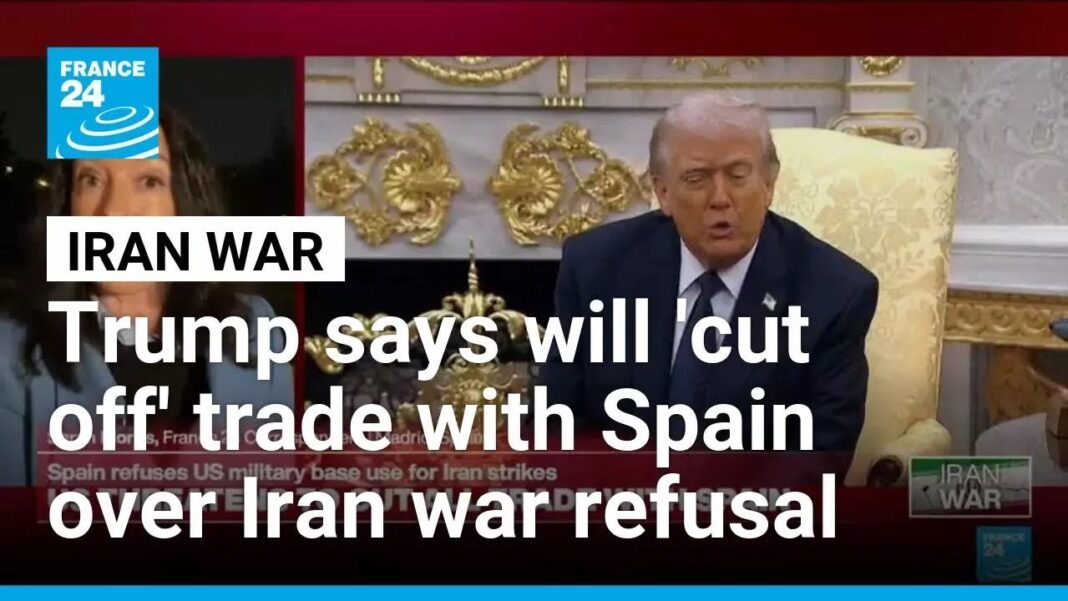
President Donald Trump on Tuesday dramatically escalated tensions with Spain, threatening to sever trade ties with the longtime NATO ally over what he described as Madrid’s failure to meet defense spending commitments and its alleged refusal to authorize the use of Spanish military bases for U.S. operations linked to strikes against Iran.
The remarks, delivered during a White House meeting with German Chancellor Friedrich Merz, reverberated swiftly across diplomatic and financial circles. As first reported by Fox Business, Trump said he had directed Treasury Secretary Scott Bessent to “cut off all dealings with Spain,” characterizing the European nation as “unfriendly” and asserting that the United States would no longer tolerate what he views as inadequate burden-sharing within the alliance.
“We’re going to cut off all trade with Spain,” Trump told reporters, according to Fox Business coverage of the meeting. “We don’t want anything to do with Spain.”
The president’s comments signal a potentially profound rupture in U.S.–Spain economic and security relations, two pillars of a transatlantic partnership that has endured for decades. Spain is a NATO member and hosts key American military installations, including Naval Station Rota and Morón Air Base, which operate under a bilateral defense cooperation agreement. While the United States maintains access to these facilities, Spain retains sovereignty and must authorize any use that extends beyond the agreement’s established parameters. Offensive combat operations launched from Spanish territory would generally require explicit approval from Madrid.
According to the report on Fox Business, Trump claimed Spain was the only NATO country that refused his call for member states to increase defense spending to 5% of GDP. He also asserted that Spanish authorities had indicated Washington could not utilize certain bases in support of what he described as Operation Epic Fury, a campaign involving strikes against Iran. Although Trump did not specify which installations were at issue, The Fox Business report noted that Rota and Morón are central to U.S. operations in Europe and the Mediterranean, serving as logistical hubs and forward operating sites.
The White House’s frustration appears to stem from two interrelated grievances: Spain’s defense expenditures and its position on operational cooperation. NATO’s longstanding target has been 2% of GDP for defense spending, a benchmark several European countries have struggled to meet. Trump has previously pressed allies to exceed that threshold, arguing that the United States shoulders a disproportionate share of alliance costs. In his remarks cited by Fox Business, Trump framed Spain’s alleged refusal to increase spending as emblematic of broader inequities within NATO.
The economic implications of Trump’s threat are considerable. According to U.S. Census Bureau data cited by Fox Business, total goods trade between the United States and Spain reached approximately $47 billion in 2025. The United States runs a trade surplus of about $4.8 billion with Spain, meaning American exports to Spain exceed imports. A wholesale cutoff would therefore affect not only Spanish exporters but also American companies that rely on Spanish goods, components, and services.
Spain’s export profile to the United States is diverse. It encompasses industrial machinery, pharmaceuticals, renewable energy components, food products such as olive oil and specialty meats, cosmetics, and financial and technological services. The economic interdependence has deepened over time, supported by investment flows and multinational corporate operations that transcend traditional trade statistics. Any abrupt cessation of trade would ripple across supply chains, disrupt procurement strategies, and potentially increase costs for businesses on both sides of the Atlantic.
Trump, however, argued that he possesses broad executive authority to restrict trade without congressional approval. He cited what he described as Supreme Court-affirmed powers to halt business with countries that are “not treating us well.” While he did not reference specific statutes, presidents have historically invoked national security provisions under U.S. trade law to impose tariffs, quotas, or sanctions. Whether such authority would withstand judicial scrutiny in this context remains uncertain and would likely become the subject of intense legal debate.
Treasury Secretary Scott Bessent and U.S. Trade Representative Jamieson Greer, both present during the meeting, indicated that the administration could pursue formal investigations and additional actions should the president decide to proceed. Fox Business reported that the officials signaled potential pathways for policy measures, suggesting the administration is examining legal mechanisms that could underpin any trade restrictions.
Financial markets and diplomatic observers are now assessing the credibility and scope of Trump’s threat. Historically, presidential rhetoric on trade has often served as leverage in negotiations rather than a definitive declaration of imminent policy. Yet the president’s language—“cut off all trade”—was unusually categorical. The Fox Business report emphasized the starkness of the statement, noting that such a move would represent one of the most sweeping trade actions against a NATO ally in modern history.
The strategic context further complicates the picture. Spain’s geographic position makes it a critical node in U.S. military logistics and maritime operations. Naval Station Rota hosts U.S. Navy destroyers equipped with ballistic missile defense systems, while Morón Air Base supports rapid deployment forces. If Madrid were to withhold authorization for certain uses of these bases, it would raise operational challenges for Washington. Conversely, aggressive economic retaliation could strain alliance unity at a moment when NATO faces multifaceted security pressures.
Spanish officials have not yet publicly responded in detail to the president’s accusations, but the defense cooperation agreement delineates clear boundaries. While the United States enjoys significant access, Spain retains ultimate authority over its sovereign territory. Any combat operations or offensive strikes launched from Spanish soil would generally require Madrid’s consent. The tension between alliance solidarity and national sovereignty lies at the heart of the dispute.
Economists warn that even the prospect of trade restrictions can unsettle markets. Companies engaged in cross-border commerce may delay investments, reconsider sourcing arrangements, or hedge against potential tariffs. Spain’s economy, integrated into the European Union’s single market, might seek to mitigate losses through alternative export destinations. Yet the American market remains one of its most important non-European trading partners.
For the United States, the trade surplus complicates the calculus. A country running a surplus typically exports more than it imports, implying that American firms could bear significant consequences if trade were curtailed. Industries ranging from aerospace and agriculture to energy and advanced manufacturing count Spain among their customers. As the Fox Business report noted, the bilateral trade relationship is substantial in scale, and its disruption would not be asymmetrical.
The episode also raises broader questions about the intersection of trade policy and security alliances. Historically, economic interdependence has been viewed as a stabilizing force within alliances, reinforcing shared interests and mutual prosperity. Leveraging trade as a punitive instrument against an ally represents a more confrontational paradigm, one that could recalibrate expectations across NATO.
Trump’s emphasis on defense spending reflects a longstanding theme of his foreign policy approach: the insistence that allies contribute more materially to their own defense. By framing Spain’s position as uniquely resistant among NATO members, he has cast the dispute as a test case. Fox Business reported that the president portrayed Spain as the sole holdout against his call for a 5% defense spending benchmark, intensifying the sense of isolation.
Whether the threat translates into concrete action will depend on a confluence of diplomatic negotiations, legal assessments, and political considerations. Trade policy changes of this magnitude typically require detailed rulemaking, investigations, and interagency coordination. The administration’s next steps may clarify whether the president intends to pursue sweeping restrictions or narrower measures tied to specific sectors or grievances.
For now, the transatlantic relationship faces a period of heightened uncertainty. Fox Business’s reporting captures the immediacy of the moment, chronicling a president prepared to wield economic power in pursuit of strategic objectives. As diplomats and policymakers on both sides of the Atlantic digest the implications, the balance between alliance cohesion and national prerogative will be tested.
The stakes extend beyond bilateral trade figures. At issue is the broader architecture of Western cooperation in an era of geopolitical volatility. If economic tools become instruments of intra-alliance enforcement, the precedent could reverberate far beyond Spain. The coming weeks may determine whether this episode becomes a catalyst for renegotiated commitments or a rupture that reshapes transatlantic commerce and security alike.
