



|
Getting your Trinity Audio player ready...
|
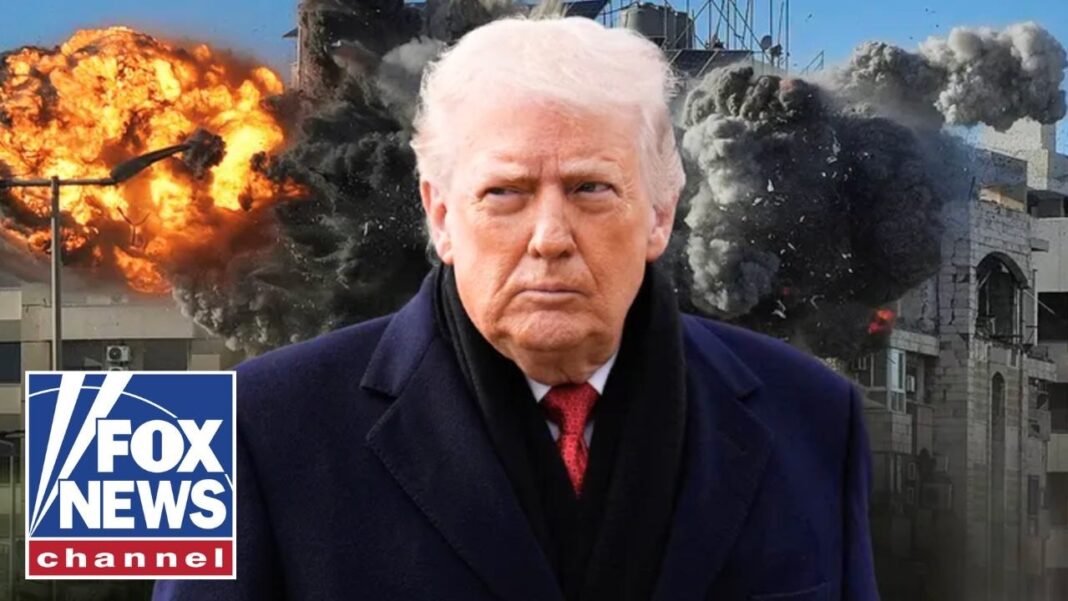
Trump Tells Bret Baier at Fox News: 8 p.m. Iran Deadline Is Firm and Moving Ahead
By: Fern Sidman
In a moment of extraordinary tension that has riveted global attention, President Donald Trump has issued one of the most sweeping and consequential ultimatums of his presidency, warning that Iran faces the prospect of an unprecedented military assault unless it agrees to a negotiated settlement by a firm and rapidly approaching deadline. As reported on Tuesday by Israel National News, the situation has evolved into a precarious standoff in which diplomacy and devastation appear to exist side by side, separated only by hours.
The immediacy of the crisis was underscored in remarks conveyed by Bret Baier, who revealed that he had spoken directly with the president. According to Baier, Trump made clear that the 8:00 p.m. Eastern Time deadline was not a rhetorical device but a genuine inflection point. Should negotiations fail to yield tangible progress, the United States is prepared to initiate what the president described as an attack “like they have not seen.”
The gravity of Trump’s warning lies not only in its scale but in its specificity. As emphasized repeatedly by Israel National News, the administration has articulated a vision of military action that would extend far beyond limited strikes or symbolic demonstrations of force. Instead, the proposed operation appears designed to fundamentally incapacitate Iran’s infrastructure and strategic capabilities in a single, overwhelming campaign.
Trump himself reinforced this perception in earlier remarks, asserting that “the entire country can be taken out in one night.” Such language, while characteristic of the president’s rhetorical style, nonetheless conveys a clear message: the United States is prepared to employ its full spectrum of military power to achieve its objectives.
At the same time, Trump has maintained that a diplomatic resolution remains possible. According to Baier’s account, the president acknowledged that meaningful progress in negotiations could alter the trajectory of events, even at the eleventh hour. This dual posture—simultaneously advancing toward conflict while leaving open the possibility of compromise—reflects a strategy of maximal pressure, one that seeks to compel concessions through the credible threat of overwhelming force.
Perhaps the most striking element of Trump’s recent statements is their apocalyptic tone. In a message posted on social media, the president warned that “a whole civilization will die tonight” if Iran fails to accede to American demands. As reported by Israel National News, this stark language has amplified the sense of urgency surrounding the deadline, transforming what might otherwise be perceived as a conventional diplomatic dispute into a moment of existential significance.
Such rhetoric serves multiple purposes. On one level, it underscores the severity of the potential consequences, signaling to both domestic and international audiences that the stakes are extraordinarily high. On another, it functions as a psychological instrument, intended to exert maximum pressure on Iranian decision-makers by framing the choice before them in the most dramatic terms possible.
Yet the invocation of civilizational collapse also raises profound ethical and strategic questions. The prospect of large-scale destruction, particularly when framed in terms that encompass entire societies, inevitably invites scrutiny regarding the proportionality and humanitarian implications of the proposed actions.
For its part, Iran has responded to the ultimatum with a combination of defiance and denunciation. Iranian officials, as cited by Israel National News, have rejected the American demands outright, characterizing Trump’s threats as “rude, insolent, and baseless.” A spokesperson for the country’s Armed Forces Central Headquarters went further, dismissing the president as “delusional” and asserting that the United States has suffered humiliation in the region.
This rhetorical escalation reflects a broader pattern of mutual antagonism that has defined the current phase of the conflict. Rather than signaling a willingness to compromise, Tehran’s statements suggest a determination to resist external pressure, even in the face of potentially devastating consequences.
At the same time, Iran has articulated its own set of conditions for de-escalation. These include an end to regional conflicts, the establishment of secure passage through the Strait of Hormuz, the restoration of damaged infrastructure, and the lifting of sanctions. As the Israel National News report noted, these demands diverge significantly from the parameters outlined by Washington, further complicating the prospects for a negotiated settlement.
Central to the unfolding crisis is the Strait of Hormuz, a narrow but critically important waterway through which a substantial portion of the world’s oil supply passes. Control over this chokepoint has long been a focal point of strategic competition, and its status has become a key issue in the current negotiations.
The United States has insisted that any agreement must guarantee free and secure passage through the strait, reflecting concerns about both economic stability and energy security. Iran, meanwhile, has sought to leverage its geographic position to extract concessions, using the threat of disruption as a bargaining tool.
The interplay between these competing interests highlights the broader geopolitical dimensions of the conflict, in which regional dynamics intersect with global economic considerations.
The current standoff did not emerge in isolation but is the culmination of a series of escalating actions and counteractions. As documented by Israel National News, recent months have seen intensified military activity, including strikes on strategic targets, retaliatory missile attacks, and a steady deterioration of diplomatic relations.
Trump’s latest ultimatum represents a further escalation, one that raises the possibility of a decisive and potentially transformative confrontation. Whether this escalation will lead to conflict or compel a last-minute agreement remains an open question.
The unfolding situation has also exposed fissures within the international community. While the United States has sought to rally support for its position, not all allies have embraced the prospect of large-scale military action. Divergent perspectives on the appropriate course of action have complicated efforts to present a unified front.
At the same time, Iran has sought to strengthen its own network of alliances, leveraging relationships with regional actors to bolster its strategic position. The resulting landscape is one of fluid and often competing alignments, in which the actions of individual states can have far-reaching implications.
Amid the strategic calculations and political rhetoric, it is essential to consider the human dimension of the crisis. The potential consequences of large-scale military action would extend far beyond the realm of geopolitics, affecting millions of civilians whose lives are intertwined with the infrastructure and systems that could be targeted.
The language employed by both sides, while reflective of their respective positions, often obscures these human realities. Yet it is precisely these realities that will ultimately define the impact of any decision made in the coming hours.
As the deadline approaches, the world finds itself at a critical juncture. The choices made by leaders in Washington and Tehran will not only determine the immediate trajectory of the conflict but also shape the broader contours of international relations for years to come.
According to the Israel National News report, the coming hours may represent one of the most consequential moments in recent history—a point at which the balance between diplomacy and destruction hangs in the balance.
The crisis now unfolding is defined by its stark contrasts: the possibility of negotiation set against the threat of annihilation, the pursuit of strategic objectives tempered by the risk of humanitarian catastrophe. President Trump’s ultimatum encapsulates this duality, presenting a choice that is as profound as it is perilous.
Whether this moment will culminate in a negotiated resolution or a dramatic escalation remains uncertain. What is clear, however, is that the stakes could scarcely be higher. In the delicate interplay between power and restraint, the fate of nations—and the lives of countless individuals—hang in the balance.
