



|
Getting your Trinity Audio player ready...
|
Tehran Takes Tougher Position Amid Ongoing Diplomatic Mediation
By: Jeff Gorman
As the conflict between Iran and the United States–Israeli alliance intensifies, the contours of any potential diplomatic resolution appear increasingly elusive. Beneath the surface of tentative mediation efforts and intermittent public statements lies a far more rigid and uncompromising negotiating posture emerging from Tehran—one shaped not only by battlefield dynamics but by internal power shifts and a recalibrated strategic doctrine. According to senior sources cited in reporting by Reuters on Tuesday and corroborated in analysis referenced by The Algemeiner, Iran has adopted a hardened stance that signals both defiance and calculated leverage in the face of mounting pressure.
At the center of this transformation is the growing influence of the Islamic Revolutionary Guard Corps, an institution that has long functioned as both a military force and a political power broker within Iran. In the current crisis, the Guards appear to have assumed an even more dominant role, shaping not only battlefield operations but also the strategic parameters of any prospective negotiations. Sources familiar with internal deliberations suggest that the Guards’ ascendancy has narrowed the scope for compromise, reinforcing a posture that prioritizes resilience and deterrence over concession.
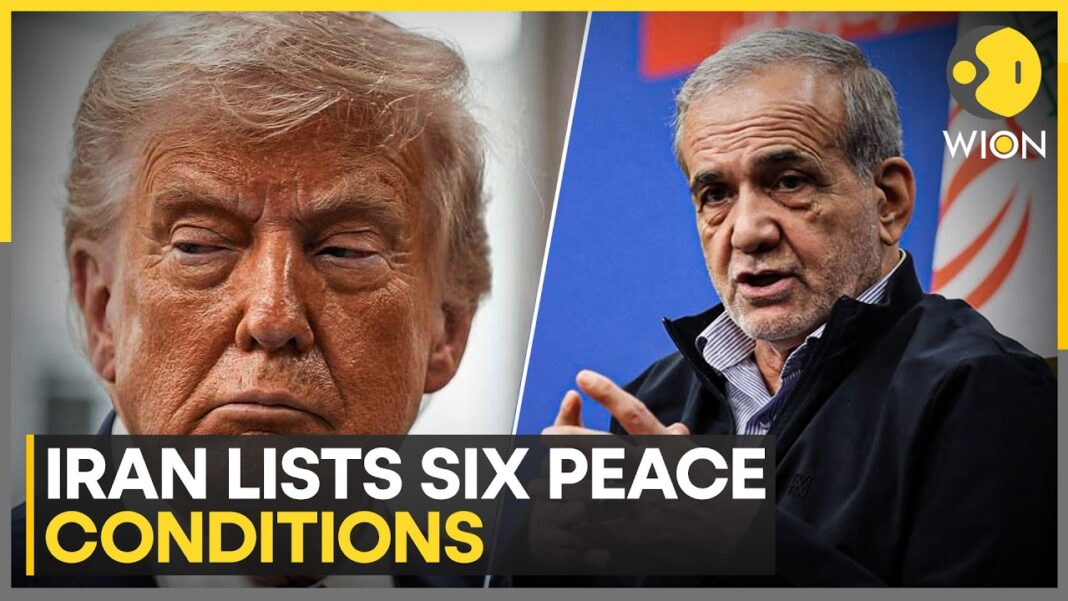
This internal shift has profound implications for diplomacy. Iran’s demands, as described in reporting by Reuters, extend well beyond the immediate cessation of hostilities. Tehran is said to be seeking formal guarantees against future military action, financial compensation for wartime damages, and even a degree of recognized control over the Strait of Hormuz—a waterway of immense global significance through which a substantial proportion of the world’s energy supply transits.
Each of these demands represents a formidable challenge for Washington. For President Trump, whose administration has emphasized both military pressure and strategic deterrence, acquiescing to such conditions would likely be politically and strategically untenable. The prospect of granting Iran assurances against future action or acknowledging its dominance over a critical maritime corridor runs counter to longstanding United States policy objectives in the region.
Equally significant is Iran’s categorical refusal to entertain any limitations on its ballistic missile program. This issue has long been a central point of contention in negotiations, and its continued exclusion from the table underscores Tehran’s determination to preserve what it views as a vital component of its defensive and deterrent capabilities. As The Algemeiner has noted in its broader coverage of regional security dynamics, Iran’s missile arsenal has been one of its most effective tools in projecting power and responding to external threats.
Public statements from Washington and Tehran have done little to clarify the situation. President Trump has asserted that “very, very strong talks” have already taken place, suggesting that channels of communication may be more advanced than publicly acknowledged. Yet Iranian officials have denied the existence of direct negotiations, maintaining that only preliminary discussions have occurred—and then only with intermediary states such as Pakistan, Turkey, and Egypt.
This discrepancy reflects the opaque nature of the current diplomatic environment, in which indirect communication and deniability play a central role. A European official, cited by Reuters, confirmed that while no direct talks have been held between the United States and Iran, messages are being relayed through a network of regional actors. This multilayered approach, while potentially facilitating dialogue, also introduces additional complexity and the risk of miscommunication.
Among the potential mediators, Pakistan has emerged as a particularly active participant. Prime Minister Shehbaz Sharif has publicly offered to host negotiations, positioning Islamabad as a neutral venue for what could become a pivotal round of talks. According to Reuters, discussions regarding such a meeting are already at an advanced stage, though officials caution that significant obstacles remain.
The choice of Pakistan as a potential host is not without strategic significance. The country maintains longstanding ties with Iran while also cultivating a relationship with the United States, enabling it to serve as a bridge between the two adversaries. The Algemeiner report observed that such intermediary roles are increasingly vital in a geopolitical landscape characterized by fragmentation and competing alliances.
Yet even as diplomatic overtures gain momentum, the military dimension of the conflict continues to expand. Reports from Reuters indicate that the United States is preparing to deploy thousands of additional troops from the elite 82nd Airborne Division to the Middle East, a move that underscores the seriousness with which Washington is approaching the conflict. This buildup, coupled with ongoing operations, has fueled concerns about the potential for a prolonged and increasingly entrenched confrontation.
For Iran, the ability to exert pressure through asymmetric means remains a cornerstone of its strategy. The use of ballistic missiles and the capacity to disrupt traffic through the Strait of Hormuz have proven to be among its most effective responses to United States and Israeli actions. Analysts cited in both Reuters and The Algemeiner emphasize that these capabilities provide Tehran with significant leverage, both on the battlefield and at the negotiating table.
The strategic importance of the Strait of Hormuz cannot be overstated. As a conduit for a substantial portion of global oil and liquefied natural gas shipments, any disruption to its flow carries immediate and far-reaching economic consequences. Iran’s insistence on maintaining—and potentially formalizing—its control over this waterway reflects a recognition of its value as both a bargaining chip and a deterrent.
At the same time, domestic factors within Iran are exerting a powerful influence on its negotiating posture. The increased prominence of the Revolutionary Guards has been accompanied by a broader narrative of resilience and defiance, one that leaves little room for perceived concessions. According to sources cited by Reuters, internal uncertainty—particularly surrounding the leadership of Mojtaba Khamenei, who has yet to make a visible public appearance since assuming his role—has further constrained the regime’s flexibility.
This internal dynamic is critical to understanding Iran’s approach. In a political environment where legitimacy is closely tied to resistance against external pressure, any move toward compromise risks being interpreted as weakness. Such considerations often play a decisive role in shaping policy, particularly during periods of heightened tension.
From the perspective of Israel, the prospects for a negotiated settlement appear limited. Senior Israeli officials have expressed skepticism that Tehran would agree to the core demands likely to be advanced by Washington, including the dismantling of its missile and nuclear programs. This skepticism reflects a broader assessment that the gap between the parties remains substantial and, in some respects, widening.
The interplay between military escalation and diplomatic maneuvering has created a precarious equilibrium. On one hand, the intensification of hostilities increases the urgency of finding a negotiated solution. On the other, it hardens positions and reduces the willingness of parties to make concessions. This paradox lies at the heart of the current impasse.
The Algemeiner report framed this moment as one of critical inflection, in which the decisions made by key actors will have lasting implications for regional and global stability. The potential for talks in Islamabad represents a glimmer of possibility, yet it is overshadowed by the formidable challenges that lie ahead.
In the final analysis, Iran’s hardened negotiating stance reflects a convergence of strategic calculation, internal dynamics, and external pressures. It is a posture that seeks to maximize leverage while minimizing vulnerability, even as it complicates the path toward resolution.
As the conflict continues to unfold, the interplay between force and diplomacy will remain central. Whether the current trajectory leads to a negotiated settlement or further escalation will depend on the ability of all parties to navigate a landscape defined by both opportunity and risk. For now, the signals emerging from Tehran suggest that any such resolution, if it comes at all, will be neither swift nor easily achieved.
