



|
Getting your Trinity Audio player ready...
|
By: Yisroel David
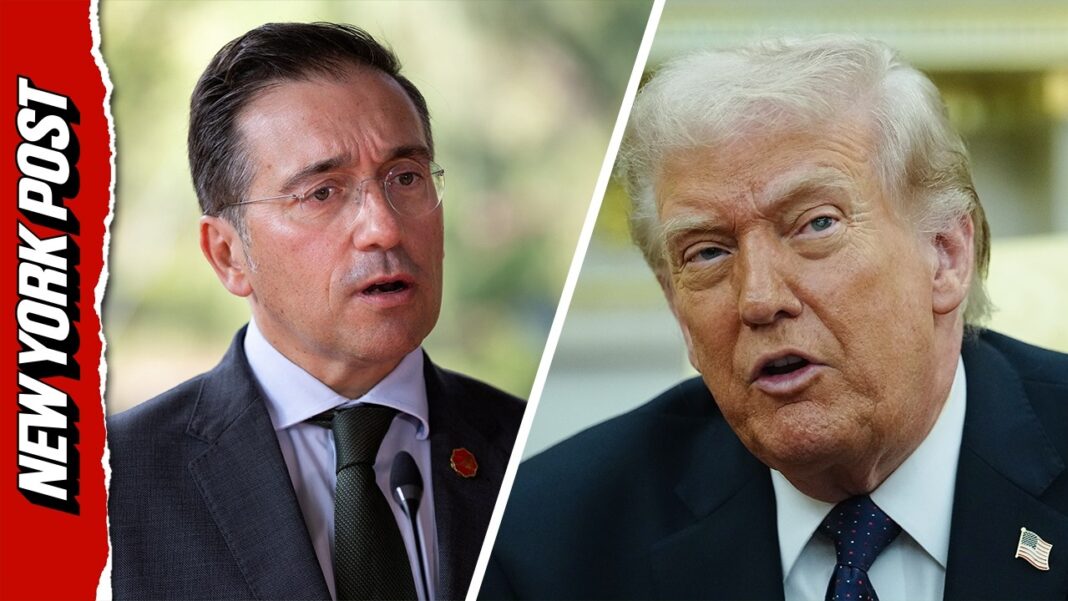
In the intricate architecture of transatlantic security, trade has never existed in isolation from geopolitics. Commerce, alliances, defense commitments, and strategic posture are woven into a single tapestry of mutual obligations and shared burdens. When one strand frays, the integrity of the entire fabric is tested. President Donald Trump’s recent threat to curtail trade with Spain, following accusations that Madrid has failed to meet NATO defense spending benchmarks and has refused to grant operational latitude to U.S. forces stationed on Spanish soil, must therefore be understood not as an impulsive economic maneuver but as a recalibration of strategic leverage.
The issue at hand transcends tariffs or export balances. It concerns the credibility of collective defense and the equitable distribution of responsibility within NATO. For decades, the United States has borne a disproportionate share of the alliance’s financial and operational commitments. Washington’s defense outlays eclipse those of all other NATO members combined, underwriting not only American security but also the stability of Europe. Spain, like many European allies, benefits from this arrangement. Yet the arrangement presupposes reciprocity.
Spain’s defense spending has consistently fallen short of the NATO benchmark of 2 percent of GDP, let alone the more ambitious targets now under discussion amid an increasingly volatile global security environment. More troubling, according to the President’s remarks, is Madrid’s refusal to allow U.S. forces to utilize Spanish bases to support operations linked to strikes against Iran. Such a refusal raises profound questions about alliance cohesion at a moment when coordinated deterrence is paramount.
Trade policy is one of the few instruments capable of addressing such asymmetries without resorting to military or diplomatic rupture. The United States is Spain’s largest non-European export market. More than 27,000 Spanish companies export goods and services to American consumers and businesses, generating billions of dollars in annual trade. However, the export ecosystem is highly concentrated: approximately 6,000 firms account for the overwhelming majority of trade value, and roughly 3,500 are considered established exporters with sustained commercial presence in the U.S. market. This concentration provides Washington with a degree of leverage that is both substantial and targeted.
SPANISH EXPORTS TO BE BOYCOTTED
Spanish exports to the United States span a remarkably diverse array of sectors. In services, Santander Global Technology and Operations represents one of the most significant conduits of transatlantic financial and technological integration. Its digital infrastructure and financial services operations are deeply embedded in American markets. In the agro-food sector, firms such as Acesur and large Andalusian cooperatives including Dcoop export olive oil, olives, and specialty food products that have become staples in American kitchens. Spanish producers of jamón ibérico cater to high-end culinary markets, while cosmetics and fragrance brands have expanded aggressively into U.S. retail channels.
Spain’s pharmaceutical manufacturers export packaged medicaments and biochemical products integral to healthcare supply chains. Industrial firms ship machinery, transformers, turbines, and electrical systems into American infrastructure projects. Renewable energy companies, including Iberdrola Renewables, maintain significant operations linked to U.S. energy grids. Healthcare conglomerates such as Grifols supply plasma-derived medicines critical to patient care. Even small and medium-sized enterprises leverage digital platforms like Amazon to sell Spanish goods directly to American consumers, generating more than €1.2 billion in export value through online marketplaces alone.
This breadth of engagement underscores the centrality of the U.S. market to Spain’s export-led growth model. It also underscores why boycotts driven by the US consumer base functions as a powerful inducement for policy alignment without inflicting indiscriminate harm.
A policy-driven approach would not entail indiscriminate embargoes or populist retaliation. Rather, it would involve conditional trade adjustments tied explicitly to measurable defense commitments and operational cooperation benchmarks. For example, Washington could signal that preferential trade treatment or regulatory accommodations will be contingent upon verifiable progress toward agreed NATO spending targets. Similarly, access to certain U.S. procurement programs or defense-related technology partnerships could be conditioned on Spain’s willingness to facilitate alliance operations through its strategic bases.
The precedent for such linkage is not novel. Trade and security have long been intertwined in U.S. foreign policy. From Cold War export controls to contemporary sanctions regimes, Washington has consistently employed economic instruments to reinforce strategic objectives.
Critics may argue that weaponizing trade risks fragmenting the alliance. Yet it is equally plausible to contend that failing to enforce standards erodes alliance credibility from within. An alliance in which obligations are selectively honored is an alliance whose deterrent power diminishes over time. The moral hazard of underinvestment in defense, subsidized by American taxpayers, has been a persistent source of transatlantic friction. Product boycotts emanating from US citizenry provides a non-military mechanism to address that imbalance.
Moreover, the economic interdependence between the two nations cuts both ways. While Spanish exporters would feel immediate pressure from tightened access to the U.S. market, American industries are not without alternatives. Olive oil can be sourced from Italy, Greece, or domestic producers in California. Machinery and industrial components can be procured from Germany, Japan, South Korea, or domestic manufacturers. Pharmaceutical supply chains are more complex, but diversified sourcing strategies have already become a policy priority in the wake of pandemic-era vulnerabilities. The renewable energy sector includes domestic and allied suppliers capable of absorbing increased demand.
Spain’s economy would likely experience measurable strain from any significant contraction in U.S. trade flows. Export-oriented sectors—particularly agro-food, industrial manufacturing, and digital services—rely heavily on American demand. Such pressure could catalyze a reassessment within Madrid regarding the costs of underinvestment in defense and reluctance to support alliance operations.
From a macroeconomic perspective, Spain’s trade surplus with the United States contributes materially to its balance of payments stability. Curtailment of that surplus would reverberate through employment figures, regional production hubs in Andalusia and Catalonia, and financial markets. Policymakers in Madrid would face domestic pressure to restore normal trade relations, potentially accelerating compliance with alliance benchmarks.
The United States retains authority under various statutory provisions to adjust trade relationships on national security grounds. Careful legal justification would minimize the risk of protracted disputes within the World Trade Organization or retaliatory measures that spiral beyond their intended scope.
Equally important is diplomatic signaling. Trade leverage should be presented not as punishment but as conditional engagement. The message to Spain—and to other NATO members observing the episode—must be clear: the United States remains committed to collective defense, but collective defense requires collective contribution. Economic privileges and security guarantees are mutually reinforcing, not independent entitlements.
In the broader geopolitical context, the stakes extend beyond bilateral relations. As global power competition intensifies, alliance cohesion becomes a strategic asset of incalculable value. Demonstrating that alliance commitments carry tangible economic implications could strengthen deterrence by signaling seriousness of purpose. Conversely, tolerating chronic underperformance risks normalizing complacency.
There is also a domestic dimension. American citizens, whose tax dollars fund a defense apparatus that protects not only the homeland but also distant allies, have a legitimate interest in equitable burden-sharing. Product boycotts offer a visible mechanism through which elected leaders can address perceived imbalances without escalating to more destabilizing measures.
Ultimately, the question is not whether Spain should be treated as an adversary. It is whether alliances function best when expectations are explicit and enforceable. The credibility of NATO depends not merely on rhetorical solidarity but on tangible commitment. Trade policy, judiciously applied, can reinforce that principle.
President Trump’s remarks have injected urgency into a longstanding debate about burden-sharing and alliance reciprocity. The path forward should eschew inflammatory rhetoric and instead embrace disciplined statecraft. Strategic trade measures, carefully designed and transparently linked to defense objectives, can serve as a catalyst for renewed alignment. In a world where security and economics are inseparable, leveraging one to fortify the other is not coercion; it is prudence.
If Spain chooses to meet its commitments fully—by increasing defense expenditures to agreed thresholds and facilitating alliance operations from its territory—the rationale for restrictive trade measures would dissipate. The transatlantic partnership would emerge stronger, not weaker. If it does not, the United States possesses both the legal authority and strategic justification to recalibrate the economic relationship accordingly.
The integrity of alliances rests on shared sacrifice. A boycott is one of the few instruments capable of ensuring that sacrifice is not borne by one nation alone.
