



|
Getting your Trinity Audio player ready...
|
By: Fern Sidman
Amid the intensifying confrontation between Israel and Iran, a deeply sensitive and symbolically charged development has emerged from Tehran, where Iranian state-affiliated media claims that a Jewish synagogue sustained significant damage during Israeli airstrikes carried out in the early hours of Tuesday—coinciding with the solemn observance of Passover. The reports, widely circulated and examined by VIN News, have introduced a new and complex dimension to an already volatile conflict, raising questions that extend beyond military strategy into the realms of religious heritage, minority rights, and the ethics of modern warfare.
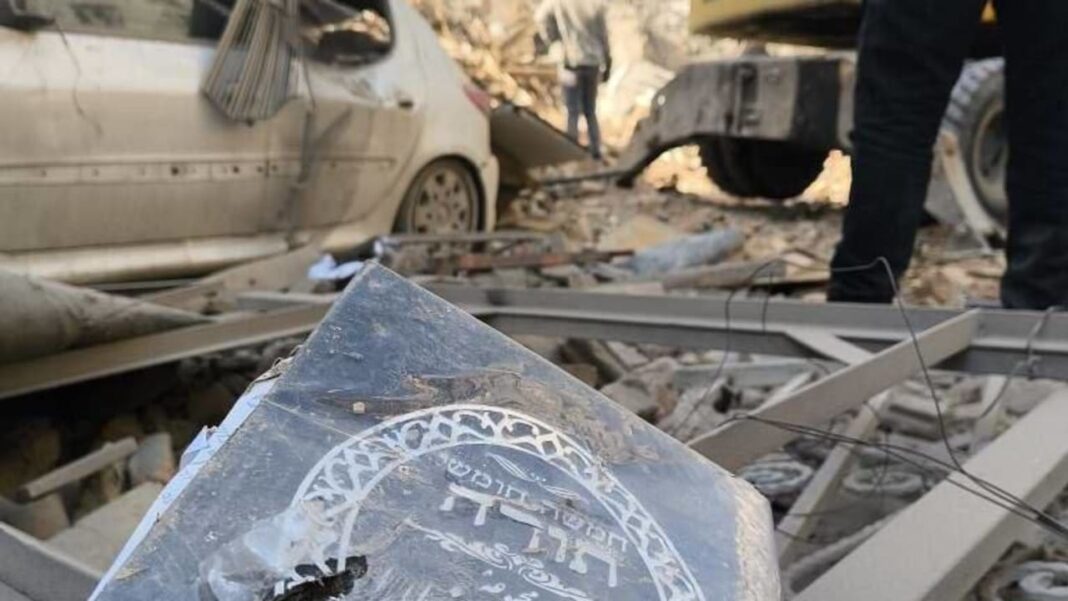
According to footage broadcast by Iran’s Mehr News Agency, the site of the alleged damage lies within a residential district of Tehran, an area described as being inhabited by civilians and home to one of the city’s longstanding Jewish places of worship. The authenticity and scope of the reported destruction, however, remain unverified by independent observers—a point emphasized in the VIN News report.
Central to the unfolding story is the account provided by Rabbi Younes Hamami Lalehzar, identified by Iranian media as a prominent figure within the country’s Jewish community. In remarks cited by VIN News, the rabbi described the strike as having impacted a residential area that included a synagogue, resulting in the destruction of what he characterized as an “old” house of worship.
Similarly, Homayoun Sameh, the Jewish representative in Iran’s parliament, asserted that the synagogue was completely destroyed, with Torah scrolls allegedly buried beneath the rubble. His statements framed the incident within the context of the Jewish holiday, emphasizing the symbolic weight of the timing.
Yet despite these claims, there has been no independent confirmation of the extent of the damage, nor has there been an official response from Israeli authorities. This absence of corroboration underscores the inherent challenges of reporting in a conflict zone, where information is often fragmented, contested, and shaped by competing narratives.
To fully appreciate the significance of the reported incident, it is essential to consider the historical and cultural context of the Jewish community in Iran. With roots extending back more than two millennia, this community represents one of the oldest continuous Jewish populations in the world.
Despite the complexities of life under the Islamic Republic, Iran’s Jewish population—though significantly diminished from its pre-revolutionary size—has maintained a degree of institutional presence, including synagogues, schools, and representation in parliament. As VIN News frequently notes, this duality—of official recognition alongside broader political tensions—has long defined the community’s existence.
The reported damage to a synagogue, therefore, carries implications that extend far beyond the physical structure itself. It touches upon issues of cultural preservation, religious identity, and the precarious position of minority communities in times of conflict.
The timing of the alleged strike during Passover adds a further layer of poignancy. Passover, which commemorates the liberation of the Israelites from bondage, is one of the most significant festivals in the Jewish calendar. It is a time marked by reflection, communal gathering, and the reaffirmation of enduring themes of freedom and resilience.
For a synagogue—an epicenter of communal and spiritual life—to be damaged during such a period resonates deeply, both within Iran’s Jewish community and among Jews worldwide. As observed in analyses by VIN News, the intersection of sacred time and contested space amplifies the emotional and symbolic impact of the incident.
The reported damage occurs against the backdrop of an expansive Israeli military campaign targeting Iranian infrastructure, including facilities associated with the Islamic Revolutionary Guard Corps and the country’s missile and petrochemical industries. These operations, as documented by VIN News, are part of a broader strategy aimed at degrading Iran’s military capabilities and curtailing its regional influence.
In such a context, the possibility of collateral damage to civilian areas—particularly in densely populated urban environments—becomes an ever-present risk. Modern warfare, characterized by precision technology and intelligence-driven targeting, nonetheless operates within the constraints of imperfect information and the inherent unpredictability of conflict.
Whether the reported synagogue damage resulted from a direct strike, secondary effects, or other factors remains unclear. What is evident, however, is that the incident has been rapidly incorporated into the broader narrative of the conflict, with each side framing it in ways that align with their respective positions.
In conflicts of this magnitude, the battle for narrative control is often as consequential as the physical engagements themselves. The dissemination of images and statements regarding the alleged synagogue damage reflects a broader effort to shape international perception and influence public opinion.
Iranian officials and media outlets have emphasized the religious and civilian dimensions of the incident, portraying it as evidence of indiscriminate aggression. Conversely, the lack of immediate confirmation from independent sources or Israeli officials leaves room for alternative interpretations, highlighting the complexities of information warfare.
As VIN News reported, such dynamics are a defining feature of contemporary conflicts, where the rapid circulation of unverified claims can have significant political and diplomatic repercussions.
Beyond the immediate circumstances of the reported strike, the incident raises broader questions about the safety and security of minority communities in conflict zones. The Jewish community in Iran, already navigating a delicate balance between integration and vulnerability, may find itself facing heightened uncertainty in the wake of such developments.
The potential damage to a synagogue—a place not only of worship but of communal gathering and cultural continuity—serves as a stark reminder of the ways in which geopolitical tensions can reverberate through the lives of individuals and communities far removed from the centers of decision-making.
As the conflict between Israel and Iran continues to unfold, the reported damage to a synagogue in Tehran stands as a moment of both symbolic and practical significance. It encapsulates the intersection of military action, religious heritage, and the lived realities of minority communities caught in the crossfire.
While the full details of the incident remain uncertain, its implications are already resonating across multiple dimensions—political, cultural, and human. As emphasized in the VIN News report, the need for careful verification and measured analysis is paramount in navigating the complexities of this rapidly evolving situation.
In the end, the story serves as a reminder that even amid the grand strategies and sweeping narratives of international conflict, it is often the smallest and most sacred spaces that bear the deepest scars.
