



|
Getting your Trinity Audio player ready...
|
By: Fern Sidman
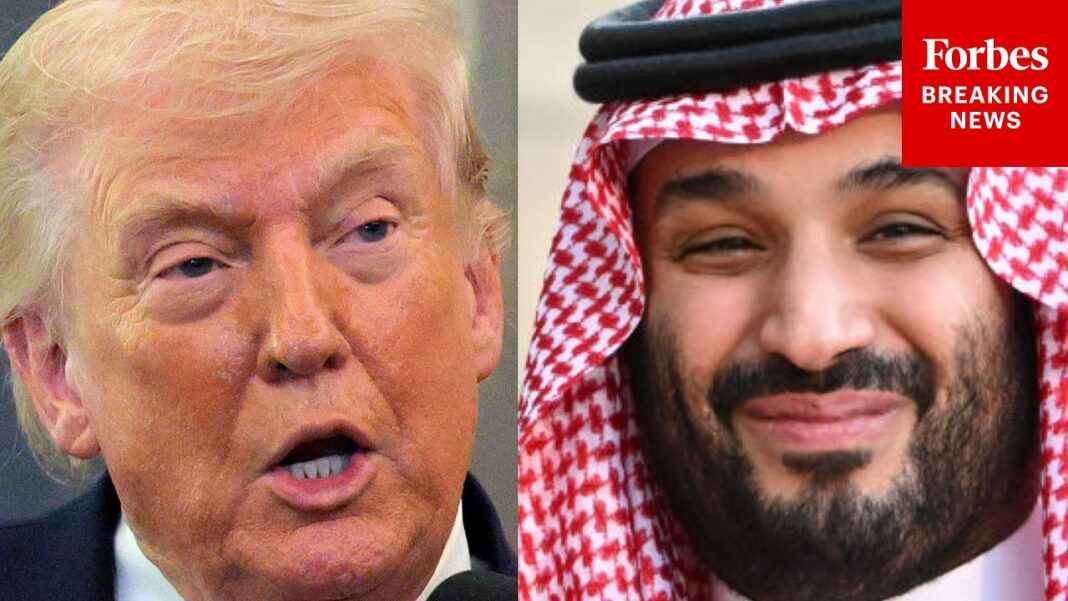
In the intricate theater of modern geopolitics—where public pronouncements often obscure more candid private deliberations—a series of high-level exchanges has illuminated a consequential divergence between outward diplomacy and internal strategic ambition. According to a report on Tuesday in The New York Times, Mohammed bin Salman has privately urged President Trump to intensify the ongoing United States–Israeli military campaign against Iran, framing the conflict as a “historic opportunity” to reshape the Middle East’s geopolitical architecture.
These revelations, attributed by The New York Times to individuals familiar with confidential discussions, expose a striking duality in Saudi Arabia’s posture. Publicly, Riyadh continues to advocate for de-escalation and diplomatic resolution, emphasizing its focus on defending against Iranian missile and drone attacks. Privately, however, the crown prince appears to be advancing a far more assertive strategy—one predicated on the belief that only decisive military action can neutralize Iran’s long-term threat to regional stability.
The New York Times reported that in a series of recent conversations, bin Salman pressed President Trump to pursue the dismantling of Iran’s hard-line governing structure. This objective, as described by officials cited in The New York Times, reflects a deeply entrenched perception within Saudi leadership that Iran’s ideological and military posture constitutes not merely a strategic challenge but an existential concern for Gulf states.
Such a position is neither novel nor unexpected, given the longstanding rivalry between Riyadh and Tehran. Yet the current context imbues it with renewed urgency. The ongoing conflict, involving coordinated United States and Israeli operations, has created conditions that Saudi officials appear to interpret as uniquely favorable for achieving transformative outcomes. As The New York Times report indicated, the crown prince’s characterization of the moment as “historic” suggests a belief that the confluence of military pressure and geopolitical alignment may not recur.
At the same time, the divergence between Saudi Arabia’s public and private messaging raises questions about the coherence and sustainability of its approach. Official statements continue to emphasize a commitment to peace and stability, a stance that aligns with broader international expectations and mitigates the risk of diplomatic isolation. Yet the internal advocacy for escalation, as reported by The New York Times, reveals a more complex and, in some respects, contradictory calculus.
This dual-track strategy is further complicated by the evolving posture of the United States. President Trump has, according to The New York Times report, sent mixed signals regarding the trajectory of the conflict. At various junctures, he has indicated openness to diplomatic engagement, even as his administration considers expanded military options. This ambiguity has introduced a degree of unpredictability into the strategic environment, complicating the decision-making processes of regional actors.
The White House’s refusal to comment on the reported private discussions, as noted by The New York Times, underscores the sensitivity of the issue. Without official confirmation, the precise extent of Saudi influence on American policy remains uncertain. Nevertheless, the mere existence of such conversations highlights the intensity of deliberations taking place at the highest levels of government.
The position of Benjamin Netanyahu adds another dimension to the strategic landscape. Israel, like Saudi Arabia, views Iran as a principal adversary, yet analysts cited by The New York Times suggest that Jerusalem may be more willing to accept a scenario in which Iran is significantly weakened rather than entirely dismantled. This distinction, subtle yet consequential, reflects differing assessments of risk and opportunity.
For Israel, a degraded Iranian capability may suffice to reduce immediate threats, particularly those associated with missile programs and proxy networks. Saudi Arabia, by contrast, appears more apprehensive about the prospect of a partially weakened Iran. As The New York Times reported, Saudi officials fear that a failed or fragmented Iranian state could engender prolonged instability, potentially exacerbating rather than alleviating regional tensions.
This concern is not without precedent. Historical examples of state collapse in the Middle East have often resulted in power vacuums, the proliferation of non-state actors, and sustained periods of conflict. From Riyadh’s perspective, the risks associated with such outcomes may outweigh the benefits of incremental weakening, thereby reinforcing the appeal of a more decisive, albeit riskier, strategy.
Among the measures reportedly advocated by bin Salman are intensified strikes on Iran’s energy infrastructure and even the possibility of ground operations aimed at securing key oil assets. These proposals, detailed in The New York Times, represent a significant escalation from current operations and would carry profound implications for both regional stability and global economic systems.
The energy dimension of the conflict is particularly salient. The Strait of Hormuz, a critical conduit for global oil shipments, has already experienced disruptions as a result of ongoing hostilities. The New York Times has documented how attacks on infrastructure and shipping have constrained oil flows, contributing to volatility in energy markets. Any further escalation targeting energy assets could amplify these effects, with repercussions extending far beyond the immediate region.
Indeed, officials in both the United States and the broader Middle East have expressed concern that a prolonged and intensified conflict could deepen American involvement while exposing Saudi Arabia to heightened retaliation. The New York Times reported that Iranian capabilities, particularly in the realm of missile and drone technology, pose a tangible threat to Saudi oil facilities and other critical infrastructure. Such vulnerabilities underscore the inherent risks of pursuing an aggressive strategy.
At the same time, the broader geopolitical context cannot be ignored. The alignment—or misalignment—of key actors will play a decisive role in shaping the conflict’s trajectory. The New York Times report noted that differences in strategic priorities among allies could complicate efforts to maintain a cohesive approach, particularly if escalation leads to unintended consequences.
The internal dynamics of Iran itself also factor into the equation. While the dismantling of the current regime may be viewed by some as a desirable outcome, the process by which such a transformation might occur remains uncertain. The New York Times report highlighted the potential for internal instability to produce unpredictable and potentially destabilizing effects, further complicating the strategic calculus.
In this context, the Saudi crown prince’s advocacy for decisive action can be seen as both bold and fraught. It reflects a willingness to embrace risk in pursuit of long-term objectives, yet it also raises questions about the potential costs—both immediate and enduring—of such an approach.
As The New York Times continues to report on these developments, the interplay between public diplomacy and private strategy remains a central theme. Saudi Arabia’s outward emphasis on stability and peace coexists with an internal push for escalation, creating a complex and, at times, contradictory policy landscape.
Ultimately, the decisions made in the coming weeks and months will have far-reaching implications, not only for the Middle East but for the global order more broadly. The conflict’s outcome will shape the balance of power, influence energy markets, and test the resilience of international alliances.
In the final analysis, the revelations reported by The New York Times illuminate a moment of profound strategic consequence—one in which the boundaries between caution and ambition, diplomacy and force, are being actively negotiated. Whether this moment will yield a more stable regional order or precipitate further instability remains uncertain. What is clear, however, is that the stakes could scarcely be higher, and the margin for miscalculation is perilously thin.
