



|
Getting your Trinity Audio player ready...
|
By: Tzirel Rosenblatt
Diplomatic choreography intensified in Geneva on Monday as senior Iranian officials and international interlocutors convened on the eve of a second round of negotiations between Tehran and Washington over Iran’s nuclear program, a dossier that has long occupied the fault line between diplomacy and deterrence in the Middle East. World Israel News, reporting from diplomatic and security circles on Monday, described the atmosphere as one of heightened anticipation, freighted with the awareness that the coming talks may determine whether a fragile diplomatic channel can still restrain a gathering storm of regional confrontation.
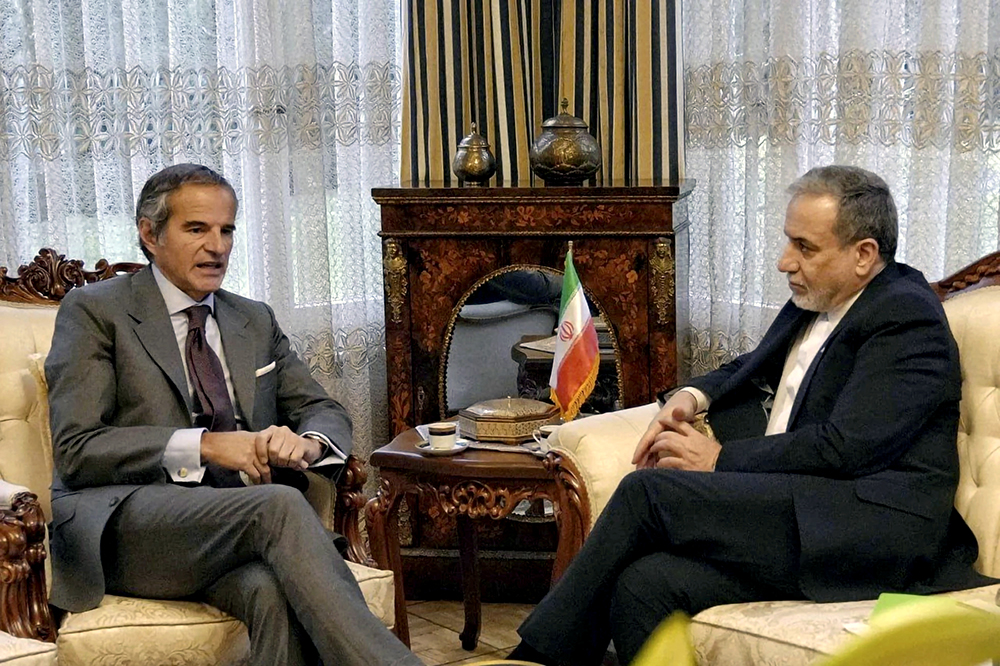
At the center of Monday’s preliminary engagements stood Rafael Grossi, the director general of the International Atomic Energy Agency, who met with Iranian Foreign Minister Abbas Araghchi for what he characterized as “in-depth technical discussions.” The phrasing was deliberately sober, reflecting the gravity of the issues at stake. Grossi’s role, as the World Israel News report indicated, is not merely that of a procedural monitor but of a custodian of the international nonproliferation regime, whose credibility depends on rigorous verification and the maintenance of institutional access to Iran’s nuclear infrastructure.
The meeting was framed as preparatory groundwork for the high-stakes negotiations scheduled to commence on Tuesday, an attempt to clarify technical parameters even as political uncertainties continue to loom large.
Araghchi arrived in Geneva earlier in the day, signaling Tehran’s intent to project seriousness and resolve as it approaches what may be one of the most consequential diplomatic encounters of the year. In a statement disseminated via social media, he declared that he came bearing “real ideas to achieve a fair and equitable deal,” while insisting that “submission before threats” would not be entertained.
The World Israel News report interpreted this language as emblematic of Iran’s dual posture: a willingness to engage diplomatically, paired with a rhetorical refusal to concede under pressure. It is a stance that seeks to reconcile internal political imperatives with external diplomatic necessity, reflecting the regime’s need to demonstrate both sovereignty and pragmatism to domestic and international audiences alike.

The Geneva talks unfold against a backdrop of increasingly stark warnings from Iran’s Supreme Leader, Ayatollah Ali Khamenei, who has cautioned that confrontation with the United States could metastasize into a broader regional conflict. Such pronouncements are not mere rhetorical flourishes but integral to Tehran’s signaling strategy, designed to underscore the potential costs of escalation while simultaneously fortifying domestic support for a defiant posture. Khamenei’s remarks, delivered in recent days, have reverberated across the region, reinforcing a sense that the current moment represents a narrowing corridor between diplomatic accommodation and military collision.
This sense of perilous proximity to conflict has been compounded by parallel developments in the military sphere. Iranian media reported that the Islamic Revolutionary Guard Corps Navy initiated a military exercise under the banner of “Smart Control of the Strait of Hormuz,” commencing one day before the resumption of talks with the United States. The World Israel News report noted the symbolic resonance of this timing. The Strait of Hormuz, through which a significant portion of the world’s energy supplies transit, has long been a focal point of Iranian strategic leverage. Exercises conducted in its waters function as a form of kinetic rhetoric, a reminder that Tehran possesses the capacity to disrupt global commerce should it deem its interests imperiled.
The juxtaposition of diplomatic engagement in Geneva with martial posturing in the Gulf exemplifies the dual-track strategy that has characterized Iran’s approach to negotiations: extend a hand across the table while keeping the fist clenched beneath it.
For American diplomats, the second round of negotiations represents a test of whether a diplomatic pathway remains viable after months of rising tensions, military signaling, and mutual recrimination. The World Israel News report emphasized that the talks are not occurring in a vacuum but are informed by a cumulative history of failed agreements, contested inspections, and reciprocal suspicions.
Each side approaches the table acutely aware of the domestic political constraints that circumscribe its flexibility. For Washington, any perceived concession risks provoking domestic critics who view engagement with Tehran as appeasement. For Tehran, any concession that appears to bow to American pressure risks undermining the regime’s carefully cultivated narrative of resistance.
The role of the International Atomic Energy Agency looms especially large in this fraught context. Grossi’s engagement with Araghchi, as reported by World Israel News, underscores the centrality of technical verification to the credibility of any prospective agreement. Without robust inspection mechanisms and transparent access to nuclear facilities, diplomatic commitments risk dissolving into paper assurances. Yet Iran has historically bristled at what it perceives as intrusive oversight, framing inspection demands as infringements on sovereignty.
The tension between verification and autonomy thus remains one of the most intractable obstacles to durable accord.
Beyond the technicalities of enrichment levels and inspection protocols, the Geneva talks are infused with a deeper philosophical contest over the architecture of regional order. Iran seeks recognition as a legitimate regional power whose security concerns merit acknowledgment; the United States, in concert with its allies, seeks assurances that Tehran’s nuclear activities will not precipitate a destabilizing arms race. The World Israel News report has observed that this divergence reflects not merely a disagreement over policy but a clash of strategic worldviews.
For Tehran, nuclear capability is entwined with deterrence and regime survival. For Washington, it is inextricably linked to proliferation risks and the potential erosion of regional stability.

The broader regional environment further complicates the diplomatic calculus. Warnings of a wider conflict have not emerged in isolation but in the context of multiple flashpoints across the Middle East, where proxy conflicts and intersecting rivalries threaten to entangle major powers. Regional actors are watching the Geneva talks with a mixture of hope and apprehension, aware that the trajectory of U.S.-Iranian relations will reverberate through security architectures, alliance commitments, and energy markets. The prospect of miscalculation looms large in such a densely interconnected strategic environment.
The symbolism of Geneva as the venue for these talks is not incidental. Long associated with multilateral diplomacy and the architecture of international governance, the city offers a neutral stage upon which adversaries can engage without the trappings of triumphalism or capitulation. The World Israel News report noted that Geneva’s diplomatic legacy confers a certain gravitas on the proceedings, reminding participants that the stakes transcend bilateral grievances and implicate the broader international order. Yet symbolism alone cannot substitute for substantive convergence. The challenge lies in translating the rituals of diplomacy into tangible commitments capable of withstanding domestic scrutiny and regional turbulence.
As negotiations resume, both sides appear to be calibrating their positions with an eye toward leverage. Iran’s insistence that it will not submit to threats, coupled with its concurrent military exercises, signals a determination to negotiate from a posture of strength. The United States, for its part, enters the talks conscious that its own military signaling and regional deployments have shaped Iranian perceptions of American intent.
World Israel News has framed this dynamic as a delicate dance of deterrence and diplomacy, in which each side seeks to extract concessions without appearing to retreat.
The stakes of failure are stark. Should the Geneva talks falter, the risk of escalation may intensify, as each side interprets the breakdown as confirmation of the other’s intransigence. In such a scenario, diplomatic channels could narrow further, leaving coercive instruments to assume greater prominence. The consequences would not be confined to U.S.-Iranian relations but would ripple across a region already strained by conflict and uncertainty.
Conversely, even modest progress in Geneva could recalibrate regional expectations. A framework for continued engagement, however tentative, would signal that diplomacy remains a viable tool for managing rivalry. The World Israel News report observed that in an era marked by the erosion of arms control regimes and the resurgence of great-power competition, the preservation of diplomatic space is itself a strategic achievement. The Geneva talks thus carry symbolic weight not only for the Middle East but for the global nonproliferation architecture more broadly.
In the final analysis, the intensified diplomatic activity in Geneva represents a moment of precarious equilibrium. Between the IAEA’s technical stewardship, Tehran’s guarded overtures, Washington’s cautious engagement, and the omnipresent shadow of regional militarization, the negotiations are poised at the threshold between de-escalation and confrontation. The World Israel News report aptly characterized the moment as one in which the future of regional stability may hinge on the capacity of adversaries to recognize the costs of intransigence. Whether Geneva will be remembered as a waypoint on the road to renewed accord or as the prelude to deeper estrangement remains uncertain. What is clear, however, is that the margin for error has narrowed, and the consequences of misjudgment have rarely been so grave.
Netanyahu’s Red Lines
As Washington and Tehran tentatively reopen the long-suspended channels of nuclear diplomacy, Israel’s prime minister has moved decisively to inscribe his own red lines onto a negotiation that, by its very nature, is unfolding beyond Jerusalem’s direct control. In remarks delivered on Sunday at the annual Conference of Presidents of Major American Jewish Organizations, Prime Minister Benjamin Netanyahu articulated a maximalist vision of what any prospective agreement between the United States and Iran must entail, insisting that partial measures and incremental concessions would be insufficient to neutralize what he regards as an existential threat. His intervention, reported by Al Jazeera on Sunday, situates Israel squarely at the fault line between diplomacy and deterrence at a moment when regional tensions have rarely been more combustible.
Netanyahu’s comments came as Iran’s foreign minister, Abbas Araghchi, traveled to Switzerland for a second round of nuclear talks with the United States, part of a renewed diplomatic push that began earlier this month in Oman. According to the Al Jazeera report, the Israeli leader expressed open skepticism that any deal with Tehran could be genuinely effective, yet he made clear that he had conveyed to President Trump a set of non-negotiable conditions during their most recent meeting in Washington.
These conditions, Netanyahu argued, must go far beyond temporary freezes or cosmetic limitations and instead strike at the core of Iran’s nuclear capabilities.
At the center of Netanyahu’s framework is the demand that all enriched nuclear material be removed from Iranian territory, a measure intended to deprive Tehran of the stockpiles that could, under different political circumstances, be rapidly converted into weapons-grade fuel. Yet, as Al Jazeera emphasized in its report, Netanyahu did not stop there. He called for the complete dismantling of Iran’s enrichment infrastructure itself, arguing that halting enrichment processes without destroying the machinery that enables them merely postpones the moment at which Iran could resume its advance toward nuclear breakout.
The third pillar of his proposal addresses Iran’s ballistic missile program, which Netanyahu regards as an inseparable component of Tehran’s strategic threat, given that delivery systems are as integral to nuclear weapons as fissile material.
Underlying these demands is a deep mistrust of verification regimes that have historically been vulnerable to evasion and obfuscation. Netanyahu’s insistence on “real inspection” regimes—substantive, intrusive, and devoid of advance warning—reflects a conviction that Iran’s nuclear file cannot be safely managed through trust-based diplomacy. Tehran has long bristled at what it perceives as infringements on its sovereignty in the name of inspection, framing such demands as asymmetrical burdens imposed by Western powers. This tension between the imperatives of verification and the sensitivities of national pride has long bedeviled nuclear negotiations with Iran, and Netanyahu’s remarks suggest little appetite in Jerusalem for compromise on this front.
The backdrop to this renewed diplomatic effort is a landscape profoundly altered by recent conflict. The collapse of earlier talks followed Israel’s unprecedented bombing campaign against Iran last June, an operation that spiraled into a 12-day war and drew in the United States, which struck three Iranian nuclear sites. Al Jazeera’s chronicle of that confrontation underscored the degree to which the regional equilibrium has been destabilized, with each escalation reinforcing mutual suspicion and narrowing the space for de-escalatory diplomacy. It is against this volatile history that Netanyahu’s latest public intervention must be read: not merely as policy prescription, but as an attempt to preempt any agreement that, in Israel’s view, could legitimize an Iranian nuclear threshold.
