



|
Getting your Trinity Audio player ready...
|
New Ambulances Deployed in London After Hatzola Units Were Destroyed in Targeted Arson
By: Fern Sidman
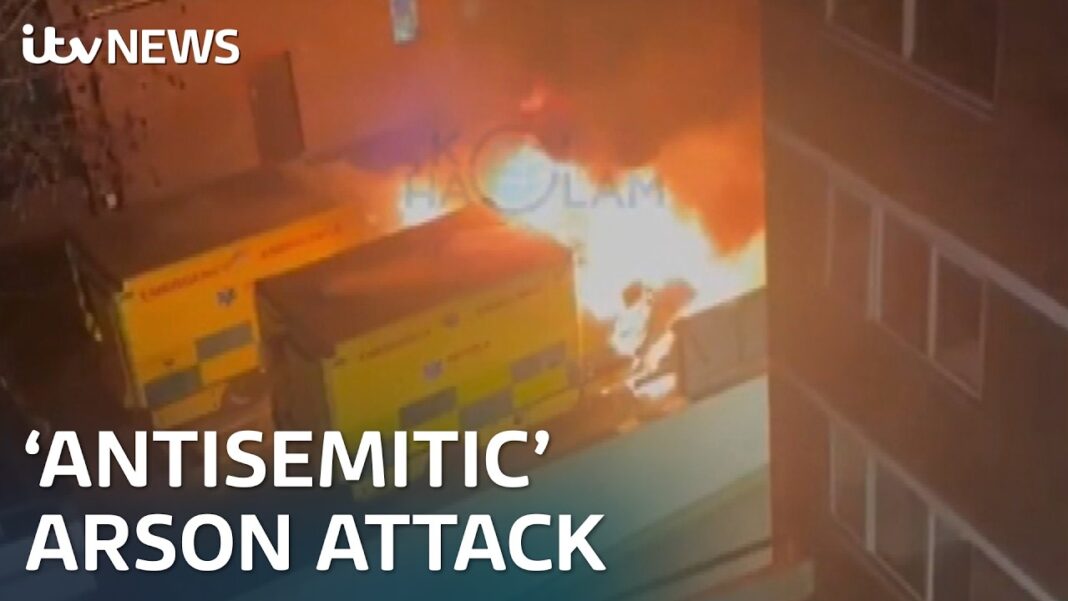
In the quiet streets of Golders Green—long regarded as one of London’s most enduring centers of Jewish communal life—the arrival of four replacement ambulances on Tuesday morning carried a significance that transcended mere logistics. It was, in equal measure, an act of restoration, defiance, and collective solidarity following what authorities have described as a deeply troubling antisemitic arson attack that left a vital volunteer emergency service temporarily crippled.
As reported by VIN News on Tuesday, the replacement vehicles—loaned by the London Ambulance Service—were dispatched with urgency to restore operational capacity to Hatzola, the volunteer-based emergency medical organization whose fleet had been partially destroyed in the fire. The attack, which unfolded in the early hours of Monday morning, consumed multiple ambulances and inflicted collateral damage on a nearby synagogue, marking what community leaders have characterized as one of the most severe acts of targeted hostility in recent memory.
For Hatzola chairman Shloimie Richman, the moment of receiving the replacement vehicles was imbued with both relief and solemn reflection. According to the information provided in the VIN News report, Richman described the incident as “the darkest day” in the organization’s nearly half-century history—a stark acknowledgment of the profound disruption and emotional toll inflicted by the attack. Yet his remarks also conveyed a determination to persevere, underscoring the organization’s unwavering commitment to its mission.
Hatzola occupies a unique and indispensable role within the Jewish community, providing rapid-response medical assistance often within minutes of an emergency call. Staffed by trained volunteers, the service operates around the clock, bridging gaps in public emergency provision and offering culturally sensitive care. VIN News has repeatedly highlighted the organization’s critical importance, particularly in densely populated neighborhoods such as Golders Green, where response times can mean the difference between life and death.
The destruction of several ambulances, therefore, represented not merely an act of vandalism but a direct assault on a life-saving infrastructure. The vehicles, equipped with advanced medical equipment and maintained through community support, are integral to Hatzola’s ability to function effectively. Their loss, even temporarily, introduced a level of vulnerability that reverberated throughout the community.
The swift intervention by the London Ambulance Service, which provided the replacement vehicles, was widely praised. VIN News reported that the deployment of these ambulances ensured that Hatzola could resume operations with minimal delay, thereby mitigating the potential impact on emergency response capabilities. The gesture also reflected a broader institutional recognition of the gravity of the situation and the necessity of immediate support.
Government officials echoed this sentiment. U.K. Health Secretary Wes Streeting announced that the government would assume responsibility for the costs associated with the replacement vehicles until permanent solutions could be secured. His statement, as noted by VIN News, emphasized that the Jewish community should not bear the financial burden of an attack motivated by hatred. This commitment represents both a practical measure and a symbolic affirmation of state responsibility in safeguarding vulnerable communities.
The physical damage inflicted by the fire extended beyond the ambulances themselves. A nearby synagogue sustained fire-related harm, raising initial concerns about structural integrity. However, community leaders confirmed that the building remained sound and was able to reopen for prayers shortly thereafter. Emergency crews were credited with their rapid and effective response, which prevented the blaze from spreading further and causing more extensive destruction.
The VIN News report underscored the importance of this outcome, noting that the preservation of the synagogue—despite the damage it sustained—served as a powerful reminder of resilience in the face of adversity. The reopening of the building for worship, even so soon after the incident, was widely interpreted as a statement of continuity and defiance.
The broader implications of the attack have prompted a sustained response from law enforcement. Police have classified the incident as a hate crime, and the investigation remains ongoing. VIN News reported that authorities are pursuing multiple lines of inquiry, including the analysis of surveillance footage and the identification of potential suspects. The involvement of specialized units reflects the seriousness with which the case is being treated.
Yet beyond the immediate investigative efforts lies a more complex and enduring challenge: addressing the conditions that enable such acts to occur. The attack on Hatzola has been widely interpreted as part of a broader pattern of rising antisemitism in the United Kingdom, a trend that has been documented in numerous reports and analyses. VIN News has consistently drawn attention to this phenomenon, highlighting incidents ranging from verbal harassment to physical violence.
Within this context, the Golders Green arson attack assumes a significance that extends beyond its immediate impact. It serves as a stark illustration of the ways in which antisemitism can manifest not only in rhetoric but in actions that endanger lives and disrupt essential services. The targeting of ambulances—vehicles associated with care, compassion, and emergency response—adds an additional layer of moral gravity to the incident.
Community leaders have responded with a combination of condemnation and resolve. Statements issued in the aftermath of the attack have emphasized unity, resilience, and the determination to continue serving the public despite the challenges posed by such acts of hostility. VIN News has reported that support has poured in from across the country, with individuals and organizations offering assistance, donations, and expressions of solidarity.
This outpouring of support has been instrumental in facilitating the rapid restoration of services. It has also reinforced a sense of collective identity and shared purpose, elements that are essential in times of crisis. The ability of the community to mobilize resources and respond effectively to adversity reflects a broader tradition of mutual aid and cooperation.
At the same time, the incident has prompted calls for enhanced security measures and greater vigilance. While the provision of replacement ambulances addresses the immediate operational needs of Hatzola, it does not eliminate the underlying risks. VIN News has highlighted ongoing discussions about the need for increased protection of community institutions, including synagogues, schools, and service organizations.
These discussions are likely to continue as the investigation unfolds and as policymakers consider potential responses. The challenge lies in balancing the imperative of security with the desire to maintain open and accessible communal spaces—a tension that is particularly acute in the context of rising threats.
For the volunteers of Hatzola, however, the focus remains on their core mission: providing emergency medical care to those in need. The return of ambulances to the streets of Golders Green represents a tangible step toward restoring normalcy, even as the broader implications of the attack continue to be assessed.
In the final analysis, the events in Golders Green offer a poignant illustration of both vulnerability and strength. The flames that consumed the ambulances revealed the destructive potential of hatred, yet the swift response—from emergency services, government officials, and the community itself—demonstrated an equally powerful capacity for renewal.
As the investigation proceeds and as efforts to secure permanent replacements continue, one conclusion emerges with unmistakable clarity: while the attack may have disrupted operations and inflicted damage, it has not diminished the resolve of those who serve. On the contrary, it has reinforced a collective commitment to stand firm, to rebuild, and to continue the essential work of saving lives.
In this sense, the arrival of four replacement ambulances is more than a logistical development. It is a symbol—of continuity, of solidarity, and of an enduring refusal to be defined by acts of hatred. And as the VIN News report observed, it becomes evident that the true story is not only one of loss, but of resilience forged in the aftermath of adversity.
