



|
Getting your Trinity Audio player ready...
|
By: Tzirel Rosenblatt
In a development that has reverberated across military, diplomatic, and strategic circles worldwide, Iran’s attempted missile strike on the joint United Kingdom–United States military base at Diego Garcia has introduced a potentially transformative dimension to the evolving conflict in the Middle East. Though the attack ultimately failed to hit its intended target, its implications—technical, geopolitical, and psychological—are profound. As reported on Saturday by NBC News, the incident marks a striking demonstration of Iran’s willingness to project power far beyond the range it has historically acknowledged.
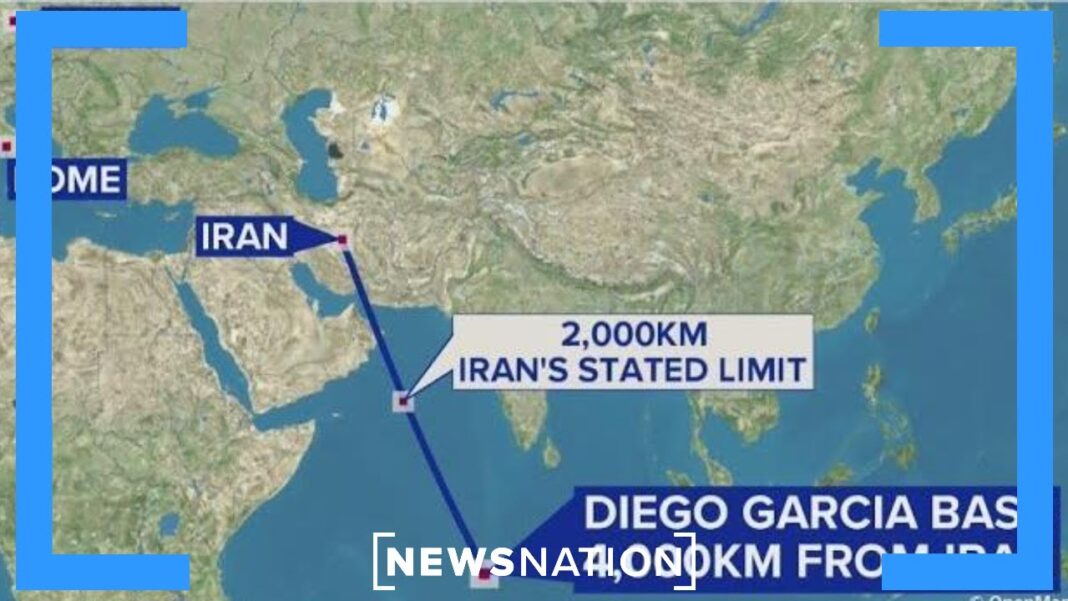
The attempted strike, carried out with two intermediate-range ballistic missiles, targeted the remote Diego Garcia base in the Chagos Islands, a British overseas territory situated deep within the Indian Ocean. According to the NBC News report, neither missile reached the base; one was reportedly intercepted by a United States naval vessel, while the other failed mid-flight. Yet, the mere act of launching such missiles across a distance exceeding 2,000 miles from Iranian territory signals a potentially significant shift in Tehran’s strategic posture.
Iranian state-affiliated media framed the attempted strike as a deliberate demonstration of expanded missile capability. The Mehr news agency characterized it as a “significant step,” suggesting that Iran’s arsenal may possess a range “beyond what the enemy previously imagined.” NBC News has highlighted the importance of this assertion, particularly in light of longstanding Iranian claims that its missile program was deliberately limited in range to avoid provoking international alarm.
Indeed, earlier this month, Iranian Foreign Minister Abbas Araghchi stated in an interview on NBC News’ “Meet the Press” that Iran had intentionally capped the range of its missiles at approximately 1,250 miles. The rationale, he explained, was to ensure that Iran would not be perceived as a threat to distant nations. The attempted strike on Diego Garcia—located nearly twice that distance from Iran—appears to contradict this position, raising questions about the transparency and scope of Iran’s missile capabilities.
NBC News has repeatedly underscored this discrepancy, noting that the strike may represent either a newly developed capability or the unveiling of previously concealed technological advancements. Analysts cited by NBC News suggest that Iran may have long possessed the technical foundation for extended-range systems but chose not to demonstrate them publicly until now.
The choice of Diego Garcia as a target is itself highly consequential. The base, located approximately 2,360 miles from Iran, serves as a critical hub for U.S. military operations in the Indo-Pacific and Middle East regions. It is capable of hosting long-range bombers and provides logistical support for naval and air operations across vast distances.
NBC News has emphasized that the base’s geographic isolation—far removed from traditional theaters of conflict—has historically been regarded as a strategic advantage, offering a secure platform for projecting power without immediate vulnerability to regional threats. The attempted strike challenges this assumption, suggesting that even remote installations may now fall within the potential reach of adversarial missile systems.
A spokesperson for the United Kingdom’s Ministry of Defense described the attack as “reckless,” warning that Iran’s actions pose a threat not only to British interests but also to allied security more broadly. NBC News has reported that British officials view the incident as part of a broader pattern of Iranian escalation, encompassing both military operations and economic pressure tactics such as the disruption of maritime traffic.
Central to the unfolding crisis is the Strait of Hormuz, a vital maritime corridor through which approximately 20 percent of the world’s daily oil supply passes. Since the outbreak of hostilities in late February, shipping through the strait has effectively ceased, creating ripple effects across global energy markets.
NBC News has consistently highlighted the strategic importance of the strait, noting that its closure represents one of the most significant disruptions to global trade in recent memory. Iran’s actions in the region, including threats to shipping and the attempted strike on Diego Garcia, appear to be part of a coordinated effort to leverage its geographic position for maximum strategic effect.
The attempted missile attack occurred shortly before the United Kingdom announced that it would permit the United States to utilize its bases—including Diego Garcia—for operations aimed at protecting shipping lanes near the strait. According to NBC News, this decision marked a notable shift in Britain’s posture, signaling a willingness to play a more active role in the conflict after weeks of relative restraint.
The British government’s decision, however, has not been without controversy. Prime Minister Keir Starmer has sought to balance competing pressures: maintaining alignment with the United States while responding to domestic opposition to deeper involvement in the conflict.
Public opinion in the United Kingdom remains overwhelmingly against participation in what many perceive as a war of choice, as was reported by NBC News. This sentiment has been echoed by Iranian officials, including Foreign Minister Araghchi, who accused Starmer of “putting British lives in danger” by allowing U.S. forces to operate from British bases.
The tension within the alliance has been further exacerbated by comments from President Donald Trump, who criticized NATO allies for what he described as insufficient support. As NBC News has detailed, Trump labeled allied nations “cowards” for failing to contribute naval forces to efforts aimed at reopening the Strait of Hormuz, even as he simultaneously suggested that such support might not be necessary.
This rhetoric has strained diplomatic relations at a critical juncture, complicating efforts to present a unified front in response to Iranian actions. NBC News has observed that the divergence in approaches among Western allies may embolden Tehran, which has historically sought to exploit divisions within opposing coalitions.
Beyond its immediate geopolitical ramifications, the attempted strike carries significant technological implications. The interception of one missile by a U.S. warship, combined with the failure of the second, provides valuable data for both defensive and offensive systems.
According to NBC News, one analyst suggested that the intercepted missile could represent the longest-range ballistic projectile ever successfully engaged by U.S. missile defense systems. This achievement, if confirmed, would mark a notable milestone in the ongoing evolution of missile interception technology.
At the same time, the incident highlights the challenges inherent in defending against increasingly sophisticated missile threats. Tom Karako, a missile defense expert at the Center for Strategic and International Studies, told NBC News that Iran has been testing “big, solid missiles” for years, indicating a steady progression in its capabilities. “There’s been speculation before that Iran could be capable of strikes beyond the claimed limit,” Karako noted, adding that the Diego Garcia incident may represent the moment when Iran has chosen to reveal—or at least suggest—the true extent of its reach.
NBC News has emphasized that the lack of clarity surrounding the missiles’ payloads and actual performance complicates efforts to assess their effectiveness. While neither missile struck its target, the demonstration of range alone may alter strategic calculations among regional and global actors.
The geopolitical complexity of the situation is further heightened by the longstanding dispute over the Chagos Islands themselves. The archipelago, which houses the Diego Garcia base, has been the subject of legal and diplomatic contention between the United Kingdom and Mauritius.
In 2019, the International Court of Justice issued an advisory opinion declaring Britain’s continued administration of the territory unlawful, siding with Mauritius’ claim that it was forced to relinquish the islands as a condition of independence. NBC News has reported that the United Kingdom has since agreed to cede sovereignty to Mauritius while retaining a 99-year lease on the base in partnership with the United States.
This arrangement has introduced an additional layer of tension, particularly given Mauritius’ close ties with China. NBC News has noted that the strategic implications of the transfer have been a point of concern in Washington, where policymakers have debated the potential risks associated with shifting sovereignty over such a critical military installation.
President Trump has publicly vacillated on the issue, alternately supporting and criticizing the agreement. Most recently, he urged Prime Minister Starmer not to “give away Diego Garcia,” even as the United States had formally endorsed the deal days earlier. NBC News has characterized this inconsistency as reflective of broader uncertainties within U.S. policy toward the region.
As the immediate aftermath of the attempted strike continues to unfold, the broader trajectory of the conflict remains uncertain. NBC News has repeatedly cautioned that the combination of military escalation, economic disruption, and diplomatic fragmentation creates a highly volatile environment in which miscalculations could have far-reaching consequences.
The attempted attack on Diego Garcia may ultimately be remembered not for its immediate impact—which, in practical terms, was limited—but for its symbolic significance. It represents a crossing of thresholds: geographic, technological, and psychological.
By demonstrating a willingness to target a base located thousands of miles away, Iran has signaled that the boundaries of the conflict are no longer confined to the Middle East. This shift carries profound implications for global security, as it suggests that critical infrastructure and military assets far beyond traditional theaters may now be at risk.
NBC News has framed the incident as a potential inflection point, one that could reshape strategic thinking on both sides. For the United States and its allies, it underscores the need to reassess defensive postures and contingency planning. For Iran, it serves as a declaration of capability and intent, aimed at deterring further actions while asserting its own strategic autonomy.
In the final analysis, the attempted missile strike on Diego Garcia encapsulates the complexities of modern conflict: the interplay of technology, geography, and political will; the delicate balance between deterrence and escalation; and the ever-present risk of unintended consequences.
As NBC News has consistently reported, the situation remains fluid, with each development carrying the potential to alter the course of events in unpredictable ways. The challenge for policymakers, military leaders, and diplomats alike is to navigate this landscape with prudence and foresight, recognizing that the stakes extend far beyond any single incident.
For now, the Indian Ocean—once considered a distant and secure arena—has become a new frontier in a conflict that shows no signs of abating. And as the echoes of those missiles fade into the vast expanse of the sea, the questions they have raised continue to reverberate across the world.
