



|
Getting your Trinity Audio player ready...
|
Antisemitic Attack on Israeli Restaurant in Munich Signals Alarming European Trend
By: Yisroel David
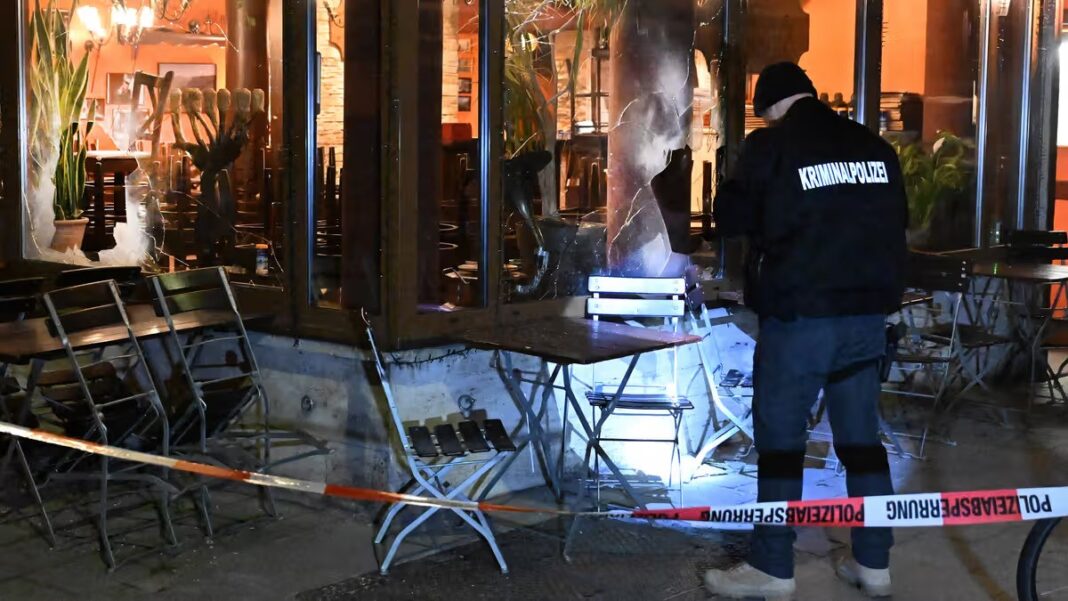
In the heart of Munich—a city long associated with cultural refinement, intellectual vigor, and a solemn historical consciousness—an act of violence has once again cast a stark and troubling shadow. An Israeli restaurant in the city’s bustling Maxvorstadt district was targeted in a brazen nighttime assault, its windows smashed and incendiary devices hurled inside, in what authorities suspect to be an antisemitic attack. As reported on Friday in The Algemeiner, the incident is not an isolated occurrence, but rather a disturbing manifestation of a broader and intensifying wave of hostility toward Jews and Israelis across Germany and Europe at large.
The attack, which occurred late Thursday evening, left the establishment visibly damaged but mercifully devoid of human casualties. Yet the symbolic weight of the violence—directed at a visibly Israeli institution in one of Germany’s most prominent cities—has resonated far beyond the shattered glass and scorched interior.
According to statements from local authorities cited by The Algemeiner, the perpetrators forcibly damaged multiple display windows before throwing pyrotechnic devices into the premises. The restaurant, fortunately closed at the time, avoided what could have been a far more devastating outcome. Nevertheless, the financial toll, estimated at several thousand euros, is only a fraction of the broader impact.
Investigators from Munich’s State Security Service—a specialized unit tasked with handling politically motivated crimes—have assumed control of the case. Their involvement underscores the seriousness with which German authorities are treating the incident, particularly in light of its suspected ideological motivation.
Despite ongoing efforts, the attackers remain unidentified. Authorities are meticulously reviewing surveillance footage and gathering witness accounts in an attempt to reconstruct the sequence of events and apprehend those responsible.
The restaurant, established in 2007 and situated on Hessstrasse, occupies a prominent position within Munich’s vibrant university quarter. The area, known for its lively pedestrian traffic, cultural institutions, and proximity to the city’s historic center, has long been regarded as a symbol of openness and cosmopolitanism.
Yet it is precisely this visibility that may have rendered the establishment vulnerable. Speaking to the German press, employee Grigori Dratva—who is related to the restaurant’s owner—acknowledged that while no explicit threats had been received prior to the attack, the nature of the business itself likely made it a target.
“We do not want to speculate,” he remarked, as cited by The Algemeiner, “but we are a clearly identifiable Israeli restaurant, and the assumption is evident.”
This statement captures the unsettling reality faced by many Jewish and Israeli institutions across Europe: that mere visibility can invite hostility in an increasingly volatile environment.
In the immediate aftermath of the attack, the restaurant’s management made a decision that speaks volumes about resilience and determination. Rather than retreat in the face of violence, they announced plans to reopen the very next day, once temporary repairs had been completed.
“We will not be intimidated,” Dratva declared, a sentiment echoed by many within the broader Jewish community. This refusal to yield to fear is emblematic of a deeper resolve to maintain presence and continuity, even amid rising threats.
Such acts of defiance, while inspiring, also highlight the burden placed upon individuals and businesses to confront dangers that extend far beyond the ordinary risks of commerce.
The attack in Munich cannot be understood in isolation. As emphasized in The Algemeiner report, it forms part of a wider and deeply concerning pattern of antisemitic incidents that has intensified dramatically since the Hamas-led attacks of October 7, 2023.
The Munich-based Conference of European Rabbis responded swiftly and unequivocally, condemning the assault and warning that it reflects a broader escalation in antisemitic activity. General Secretary Gady Gronich described the incident as emblematic of a “dangerous trend” that has taken root across the continent.
“Until now, Munich was considered a safe place for Jews,” he noted, calling for a firm and uncompromising response from authorities. His appeal for “zero tolerance” underscores a growing sense of urgency among Jewish leaders, who fear that the current trajectory could erode decades of progress in combating antisemitism.
The empirical data paints a sobering picture. According to figures cited by The Algemeiner, Germany recorded 2,267 antisemitic incidents in 2025—a record high that marks a dramatic increase from previous years. By comparison, the number stood at 1,825 in 2024, 900 in 2023, and fewer than 500 in 2022.
These figures encompass a wide spectrum of offenses, including acts of violence, property damage, incitement, and the dissemination of hateful propaganda. Experts caution that even these alarming numbers likely understate the true scale of the problem, as many incidents go unreported.
The upward trajectory is unmistakable, suggesting that antisemitism is not merely resurfacing but intensifying in both frequency and severity.
For Germany, the resurgence of antisemitic violence carries a particularly heavy historical burden. The nation’s postwar identity has been shaped in large part by a commitment to remembrance and reconciliation, anchored in an acknowledgment of the atrocities of the past.
Yet the attack in Munich serves as a stark reminder that history alone cannot inoculate a society against the reemergence of hatred. The persistence of antisemitic attitudes—manifesting in new forms and contexts—poses a challenge that is both moral and political.
The convergence of global events, domestic tensions, and the rapid dissemination of information through digital platforms has created a complex environment in which old prejudices can be revived and amplified.
Germany is not alone in confronting this phenomenon. Across Europe, Jewish communities have reported a surge in incidents ranging from verbal harassment to physical assault. The trend has been particularly pronounced in the aftermath of geopolitical developments in the Middle East, which have often served as catalysts for local expressions of hostility.
As The Algemeiner has documented, the line between political protest and antisemitic expression has become increasingly blurred. Demonstrations ostensibly focused on international issues have, in some cases, devolved into platforms for hate speech and intimidation.
This conflation complicates efforts to address the problem, as it requires a careful balancing of fundamental freedoms with the imperative to protect vulnerable communities.
The involvement of Munich’s State Security Service reflects a recognition that the attack is not merely a criminal act but a potential manifestation of politically motivated extremism. The outcome of the investigation will be closely watched, both for its immediate implications and for what it signals about the broader response to antisemitism.
Calls for stronger measures have grown louder in recent months, with community leaders urging authorities to adopt a more proactive stance. This includes enhanced security for Jewish institutions, stricter enforcement of existing laws, and a commitment to addressing the root causes of hatred.
The challenge, however, extends beyond law enforcement. It encompasses education, public discourse, and the cultivation of a societal ethos that unequivocally rejects antisemitism in all its forms.
The attack on the Israeli restaurant in Munich is a sobering reminder that the fight against antisemitism is far from over. It is a test of resolve—not only for the immediate victims but for society as a whole.
As The Algemeiner report underscored, the incident is emblematic of a broader trend that demands urgent attention. The response will require vigilance, unity, and an unwavering commitment to the principles of tolerance and justice.
In the shattered windows of a Munich restaurant, one can glimpse not only the work of a single act of violence but also the contours of a larger struggle. Whether that struggle leads to renewed determination or further division will depend on the choices made in its aftermath.
For now, the message from those directly affected remains clear: they will endure, they will rebuild, and they will not be driven into silence.
