



|
Getting your Trinity Audio player ready...
|
By: Fern Sidman
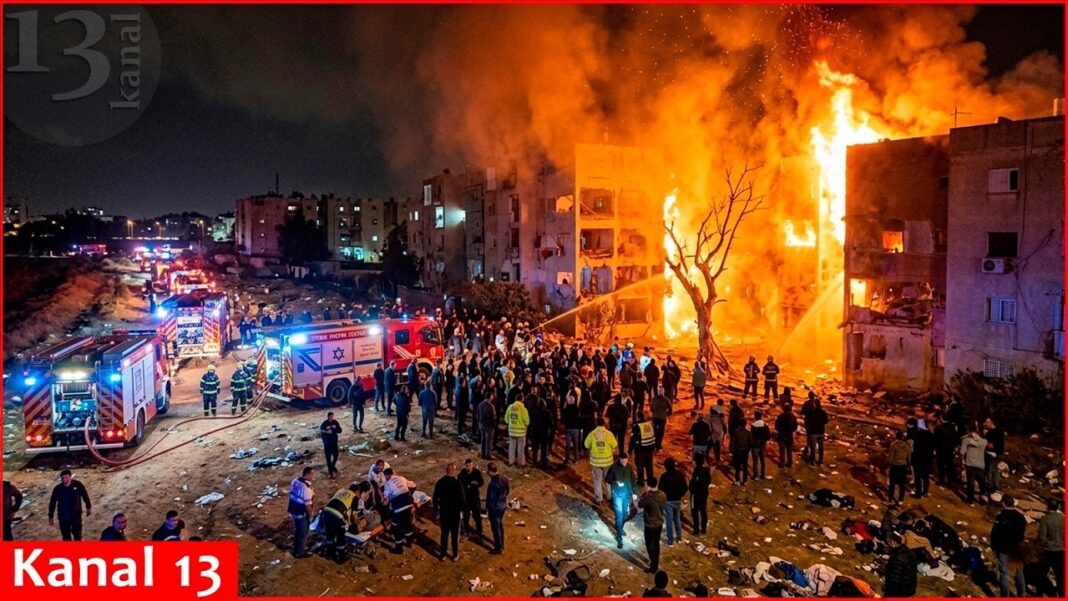
In the pre-dawn hours of a harrowing Sunday, the southern Israeli city of Arad was transformed into a scene of devastation and urgency, as a ballistic missile strike triggered what emergency responders described as a “mass casualty incident” of exceptional complexity. The attack, which followed an earlier strike on Dimona, has intensified fears about the evolving scope of the ongoing war with Iran and raised troubling questions about the resilience of Israel’s air defense systems under sustained assault.
According to a report on Saturday by the Jewish News Syndicate, emergency medical teams raced against time to treat dozens of casualties amid shattered buildings and widespread destruction. United Hatzalah, one of Israel’s leading volunteer emergency response organizations, reported that its paramedics treated 95 individuals, including 10 in serious condition. Many of the injured required hospitalization, underscoring the severity of the blast and its immediate human toll.
Aerial footage released by United Hatzalah and cited by JNS revealed the scale of the destruction. Entire sections of residential buildings appeared to have been blown apart, with debris scattered across a wide impact zone. The force of the explosion not only damaged infrastructure but also created hazardous conditions for rescue teams navigating unstable structures.
Magen David Adom, Israel’s national emergency medical service, provided additional details that further illustrated the gravity of the situation. As of 1:20 a.m., its medics and paramedics had treated 88 individuals, including 10 who were seriously injured. Among the most distressing cases was that of a young girl, approximately five years old, who sustained critical injuries.
The evacuation effort was equally formidable. Dozens of ambulances were deployed to transport the wounded to hospitals across the region, a logistical undertaking that required precise coordination under immense pressure.
The Israeli Foreign Ministry swiftly condemned the attacks on Arad and Dimona, describing them as a “blatant war crime” and an act of “pure terrorism.” These strong words reflect not only the scale of the destruction but also the broader context of a conflict that has increasingly blurred the lines between military targets and civilian areas.
Prime Minister Benjamin Netanyahu, speaking shortly after the strike, conveyed a message of both empathy and resolve. As reported by JNS, Netanyahu described the night as “very difficult” and emphasized the collective solidarity of the nation. “I spoke with Arad mayor Yair Ma’ayan and asked to convey, on behalf of all the citizens of Israel, our prayers for the recovery of the wounded,” he said.
Yet the prime minister’s remarks also carried an implicit warning: Israel’s response would be neither restrained nor limited.
The immediate aftermath of the strike was marked by a frenetic yet highly coordinated rescue effort. Simmy Allen, international spokesman for United Hatzalah, described the scene as “extremely complex and challenging,” highlighting the dual burden faced by responders—providing urgent medical care while navigating the psychological trauma experienced by victims.
“Our medics and volunteers operated under intense conditions, working tirelessly to deliver immediate, life-saving care while also supporting those experiencing profound emotional distress,” Allen said, according to the JNS report.
One of the most notable aspects of the response was the deployment of United Hatzalah’s specialized drone unit. These drones played a critical role in guiding search-and-rescue teams, enabling them to locate individuals trapped beneath rubble and assess the structural integrity of damaged buildings in real time.
Such technological integration reflects a broader evolution in emergency response, where advanced tools are increasingly used to augment human efforts in high-risk environments.
Even as medical teams worked to stabilize the injured, law enforcement officials focused on ensuring that no victims remained trapped beneath the debris. Police Commissioner Danny Levy, speaking at the scene, emphasized the thoroughness of the ongoing search operations. “We won’t leave here until we confirm that there is no one missing and no one we have forgotten in the rubble,” Levy stated, as reported by JNS.
He noted that the search effort combined traditional methods with advanced technological tools, reflecting a comprehensive approach to disaster response. At the time of his remarks, preliminary assessments suggested that no individuals were unaccounted for, but officials remained cautious, continuing their search to ensure absolute certainty.
Perhaps the most troubling aspect of the attack lies in the apparent failure of Israel’s air defense systems to intercept the incoming missiles. The Israeli military confirmed that both projectiles had been engaged by air defenses, yet the interceptors failed to neutralize them.
This admission has prompted an urgent investigation by both the Israeli Air Force and the Home Front Command. As JNS reported, authorities are examining the circumstances that led to the failure, seeking to identify potential vulnerabilities in the system.
For a nation that has long relied on its advanced missile defense capabilities as a cornerstone of civilian protection, such failures are deeply concerning. They raise critical questions about the effectiveness of existing systems under the strain of sustained and coordinated attacks.
In response to the strikes on Arad and Dimona, the Israeli military announced that it had begun conducting operations against targets associated with the Iranian regime in central Tehran. This escalation underscores the interconnected nature of the conflict, in which actions on one front are swiftly met with countermeasures on another.
The timing of these strikes—occurring just hours after the attacks in southern Israel—suggests a deliberate effort to signal both capability and resolve. As JNS has noted in its broader coverage, such rapid responses are intended to deter further aggression while demonstrating the reach of Israeli military operations.
The conflict has also drawn strong reactions from the United States, with President Donald Trump issuing statements that reflect an increasingly assertive posture. In remarks cited by JNS, Trump claimed that the United States had already achieved significant success in its campaign against Iran. “The United States has blown Iran off of the map,” he declared, asserting that the country’s leadership and military capabilities had been effectively neutralized.
In a subsequent statement, Trump issued a stark ultimatum regarding the Strait of Hormuz, warning that failure to fully open the vital shipping route within 48 hours would result in devastating strikes on Iranian power infrastructure.
The events in Arad are emblematic of a broader conflict that has expanded across multiple fronts since its inception on February 28. As Israeli leaders have repeatedly emphasized, the war is not confined to a single theater but encompasses a range of threats, from missile attacks to drone incursions and beyond.
Prime Minister Netanyahu and Israel Defense Forces Chief of Staff Lt. Gen. Eyal Zamir have both pledged to continue operations against Israel’s adversaries on “all fronts,” signaling a comprehensive approach to the conflict.
This multi-front strategy reflects the complexity of the challenges facing Israel, as it seeks to address both immediate threats and the underlying structures that enable them.
Amid the strategic calculations and military operations, the human impact of the conflict remains paramount. The residents of Arad, like those in other affected areas, have been forced to confront the realities of war in their daily lives.
For the families whose homes were destroyed, the experience is one of sudden displacement and uncertainty. For the injured, it is a struggle for recovery and rehabilitation. And for the broader community, it is a test of resilience in the face of repeated adversity.
The image of a young child among the seriously wounded serves as a poignant reminder of the indiscriminate nature of such attacks and the enduring cost of conflict.
The missile strike on Arad represents more than a single incident; it is a defining moment in a conflict that continues to evolve with alarming speed and intensity. It exposes vulnerabilities, tests capabilities, and underscores the stakes for all involved.
As the JNS report noted, the broader implications become increasingly clear. The war is not only a contest of military force but also a struggle over security, stability, and the future of an entire region.
In the days and weeks ahead, the responses of both Israel and its allies will shape the trajectory of the conflict. For now, the events in Arad stand as a stark reminder of the challenges that lie ahead—and the resilience required to meet them.
