



|
Getting your Trinity Audio player ready...
|
By: Fern Sidman
In a development fraught with geopolitical consequence, marathon negotiations between the United States and Iran have concluded without agreement, casting a pall of uncertainty over an already fragile ceasefire and heightening fears of a renewed and potentially intensified conflict. As reported on Saturday evening by Axios, the high-stakes diplomatic effort—conducted over more than twenty-one hours in Islamabad—ended in a stark impasse, underscoring the profound divisions that continue to define relations between Washington and Tehran.
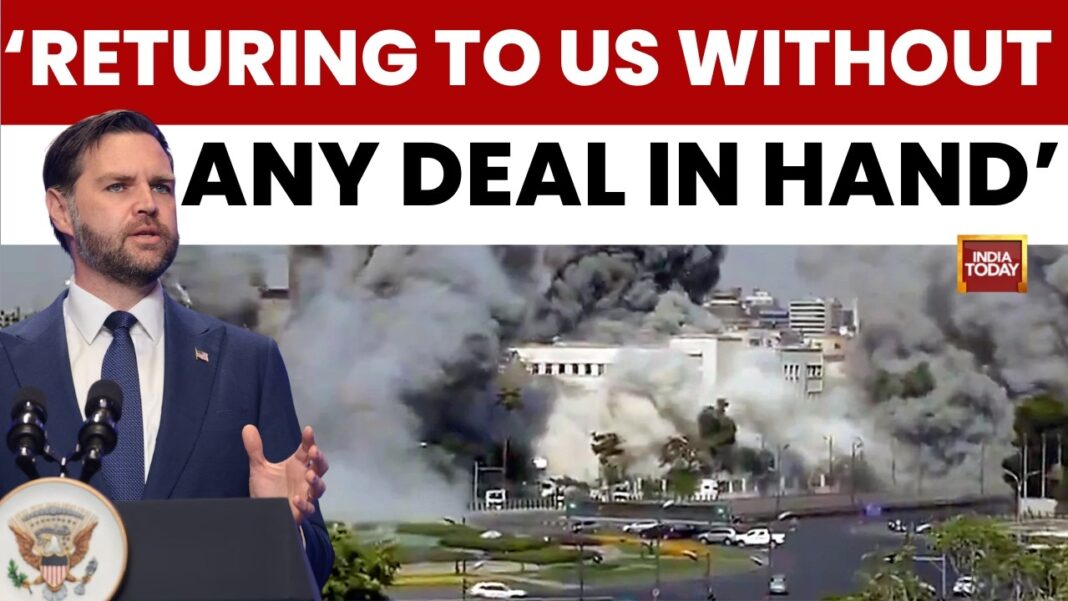
The announcement, delivered by Vice President JD Vance at a press conference in Pakistan’s capital, marked a sobering moment in what had been widely regarded as a critical opportunity to transform a tenuous cessation of hostilities into a durable framework for peace.
The negotiations, which unfolded across multiple rounds and formats, were characterized by intensity, urgency, and a palpable sense of consequence. According to the Axios report, American and Iranian delegations engaged in substantive discussions that extended deep into the early hours of Sunday, reflecting both the complexity of the issues at hand and the determination of both sides to explore avenues for resolution.
Yet despite the duration and depth of these engagements, the talks ultimately failed to bridge the fundamental gaps separating the two parties. “We had substantive discussions,” Vance acknowledged, while conceding that the negotiations did not yield the progress necessary to secure an agreement.
This outcome leaves the two-week ceasefire—previously hailed as a potential turning point—dangling in precarious uncertainty, its future now contingent upon decisions that may be made in the coming days.
At the core of the impasse lies a set of irreconcilable demands, most notably concerning Iran’s nuclear ambitions. The United States has insisted upon what Vance described as a long-term, affirmative commitment from Iran to forgo not only the development of nuclear weapons but also the acquisition of capabilities that could enable rapid weaponization.
“We have made very clear what our red lines are,” Vance stated, as cited by Axios. “They have chosen not to accept our terms.”
This insistence reflects a broader strategic doctrine aimed at preventing nuclear proliferation and maintaining regional stability. From Washington’s perspective, any agreement that falls short of these objectives would represent an unacceptable compromise.
Iran, however, has historically maintained its sovereign right to pursue nuclear technology for peaceful purposes, a position that has repeatedly placed it at odds with Western demands. The resulting stalemate highlights the enduring difficulty of reconciling these competing visions.
In his remarks, Vance sought to frame the breakdown in negotiations as more detrimental to Iran than to the United States, emphasizing the asymmetry of the stakes involved. “This is bad news for Iran much more than this is bad news for the U.S.,” he asserted, as was reported by Axios.
This characterization reflects a belief within the American administration that Iran faces greater economic and strategic pressures, particularly in light of ongoing sanctions and its dependence on access to international markets. By contrast, the United States retains a broader array of options, including military, economic, and diplomatic tools.
Nevertheless, the potential consequences of renewed conflict would not be confined to a single nation. The ripple effects—ranging from disruptions to global energy supplies to heightened regional instability—would likely be felt across the international system.
The significance of the negotiations was underscored by the degree of involvement from senior American leadership. As reported by Axios, the U.S. negotiating team maintained constant communication with President Donald Trump throughout the process, consulting with him multiple times over the course of the day.
In addition, key figures across the administration—including Secretary of State Marco Rubio, Defense Secretary Pete Hegseth, Treasury Secretary Scott Bessent, and CENTCOM commander Brad Cooper—were actively engaged in shaping the U.S. position.
This level of coordination speaks volumes about the gravity of the situation and the extent to which the outcome of the talks was regarded as a matter of national and international importance.
Despite the failure to reach an agreement, the United States has not entirely closed the door on diplomacy. Vance indicated that Washington has presented what he described as its “final and best offer,” a proposal that remains available for Iranian consideration.
“We leave here with a very simple proposal,” he said, as quoted by Axios. “A method of understanding that is our final and best offer. We will see if the Iranians accept it.”
This formulation suggests a strategic pivot toward a take-it-or-leave-it approach, one that places the onus squarely on Tehran to decide whether to engage further or risk the consequences of inaction.
The immediate implication of the failed talks is the precarious state of the ceasefire established just several days prior. Initially conceived as a breathing space for diplomacy, the ceasefire now appears increasingly vulnerable to collapse.
The absence of a negotiated framework raises the likelihood of renewed hostilities, particularly if either side perceives the other as acting in bad faith or preparing for escalation. In such a scenario, the region could once again find itself engulfed in conflict, with potentially far-reaching consequences.
As the Axios report emphasized, the situation remains fluid, with developments likely to unfold rapidly in the coming days.
The breakdown in negotiations reverberates beyond the immediate parties involved, carrying implications for global security and economic stability. The Middle East, already a focal point of geopolitical tension, could become the epicenter of a broader crisis if the ceasefire unravels.
Energy markets, in particular, are acutely sensitive to developments in the region, given the critical role of Middle Eastern oil in the global economy. Any disruption to supply routes or production could trigger significant price volatility, with cascading effects on economies worldwide.
Moreover, the failure of diplomacy in this instance may complicate future efforts to address similar challenges, reinforcing perceptions of intractability and diminishing confidence in negotiated solutions.
As the dust settles on the unsuccessful negotiations, the international community finds itself at a critical juncture. The choices made by the United States and Iran in the immediate aftermath of the talks will likely determine whether the current moment becomes a prelude to peace or a prelude to war.
For Washington, the emphasis remains on maintaining pressure while leaving open the possibility of diplomatic resolution. For Tehran, the decision will hinge on whether it is willing to accept the terms presented or to pursue an alternative course.
The collapse of the Islamabad talks represents a sobering reminder of the challenges inherent in high-stakes diplomacy. It underscores the difficulty of reconciling deeply entrenched positions and the fragility of agreements forged under pressure.
Yet even in failure, the negotiations have clarified the contours of the dispute, delineating the boundaries within which future efforts must operate. Whether these efforts will succeed remains an open question.
For now, the world watches and waits, acutely aware that the line between peace and conflict has seldom appeared so thin—and so perilous.
