



|
Getting your Trinity Audio player ready...
|
Skyfall Shield: NYPD Deploys $1M ‘Drone Killer’ Vehicle to Defend NYC’s Skies
By: Justin Winograd
In a striking illustration of how modern policing is evolving to confront emerging technological threats, the New York Police Department has quietly acquired a cutting-edge mobile command unit designed to neutralize hostile drones in real time. The nearly $1 million investment—revealed in a report on Saturday in The New York Post—signals a decisive shift in how America’s largest police force prepares for the next generation of security challenges.
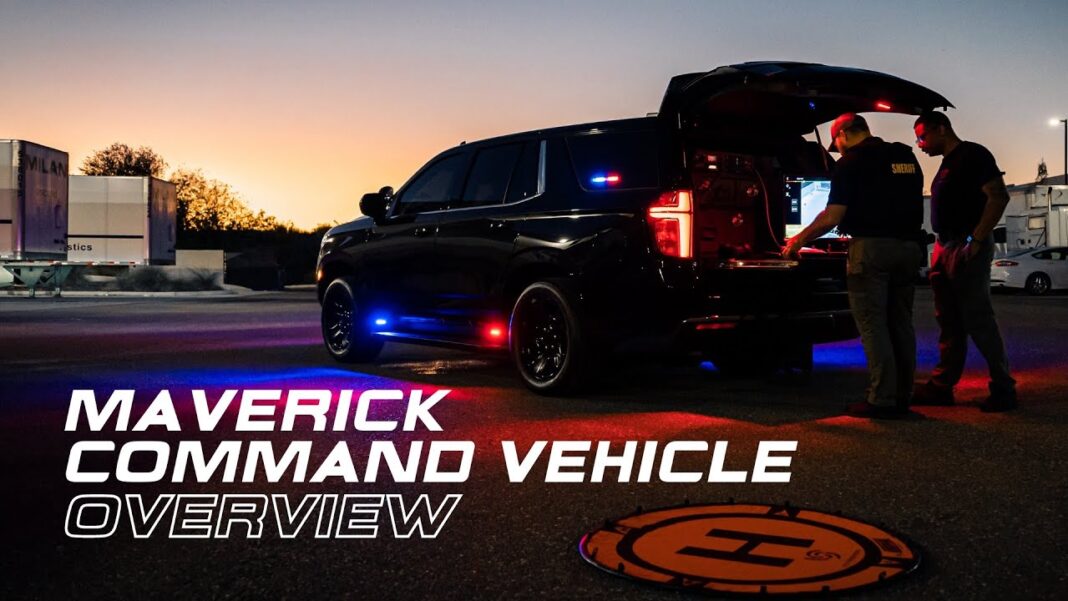
At first glance, the newly acquired vehicle appears indistinguishable from the countless sport utility vehicles that populate the city’s streets. Beneath its unassuming exterior, however, lies a sophisticated array of counter-drone technologies that officials believe could prove critical in safeguarding densely populated urban environments and high-profile events.
The vehicle, known as the Maverick Unmanned Aerial Systems mobile command unit, represents a convergence of mobility, surveillance, and tactical response capabilities. Built on the chassis of a Chevrolet Suburban and costing approximately $984,280 according to procurement documents reviewed by The New York Post, the unit is designed to operate both as a standard patrol vehicle and as a fully integrated command-and-control hub.
Its most notable feature is its ability to deploy drones directly from concealed compartments within the vehicle itself. These onboard systems can be launched within moments of detecting a potential threat, allowing officers to respond dynamically to hostile unmanned aerial devices.
As The New York Post report detailed, the vehicle is intended primarily for counterterrorism operations, particularly in scenarios involving large gatherings or critical infrastructure. In an era where drones have increasingly been used for surveillance, smuggling, and even weaponized attacks, the ability to rapidly detect and neutralize such threats has become an essential component of urban security planning.
One of the key advantages of the Maverick system lies in its mobility. Unlike previous drone-command platforms employed by the NYPD—most notably a van-based system—the Suburban-based unit offers significantly greater maneuverability. According to sources cited by The New York Post, this allows officers to reposition quickly in response to evolving situations, enhancing both operational flexibility and tactical discretion.
“They can pull over and launch drones from portable compartments,” one law enforcement source explained. “It’s much more stealthy and responsive than the larger vehicles.”
This capability is particularly valuable in a city like New York, where congestion, narrow streets, and unpredictable traffic patterns can complicate rapid deployment. The Maverick’s design enables it to blend seamlessly into its surroundings, reducing the likelihood of drawing attention while maintaining readiness for immediate action.
Beyond its launch capabilities, the vehicle is equipped with advanced monitoring systems, including screens that provide live feeds from detection drones. These feeds enable officers to maintain situational awareness in real time, tracking potential threats as they develop.
The New York Post reported that there is also hope among officials that the system incorporates software capable of taking control of hostile drones—a process sometimes likened to “jail-breaking” an electronic device. Such functionality would represent a significant escalation in counter-drone capability, allowing authorities not merely to intercept but to commandeer potentially dangerous devices.
While the NYPD has not publicly confirmed the full extent of the Maverick’s technological suite, the emphasis on integrated command-and-control features suggests a comprehensive approach to aerial threat mitigation.
The acquisition of the Maverick unit is not an isolated development but part of a broader strategy to enhance the city’s defenses against unmanned aerial threats. The New York Post has previously reported on the department’s purchase of additional systems, including the Trident Series Command Center—a Mercedes-Benz Sprinter van outfitted with drone detection nodes.
That earlier investment, valued at approximately $500,000, laid the groundwork for a layered approach to aerial security. By combining stationary detection systems with mobile response units like the Maverick, the NYPD aims to create a networked defense capable of identifying, tracking, and neutralizing threats across multiple environments.
This strategy has been further bolstered by a $6.5 million federal grant dedicated to counter-unmanned aircraft systems. According to The New York Post report, these funds are being used to expand the department’s technological arsenal and prepare for a range of potential scenarios.
The timing of these investments is particularly significant, as New York City prepares to host a series of major events, including celebrations marking the 250th anniversary of the United States. Such occasions are expected to draw massive crowds, making them potential targets for those seeking to exploit vulnerabilities.
The New York Post has emphasized that the integration of advanced counter-drone systems into event security planning reflects a proactive approach to risk management. By deploying assets like the Maverick unit, authorities aim to ensure that any aerial threats can be addressed swiftly and effectively.
Police Commissioner Jessica Tisch has underscored the importance of these efforts, noting that federal authorities are working toward granting the NYPD expanded powers to neutralize hostile drones. Final authorization is expected to come from President Trump, a development that could significantly enhance the department’s operational capabilities.
The emergence of systems like the Maverick reflects a broader trend in law enforcement and military strategy. As drones become more accessible and versatile, the need for effective countermeasures has grown correspondingly.
The New York Post has reported on additional technologies under consideration, including the Iron Drone Raider system developed by American Robotics. This system employs “interceptor drones” equipped with radar to locate hostile devices and deploy lightweight nets that entangle their rotors. A parachute mechanism then allows the captured drone to descend safely to the ground.
Such innovations illustrate the rapid evolution of counter-drone tactics, moving beyond traditional methods such as signal jamming or kinetic interception. The emphasis on precision and control reflects a desire to neutralize threats without causing collateral damage—an especially critical consideration in densely populated urban areas.
While the introduction of advanced surveillance and defense technologies offers clear benefits, it also raises important questions about public perception and civil liberties. The presence of vehicles capable of launching drones and potentially taking control of electronic devices may prompt concerns about privacy and oversight.
The New York Post report noted that transparency and accountability will be key in addressing these concerns. Ensuring that such technologies are used responsibly and within clearly defined legal frameworks will be essential in maintaining public trust.
At the same time, the increasing prevalence of drone-related incidents has underscored the necessity of proactive measures. From unauthorized flights near airports to the potential use of drones in criminal or terrorist activities, the risks are both real and evolving.
The Maverick unit offers a glimpse into the future of urban policing, where technology plays an increasingly central role in both detection and response. The ability to integrate multiple systems—surveillance, communication, and intervention—into a single mobile platform represents a significant advancement in operational capability.
As The New York Post report observed, such developments are likely to become more common as cities around the world seek to adapt to new forms of threat. The challenge will be to balance innovation with oversight, ensuring that the tools designed to enhance security do not inadvertently compromise the very freedoms they are intended to protect.
In the final analysis, the NYPD’s acquisition of the Maverick Unmanned Aerial Systems vehicle marks a pivotal moment in the evolution of law enforcement strategy. By investing in advanced counter-drone capabilities, the department is positioning itself at the forefront of a rapidly changing security landscape.
The New York Post has consistently framed the initiative as both a necessary response to emerging threats and a bold step toward the future of policing. Whether the Maverick will prove as effective in practice as it appears on paper remains to be seen, but its introduction underscores a fundamental reality: the battle for urban security is no longer confined to the streets—it now extends to the skies above.
As New York City prepares for the challenges ahead, the deployment of such technology serves as both a safeguard and a signal—a reminder that in an age of innovation, vigilance must evolve just as rapidly as the threats it seeks to counter.
