



|
Getting your Trinity Audio player ready...
|
By: Justin Winograd
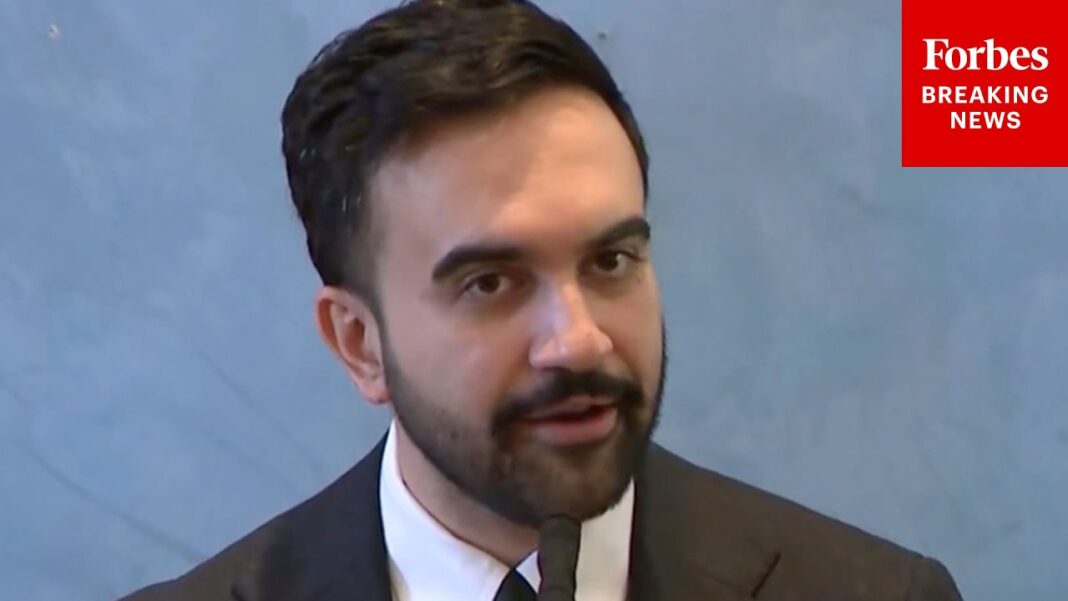
In a moment that fused celebration with controversy, New York City Mayor Zohran Mamdani transformed what is traditionally a day of cultural pride into a platform for geopolitical commentary—drawing sharp criticism and igniting a broader debate over the intersection of identity, politics, and public discourse.
At a St. Patrick’s Day breakfast hosted at Gracie Mansion, Mamdani invoked Ireland’s long history of hardship and resilience to draw a striking parallel with the ongoing Israel-Hamas war, describing what he termed a “genocide” in Gaza. The remarks, reported in detail by The New York Post on Tuesday. quickly reverberated beyond the confines of the event, prompting backlash from community leaders and political observers alike.
The breakfast, which served as the ceremonial kickoff to New York City’s annual St. Patrick’s Day festivities, featured distinguished guests including former Irish President Mary Robinson. Traditionally, such gatherings emphasize cultural heritage, community contributions, and the enduring ties between Ireland and New York City. This year, however, the tone shifted markedly.
According to The New York Post report, Mamdani used the occasion to reflect on what he described as a shared history of oppression between the Irish and Palestinians. In doing so, he framed Ireland’s past—marked by famine, colonization, and discrimination—as a lens through which to interpret contemporary global conflicts.
“Who can better understand those who weep than those who have been made to weep for so long?” Mamdani asked, invoking the emotional weight of Irish history. He characterized the Irish experience as one of “oppression, subjugation, and discrimination,” suggesting that this legacy has fostered a tradition of solidarity with other marginalized groups.
Yet it was his explicit reference to Gaza that proved most contentious. As The New York Post reported, Mamdani lamented what he called a “deafening silence” from many observers regarding the conflict, asserting that Palestinians have been “left to weep alone.”
Central to Mamdani’s remarks was his praise for Mary Robinson, Ireland’s first female president and a prominent figure in international human rights advocacy. He commended Robinson for her longstanding support of Palestinian causes, presenting her as an exemplar of moral clarity in times of crisis.
Robinson, for her part, adopted a more expansive perspective. In her address, she enumerated a range of global conflicts—from Iran and Lebanon to Ukraine and Sudan—emphasizing the universality of human suffering. As noted by The New York Post, she framed Ireland’s historical experiences as a source of empathy for people facing displacement and violence worldwide. “Perhaps because of that, many recognize echoes of Ireland’s past within the suffering of others today,” Robinson said, highlighting themes of dignity, justice, and self-determination.
Mamdani’s remarks, however, were met with swift and pointed criticism. Bill Donohue, president of the Catholic League, accused the mayor of politicizing a day meant to celebrate Irish heritage. “Mamdani is a master of the politics of victimization,” Donohue said in a statement cited by The New York Post. He argued that the mayor’s framing of history served to advance a broader ideological agenda, one that emphasizes oppression as a unifying narrative.
Others echoed similar concerns. Neil Cosgrove, political education chair of The Ancient Order of Hibernians in America, expressed frustration that the focus of the day had been diverted. “Today is a day to celebrate the Irish-American community,” Cosgrove told The New York Post. “There are 364 other days to go into areas of other politics.”
Cosgrove’s remarks reflect a broader sentiment among some Irish-American leaders who believe that St. Patrick’s Day should remain a space for cultural recognition rather than political debate.
The controversy is further complicated by the timing of Mamdani’s statements. Just one day prior, the mayor had met privately with Orthodox Jewish leaders, assuring them that combating antisemitism would be a central priority of his administration.
As The New York Post reported, this juxtaposition has raised questions about consistency and messaging. Critics argue that invoking the term “genocide” in relation to Gaza—particularly in a highly public and symbolic setting—risks alienating segments of New York’s diverse population.
The following morning, Mamdani attended Mass at St. Patrick’s Cathedral, where he was seen interacting amicably with Archbishop Ronald Hicks. He later marched in the city’s iconic St. Patrick’s Day parade alongside NYPD Commissioner Jessica Tisch, before departing early for a private lunch.
The sequence of events—religious observance, political commentary, and public celebration—underscores the multifaceted nature of the mayor’s role, as well as the challenges inherent in navigating New York’s complex social landscape.
When pressed by reporters to elaborate on his remarks, Mamdani defended his comparison between the Irish and Palestinian experiences. He pointed to Ireland’s historical record of advocacy, citing its early stance against apartheid in South Africa and the activism of figures like Robinson. “What we’ve seen time and time again is that it has been the Irish who have been standing up whenever there’s been a person or people oppressed,” he said, according to The New York Post.
Mamdani also referenced the discrimination faced by Irish immigrants in the United States, including the notorious “Irish Need Not Apply” signs, as evidence of a shared history of marginalization. “It is truly a testament to the Irish spirit of perseverance, of struggle and solidarity that we are here in the city today,” he added.
The episode unfolds against a backdrop of heightened tensions surrounding the Israel-Hamas war, which has polarized public opinion both domestically and internationally. Within New York City—a global metropolis with significant Jewish, Irish, and Middle Eastern communities—such debates carry particular resonance. As The New York Post has frequently observed, the city often serves as a microcosm of broader geopolitical dynamics, where local events can quickly take on global significance.
Mamdani’s remarks reflect a broader trend among some progressive leaders to frame international conflicts through the lens of historical injustice and solidarity movements. However, this approach is not without its critics, who argue that it can oversimplify complex issues and inflame divisions.
For many Irish-Americans, the controversy has prompted a reevaluation of how their heritage is invoked in contemporary political discourse. While Ireland’s history of struggle is widely acknowledged, there is debate over how—and whether—it should be used to draw parallels with modern conflicts.
Governor Kathy Hochul, who also participated in the parade, offered a more straightforward perspective. When asked about the idea of a unified Ireland, she expressed unequivocal support. “I believe in unifying the Irish people, of course,” she told The New York Post.
Mamdani, by contrast, appeared less certain when asked the same question earlier in the week, admitting that he had not given it sufficient thought. The contrast highlights differing approaches to issues of identity and political expression among New York’s leadership.
At its core, the controversy surrounding Mamdani’s remarks underscores the power of symbolism in political communication. St. Patrick’s Day, with its rich cultural and historical associations, provides a potent platform for messages about identity, resilience, and solidarity.
Yet as this episode demonstrates, such symbolism can also be fraught. By linking the Irish experience to the Israel-Hamas conflict, Mamdani introduced a layer of complexity that many attendees—and observers—found jarring.
As The New York Post has noted, the use of emotionally charged language in such contexts can amplify both support and opposition, often in equal measure.
New York City’s diversity is both its strength and its challenge. With communities representing nearly every corner of the globe, the city is a space where multiple narratives coexist—and sometimes collide. Mamdani’s remarks have brought these dynamics into sharp relief, prompting conversations about how leaders should address global issues in local settings. Should public officials use cultural events as platforms for political advocacy? Or should such occasions remain focused on celebration and unity?
There are no easy answers. What is clear, however, is that the debate is far from over.
As the echoes of St. Patrick’s Day fade and the city returns to its daily rhythms, the controversy surrounding Mamdani’s remarks continues to resonate. It is a reminder of the complexities inherent in leadership, particularly in a city as diverse and dynamic as New York.
For Mamdani, the episode represents both a challenge and an opportunity—a chance to clarify his positions and engage with critics, but also a test of his ability to navigate the delicate balance between advocacy and inclusivity.
For the broader public, as chronicled by The New York Post, it is an invitation to reflect on the role of history, identity, and rhetoric in shaping our understanding of the world.
In the end, the story is not merely about one speech or one day. It is about the ongoing dialogue that defines a city—and a society—constantly grappling with its past, its present, and its future.

The Irish have long been contributors to the UN “peacekeeping” force in Southern Lebanon and thus, and not unexpectedly, have come into conflict with Israeli soldiers coming across the border, well before the emergence of Hezbollah in response to Israel’s invasion of the country and 18 year occupation. While there on a photographic assignment in 1983, some of the Irish talked of their experiences with the Israelis which were not very pretty or fit for public consumption on the internet,
Ireland has a long long long history of Jew hate. It has consistently voted against Israel in the UN, more than other western nations. For anyone to attempt to excuse Ireland’s Jew hate, support of BDS & calling Israel a genocidal killer…is just the newest flavor of Jew hate 2026 style. I don’t give a damn what someone saw or did not “see” in S. Lebanon. Ireland outright says the elimination of Israel would be a good thing. That is the issue. Don’t side track it.
Mamdani stands with the Jew haters, Ireland. He’ll be inviting Hamas to speak and have a parade next. What did you expect when you voted for him????????
Antisemitism among Irish Christians at ‘Medieval’ levels, say researchers
New survey finds religious narratives play a ‘massive role’ in strong anti-Jewish and anti-Israel trends, with Catholics far less supportive of Israel than Protestants
https://www.timesofisrael.com/antisemitism-among-irish-christians-at-medieval-levels-say-researchers/
—————————
Ireland’s Obsession With the Jews
WSJ
https://www.wsj.com › opinion › free-expression › irela…
19 hours ago — Since the Oct. 7, 2023, terrorist attacks, Ireland has emerged as one of the most unhinged anti-Israel countries in Europe. The Irish …Read more
———————-
https://blogs.timesofisrael.com/its-finally-official-ireland-has-an-antisemitic-problem/
It’s finally official, Ireland has an antisemitic problem