



|
Getting your Trinity Audio player ready...
|
By: Jerone Brookshire
The New York City Council is poised to enter a fraught and consequential debate that touches the deepest nerves of the city’s political culture: the balance between religious security and the constitutional right to protest. Next Wednesday’s hearing, convened under the auspices of Council Speaker Julie Menin, inaugurates the formal push for legislation that would authorize the New York Police Department to restrict demonstrations outside synagogues and other houses of worship, establishing police-controlled buffer zones extending as far as 100 feet from religious sites.
In a report on Tuesday on the JewishCurrents.org website, the moment was framed as the first major Mamdani-era legislative confrontation over Israel, antisemitism, and Jewish safety—an early and revealing test of the shifting alignments that now shape municipal power in a city where global conflicts reverberate through local streets.
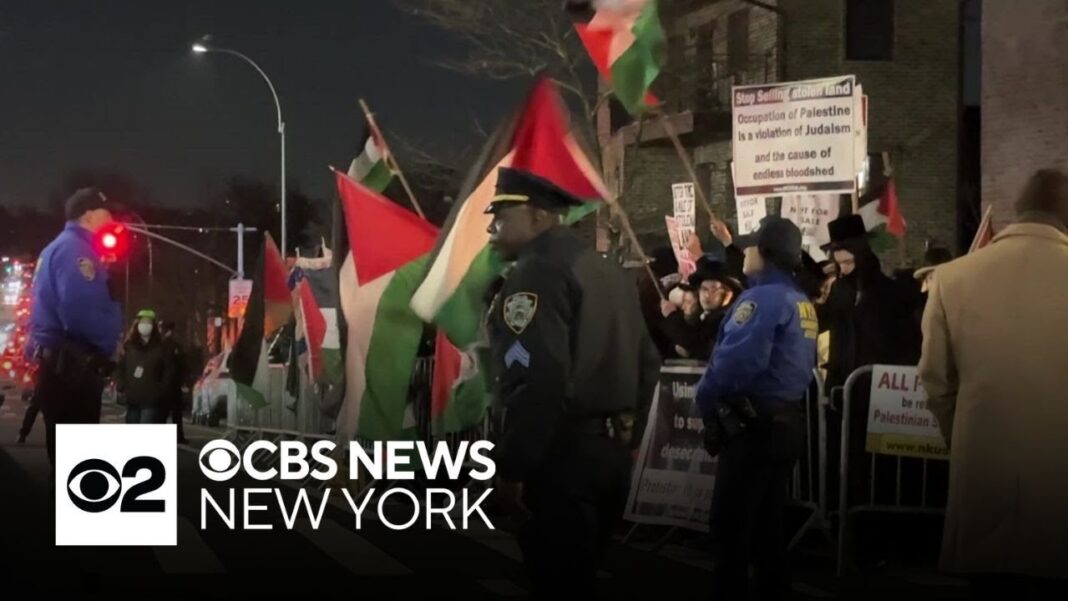
The proposal arrives in the wake of two recent demonstrations outside city synagogues that have unsettled communal leaders and alarmed public officials. One protest took place at a synagogue hosting an event promoting property sales in Israel and in a settlement in Judea and Samaria; another unfolded outside a synagogue that had welcomed a group advocating immigration to Israel and the liberated territories of Judea and Samaria.
At one of these demonstrations, protesters chanted, “We support Hamas here,” language that city and state officials swiftly and unequivocally denounced as antisemitic. The JewishCurrents.org report emphasized that the controversy is not simply about the content of speech but about the geography of dissent: whether the city can or should draw bright lines around sacred spaces in an era of polarized politics and heightened communal fear.
Menin’s proposal directs the NYPD to devise and implement a plan to address what the legislation terms “interference” or “intimidation” outside houses of worship. It authorizes law enforcement to erect barriers that would effectively push demonstrators back from entrances and gathering spaces, a measure supporters argue is necessary to ensure that congregants can enter and exit their synagogues without fear. The speaker’s office has presented the bill as a pragmatic response to a climate of escalating tension, one that seeks to protect worshippers without extinguishing protest altogether. The measure immediately provoked unease among civil liberties advocates and progressive Jewish organizations, who warn that empowering police to define and enforce such perimeters risks eroding fundamental First Amendment protections.
The political context of this debate lends it a particular intensity. The Mamdani era—still in its early stages—has already been marked by sharp disagreements over Israel, Zionism, and the contours of antisemitism. The synagogue protest bill now threatens to crystallize those disagreements into a concrete legislative showdown. The JewishCurrents.org report characterized the impending vote as an early test of the relative influence within Menin’s Council of two competing Jewish political currents: an ascendant Jewish left that generally opposes the bill on civil liberties grounds, and centrist and right-wing Jewish institutions that have rallied behind it as a necessary safeguard for communal security. The tension between these camps reflects broader fractures within the city’s Jewish community, fractures that mirror national debates about the boundaries of protest in a time of war and moral outrage.
Mayor Zohran Mamdani has, to date, declined to stake out a definitive position on Menin’s proposal. Early in the year, he instructed the city’s law department and the NYPD to review the legality of restricting protests outside houses of worship, a process that appears to be ongoing. The JewishCurrents.org report noted that Mamdani’s reticence calls attention to the delicacy of his political predicament. His own politics are widely understood to be anti-Zionist, and he has cultivated support among progressive activists who are skeptical of police power. At the same time, the pro-Israel Jewish establishment retains considerable clout in New York City’s political ecosystem. Should the Council advance the bill, Mamdani may find himself squeezed between these constituencies, forced to navigate a narrow passage between principle and pragmatism.
Civil liberties experts and progressive Jewish activists have voiced some of the most pointed criticisms of the proposed buffer zones. Sophie Ellman-Golan of Jews for Racial and Economic Justice, quoted by JewishCurrents.org, expressed bewilderment at the notion of further empowering law enforcement to police protest. Her argument reflects a broader concern within progressive circles: that the NYPD, with its long and troubled history of surveilling and suppressing political movements, cannot be entrusted with the discretion to determine when protest crosses the line into “interference” or “intimidation.” To critics, the bill risks transforming houses of worship into de facto speech-free zones, setting a precedent that could be extended to other politically sensitive sites.
These concerns appear to have reached the speaker’s office. Menin has signaled openness to amending the legislation, insisting in comments to City & State that the bill does not, in her view, infringe upon free speech. JewishCurrents.org reported that the NYPD itself has expressed reservations about the proposal, with Police Commissioner Jessica Tisch said to be working closely with Menin’s staff to ensure that any policy preserves the department’s ability to protect houses of worship while facilitating First Amendment rights.
This unusual alignment—police leadership urging caution about expanded enforcement authority—adds another layer of complexity to the debate, suggesting that the practical challenges of implementing buffer zones may be more daunting than proponents initially acknowledged.
Yet the bill enjoys robust support from influential Jewish institutions. Menin’s broader “plan to combat antisemitism,” unveiled in January and encompassing the synagogue protest measure alongside proposals such as a hotline for reporting hate incidents, has been endorsed by both the UJA-Federation of New York and the city’s Jewish Community Relations Council. Rabbi Joseph Potasnik of the New York Board of Rabbis told JewishCurrents.org that a buffer zone is “necessary in the climate we have today,” a climate he and other communal leaders perceive as increasingly hostile to Jewish life. For these organizations, the specter of protesters chanting support for Hamas outside synagogues is not an abstract free speech issue but a tangible threat to the sense of safety that underpins communal worship.
The Council’s Progressive Caucus finds itself in an unenviable position. JewishCurrents.org has described how the caucus is squeezed between competing imperatives: a principled commitment to civil liberties, deference to Jewish institutional leaders who argue for heightened security, and the political reality of operating under a speaker who controls committee assignments and the legislative calendar.
Tiffany Cabán, a prominent voice within the caucus, has articulated a clear opposition to Menin’s bill. In an interview with JewishCurrents.org, she acknowledged the reality of heightened alert at synagogues but rejected the notion that expanding police discretion would meaningfully enhance Jewish safety. Her critique speaks to a deeper skepticism about the capacity of carceral solutions to address social harm, a skepticism that animates much of the city’s progressive politics.
Other progressives have struck a more ambivalent tone. Manhattan Councilman Harvey Epstein, also quoted by JewishCurrents.org, suggested that establishing perimeters around houses of worship could be sensible, provided the legislation is carefully tailored to avoid infringing on free expression. His comments point to a possible path of compromise, one that acknowledges the legitimacy of security concerns while insisting on rigorous safeguards for constitutional rights. Still, many members of the Progressive Caucus have yet to publicly declare their positions, wary of antagonizing Menin or inviting accusations of indifference to antisemitism.
The political risks of opposing the bill are substantial. Council members who vote against it may find themselves portrayed as apologists for incendiary rhetoric or as insufficiently responsive to Jewish communal fears. The report at JewishCurrents.org has noted that the charge of “coddling antisemitism” looms over the debate, even as critics insist that opposing the bill is not equivalent to endorsing hateful speech. This dynamic illustrates the rhetorical traps that often ensnare debates about Israel and antisemitism in American politics, where nuanced positions are easily flattened into caricature.
The synagogue protest bill is scheduled to be the first item considered at the February 25 meeting of the Council’s Committee to Combat Hate, after which it would advance to the full Council. A parallel bill aimed at restricting demonstrations outside educational institutions is also on the agenda, suggesting that Menin’s initiative represents a broader attempt to redraw the boundaries of permissible protest around sensitive sites. If the legislation clears the Council, it will present Mamdani with a formidable challenge. Vetoing the bill could alienate powerful Jewish organizations; signing it could provoke backlash from the progressive base that helped propel him into office.
The JewishCurrents.org report framed this as a question of democratic norms: how to reconcile the imperative to protect vulnerable communities with the equally vital imperative to preserve the right to contest the policies and ideologies associated with those communities’ institutions.
The debate also reflects a deeper anxiety about the permeability of global conflicts into local spaces. The Gaza war, the politics of settlements, and the rhetoric of resistance have all found expression on New York’s sidewalks, outside synagogues that host events linked to Israel and Judea and Samaria. For some, this is an intolerable intrusion of geopolitics into the sanctity of worship; for others, it is an unavoidable consequence of transnational politics in a global city.
In the end, the Council’s decision will signal more than a policy choice; it will articulate a vision of how New York navigates the collision of identity, politics, and protest in a polarized age. What is clear is that the synagogue protest bill has become a crucible for the city’s unresolved debates about antisemitism, Israel, policing, and the meaning of public space.
