



|
Getting your Trinity Audio player ready...
|
By: Fern Sidman
In a chilling case that illustrates the persistent and evolving threat of global terrorism targeting Jewish communities, a Pakistani national residing in Canada has pleaded guilty in a United States federal court to orchestrating a cross-border plot aimed at unleashing mass violence in the heart of New York City. As detailed in a report on Friday at The Jewish News Syndicate, the case represents both a sobering reminder of the dangers posed by extremist ideologies and a testament to the effectiveness of coordinated law enforcement efforts in preventing catastrophe.
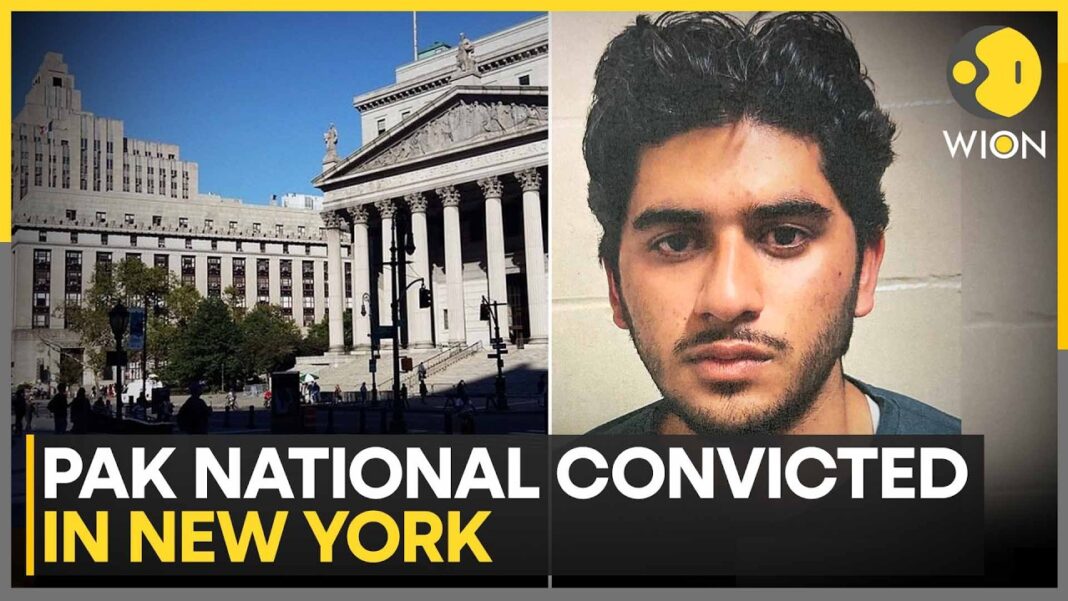
The defendant, Muhammad Shahzeb Khan, also known as Shahzeb Jadoon, entered his guilty plea on April 8 in a United States District Court, admitting to charges stemming from an elaborate and deeply disturbing plan to carry out a mass shooting at a Jewish center in Brooklyn. According to the U.S. Justice Department, Khan’s objective was not merely to inflict harm, but to maximize casualties in an attack timed with deliberate symbolic intent.
As reported by JNS, Khan specifically sought to align his planned assault with the one-year anniversary of the October 7 attacks carried out by Hamas, thereby amplifying both the psychological and ideological impact of his actions. The choice of date underscores the extent to which terrorist actors seek to exploit moments of historical trauma to advance their agendas.
What renders the case particularly alarming is its transnational dimension. Khan, a Pakistani citizen residing in Canada, attempted to cross into the United States with the explicit purpose of executing his plan. His actions highlight the increasingly borderless nature of modern terrorism, in which individuals radicalized in one jurisdiction can seek to perpetrate violence in another.
The Justice Department revealed that Khan intended to use automatic weapons to carry out the attack, targeting what he believed would be a densely populated Jewish site. His ambition, as articulated in court documents, was chilling in its scope: to conduct an assault that could rival the scale of the most devastating attacks in recent American history.
John Eisenberg, assistant U.S. attorney general for national security, provided a stark assessment of the threat. As cited in the JNS report, he stated that Khan viewed New York City as the “perfect” location due to its substantial Jewish population and expressed aspirations that his plot could become the largest attack on U.S. soil since September 11, 2001.
Central to Khan’s plan was his focus on Jewish communal institutions, particularly those associated with the Chabad movement. Brooklyn, home to the global headquarters of Chabad, represents not only a geographic hub but also a symbolic center of Jewish religious and cultural life.
By targeting such institutions, Khan sought to strike at the very heart of Jewish identity and continuity. The intent to attack a Chabad center highlights the broader pattern of antisemitic violence in which places of worship and community gathering are singled out for their visibility and significance.
As JNS reported, such threats are part of a wider trend in which extremist ideologies, including those affiliated with ISIS, continue to incite violence against Jewish communities worldwide.
Although the operational details of Khan’s plot were specific to New York City, the ideological framework underpinning his actions was rooted in the broader narrative propagated by ISIS. The group’s persistent efforts to inspire lone actors and decentralized cells have proven difficult to counter, particularly in the digital age.
Khan’s case illustrates how individuals can internalize and act upon such propaganda, translating abstract calls for violence into concrete plans. His guilty plea confirms that he not only embraced these ideologies but also took active steps to operationalize them.
The transnational nature of his activities further complicates the challenge faced by security agencies, necessitating close cooperation among international partners to identify and neutralize threats before they materialize.
Despite the gravity of the threat, the plot was ultimately thwarted through the coordinated efforts of federal and local law enforcement agencies. The New York City Police Department, working in conjunction with federal partners, played a pivotal role in identifying and disrupting Khan’s plans.
Police Commissioner Jessica Tisch emphasized the significance of this collaboration. In remarks highlighted by JNS, she noted that the successful prevention of the attack exemplifies the “sophisticated work” undertaken by the NYPD to safeguard the city’s diverse communities.
“This case is yet another example of the sophisticated work that the NYPD does to protect our communities from harm and our ongoing commitment to stop hate-fueled violence,” Tisch stated, underscoring the department’s vigilance in the face of evolving threats.
Khan’s guilty plea marks a critical step in the judicial process, ensuring that he will be held accountable under American law. His sentencing, scheduled for August 12, is expected to reflect the severity of his actions and the potential consequences of his plot.
Assistant Attorney General Eisenberg affirmed the government’s commitment to pursuing justice in such cases, stating that the national security division would “work tirelessly” to ensure that individuals who engage in terrorism face the full weight of the law.
The legal proceedings serve not only to punish wrongdoing but also to reinforce the broader principle that acts of terror, regardless of their origin, will be met with decisive and uncompromising responses.
The case of Muhammad Shahzeb Khan must be understood within the broader context of ongoing efforts to combat antisemitism and terrorism. As the JNS report emphasized, the persistence of such threats necessitates constant vigilance and proactive measures.
Jewish communities, particularly in major urban centers like New York, remain potential targets due to their visibility and symbolic significance. The prevention of this plot highlights the importance of intelligence gathering, community engagement, and interagency cooperation in mitigating risks.
The guilty plea of Muhammad Shahzeb Khan brings to light a harrowing narrative of intent, ideology, and intervention. It is a story that could have ended in tragedy but instead stands as a testament to the effectiveness of law enforcement and the resilience of the systems designed to protect society.
As documented by JNS, the case serves as both a warning and a reassurance—a reminder of the threats that persist and the capacity of institutions to confront them.
In an era defined by uncertainty and evolving challenges, the successful disruption of such a plot offers a measure of hope. It affirms that, even in the face of deeply entrenched hatred, the combined efforts of dedicated professionals can prevail, safeguarding lives and upholding the principles of justice and security.
