



|
Getting your Trinity Audio player ready...
|
By: Carl Schwartzbaum
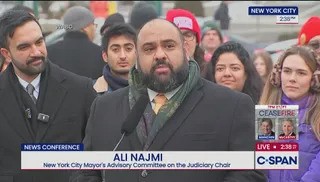
In the ever-contentious arena of New York City politics, few assertions have ignited as much astonishment, indignation, and debate as the recent claim that Mayor Zohran Mamdani has emerged as the preeminent political voice for a new generation of Jewish New Yorkers. The statement, delivered with striking confidence by his top legal adviser Ali Najmi, has reverberated across the city’s political, religious, and civic spheres, provoking both incredulity and fierce rebuttal.
According to an exclusive report that appeared on Saturday in The New York Post, Najmi’s remarks—made during a podcast conversation with Twillie Ambar—have crystallized a broader and deeply polarizing debate about identity, representation, and the evolving contours of Jewish political engagement in America’s largest city.
Najmi’s declaration was nothing short of audacious. He contended that Mayor Mamdani, a self-described democratic socialist whose positions on Israel have drawn sustained scrutiny, has become “the real political leader of the young Jewish community in New York.” According to The New York Post report, Najmi further argued that there exists a widening disconnect between established Jewish communal leadership and younger constituents, suggesting that Mamdani’s appeal transcends traditional boundaries.
Even Ambar, presiding over one of the nation’s most progressive academic institutions, appeared momentarily taken aback, characterizing the claim as “a bold statement.” The understated response reflected what many observers would later echo: that Najmi’s assertion was not merely bold, but profoundly controversial.
The intensity of the reaction cannot be understood without reference to Mamdani’s political record, which has been a persistent source of friction with many segments of the Jewish community. As detailed by The New York Post, the mayor has been an outspoken supporter of the Boycott, Divestment and Sanctions movement targeting Israel. He has also accused Israeli authorities of committing grave abuses in Gaza—positions that have drawn both support and sharp condemnation.
Compounding the controversy are Mamdani’s associations with prominent activist figures such as Hasan Piker and Linda Sarsour, both of whom have themselves been polarizing figures in debates surrounding Israel and antisemitism. Critics argue that such affiliations reinforce concerns about the mayor’s political orientation and its implications for Jewish New Yorkers.
Further fueling unease has been Mamdani’s reluctance to explicitly condemn the phrase “globalize the intifada,” a slogan widely interpreted by many as endorsing violence against Jews. According to The New York Post report, this silence has deepened skepticism regarding his commitment to addressing antisemitism in all its forms.
The controversy has also enveloped individuals within Mamdani’s personal and professional orbit. His wife, Rama Duwaji, has faced criticism over resurfaced social media activity, including posts that appeared to praise militant actions and cast doubt on widely reported atrocities. While such matters are distinct from the mayor’s official conduct, they have nonetheless contributed to a broader narrative that critics argue raises troubling questions.
Similarly, Mamdani’s personnel decisions have not escaped scrutiny. The dismissal of Moshe Davis, who previously led the city’s efforts to combat antisemitism under former Mayor Eric Adams, and the appointment of Phylisa Wisdom have been interpreted by some as indicative of a shifting institutional posture.
Yet Najmi’s argument rests on a counterintuitive premise: that criticism itself has fueled Mamdani’s appeal among younger Jewish voters. As he explained on the podcast, the more frequently the mayor was labeled an antisemite, the more enthusiastic the response from this demographic became.
According to The New York Post report, Najmi cited campaign observations, donor patterns, and volunteer engagement as evidence of this phenomenon. He described an “inverse reaction,” wherein negative portrayals galvanized rather than deterred support.
Such a claim invites a deeper examination of generational dynamics within the Jewish community. Younger voters, particularly those shaped by progressive movements and global human rights discourse, may interpret issues differently from their elders. For some, advocacy for Palestinian rights may coexist with Jewish identity in ways that challenge conventional frameworks.
The response from elected officials and community leaders has been swift and, in many cases, scathing. New York State Assemblyman Kalman Yeger dismissed Najmi’s assertion as “hilariously ridiculous,” arguing that it reflects an attempt to redefine Jewish communal identity without legitimacy.
Yeger emphasized that in many traditionally Jewish neighborhoods, Mamdani’s message failed to resonate. “He got trounced,” he noted, pointing to electoral outcomes as evidence of widespread rejection.
Similarly, Moshe Davis offered a more sociological critique, suggesting that Mamdani’s appeal among some younger Jews reflects not leadership but exploitation. According to Davis, as quoted by The New York Post, these individuals may be experiencing a disconnection from their heritage—a condition he believes will evolve over time.
“This is not leadership,” Davis argued in substance, “but a temporary alignment that may dissipate as individuals seek deeper roots and understanding.”
Empirical data provides a more nuanced picture. Exit polling cited by The New York Post indicates that Mamdani secured approximately 31 percent of the Jewish vote in the general election—a figure that, while not insignificant, falls well short of a majority.
Among younger Jewish voters aged 18 to 29, his support rose to 44 percent, suggesting a generational divide. However, even within this cohort, the data does not support the notion of overwhelming or universal backing.
This disparity between narrative and numerical reality lies at the heart of the controversy. Najmi’s assertion, critics contend, extrapolates from selective observations to a sweeping conclusion that is not borne out by broader evidence.
The debate surrounding Mamdani’s relationship with Jewish voters reflects broader transformations within American Jewish life. Questions of identity, political alignment, and global responsibility are increasingly contested, particularly among younger generations.
At the same time, the enduring significance of Israel as a central element of Jewish identity continues to shape political attitudes. For many, Mamdani’s positions represent a departure from core communal values, while for others they align with a reimagined understanding of justice and solidarity.
This tension is not unique to New York City, but the city’s size, diversity, and political prominence render it a particularly vivid stage on which these dynamics play out.
As the dust settles on Najmi’s remarks, one conclusion is clear: the question of who speaks for New York’s Jewish community—particularly its younger members—remains deeply contested.
Councilwoman Inna Vernikov offered one of the most pointed rebuttals, challenging the premise that Mamdani’s alliances and rhetoric could position him as a communal leader. Her remarks, cited by The New York Post, encapsulate a broader skepticism shared by many critics.
Yet the persistence of the debate suggests that it taps into genuine and unresolved questions. How do generational shifts reshape political identity? What constitutes authentic representation? And how should communities navigate internal diversity of thought?
The controversy ignited by Najmi’s comments is more than a fleeting political skirmish. It is a flashpoint in a larger struggle over identity, leadership, and the future of communal politics in an era of rapid change.
For Mayor Zohran Mamdani, the episode underscores both the breadth of his appeal and the intensity of the opposition he faces. For his critics, it reinforces concerns about the direction of his administration and its relationship with a historically significant constituency.
As The New York Post has chronicled, this debate is unlikely to dissipate anytime soon. Instead, it will continue to evolve, reflecting the complexities of a city—and a community—grappling with its own transformation.
