



|
Getting your Trinity Audio player ready...
|
By: Fern Sidman
The annual March for Israel along Fifth Avenue has long been a carefully choreographed expression of solidarity between American Jewry and the Jewish state, a public ritual that binds diaspora identity to the rhythms of Israeli diplomacy. This year’s parade, scheduled for May 31, was expected to unfold with the familiar choreography of flags, anthems, and dignitaries. Instead, it has become the unexpected stage for a diplomatic rupture—one that, as VIN News reported on Wednesday, exposes fault lines within Israel’s own leadership over how to engage political figures in the United States whose record on Israel and antisemitism remains deeply contested.
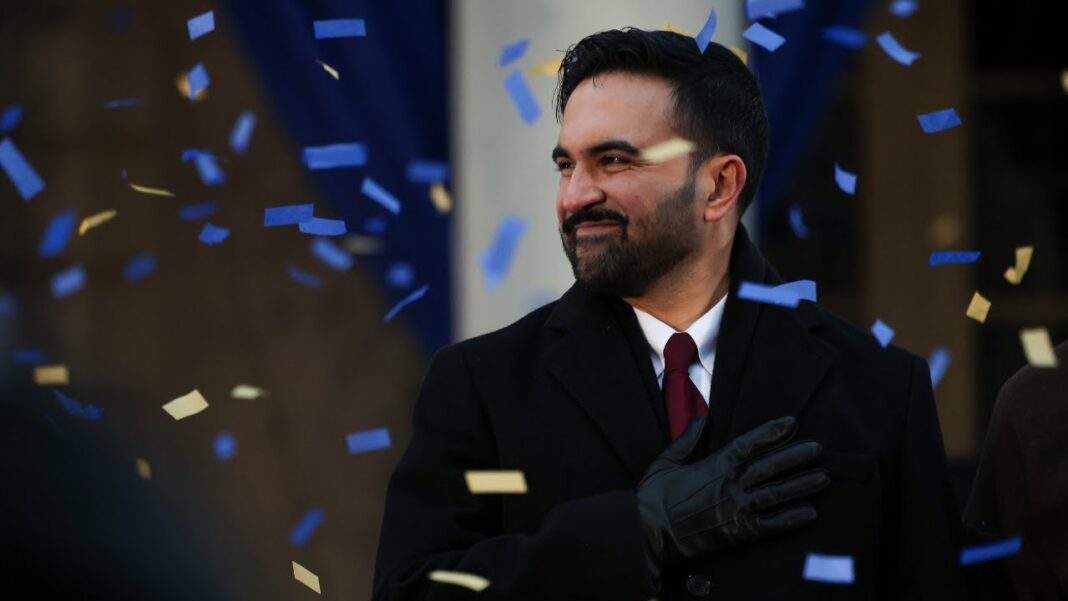
At the center of the controversy stands Yaakov Hagoel, chairman of the World Zionist Organization, who publicly announced his intention to invite New York City Mayor Zohran Mamdani to march beside him in the parade. Hagoel framed the gesture as an appeal to unity, a symbolic overture intended to draw the mayor closer to the Jewish community and, by implication, to the State of Israel itself. Yet the invitation, made in the glare of a Jerusalem conference was received by many as a bewildering miscalculation. For critics, the problem was not merely procedural, but moral and strategic: an embrace extended to a mayor whose municipal decisions and political rhetoric have placed him at odds with mainstream Jewish communal concerns.
The response from Israel’s top diplomat in New York, Consul General Ofir Akunis, was swift and unequivocal. In a statement that the VIN News report described as unusually blunt for an internal Israeli dispute, Akunis rebuked Hagoel for overstepping his authority. The official Israeli delegation to the March for Israel, Akunis made clear, is led by the consulate and composed of ministers, lawmakers, and guests invited through established diplomatic channels. Hagoel, though a familiar presence at the parade, attends as a guest rather than as a representative empowered to extend invitations on Israel’s behalf. More pointedly, Akunis underscored that those who do not recognize Israel as the Jewish state have no place marching as symbolic standard-bearers at an event explicitly designed to affirm that very identity.
The subtext of Akunis’s rebuke reflects a deeper unease within Israel’s diplomatic corps about how the Jewish state should relate to political leaders abroad who position themselves as allies of Jewish communities while simultaneously advancing policies that many Jews perceive as inimical to their security. Mayor Mamdani’s tenure has been marked by contentious decisions, including his refusal to prohibit protests outside synagogues and his administration’s retreat from adopting the International Holocaust Remembrance Alliance’s working definition of antisemitism. For many in New York’s Jewish community, these choices have felt less like principled neutrality and more like abdication at a moment when antisemitic incidents and intimidation have surged.
Hagoel, in explaining his invitation, suggested that marching together could serve as a catalyst for dialogue. He has reportedly urged Mamdani to reconsider certain municipal policies, presenting the parade as an opportunity for rapprochement rather than confrontation. Yet this logic, however well-intentioned it may appear on the surface, betrays a troubling naïveté about the symbolic weight of the March for Israel. As the VIN News report observed, the parade is not merely a civic procession; it is a performative declaration of shared values and commitments. To invite a political figure whose record suggests ambivalence, if not hostility, toward core Jewish concerns risks diluting the parade’s meaning and, worse, legitimizing positions that many in the community experience as threatening.
The controversy has laid bare the tensions between two competing instincts within Zionist leadership: the impulse toward broad coalition-building and the imperative to draw clear moral boundaries. Hagoel’s approach appears rooted in the former. He has long positioned the World Zionist Organization as a platform for engagement across ideological divides, a forum in which dialogue might temper extremism and misunderstanding. But in this instance, the calculus seems to have misjudged the asymmetry of the encounter.
Mamdani stands to gain symbolic capital from marching alongside Zionist leaders, presenting himself as a bridge figure to Jewish voters and institutions. The Jewish community, by contrast, risks seeing one of its most visible annual affirmations of Israel’s legitimacy reframed as a gesture of accommodation to a mayor whose policies have, in practice, left synagogues and Jewish institutions feeling exposed.
VIN News’s coverage has underscored how deeply unsettling this episode has been for communal leaders in New York. For them, the March for Israel is not a venue for political experimentation but a sanctuary of collective affirmation in a fraught climate. The parade takes place against a backdrop of rising antisemitism, polarized campus politics, and a broader erosion of consensus around Israel in progressive circles. To introduce ambiguity into such a moment is, in the eyes of many, to weaken the community’s already strained sense of security. It is here that the criticism of Hagoel’s decision sharpens: leadership, particularly in moments of vulnerability, demands discernment. Extending a public olive branch without securing substantive commitments in return risks being read not as magnanimity but as capitulation.
The dispute also highlights a structural ambiguity in the World Zionist Organization’s contemporary role. Founded as a movement to galvanize Jewish national revival, it now operates within a complex ecosystem of Israeli state institutions and diaspora organizations. Hagoel’s invitation, while perhaps consonant with a vision of the WZO as an independent civil society actor, collided with the protocols and sensibilities of Israel’s official diplomatic apparatus. Akunis’s intervention was not merely a bureaucratic correction but a reassertion of diplomatic coherence: Israel’s representation abroad, he insisted, must speak with one voice, particularly on matters as symbolically charged as the March for Israel.
City Hall’s silence in the wake of the controversy has only amplified the unease. As the VIN News report noted, the absence of an immediate response from Mayor Mamdani leaves open the question of how he interprets the invitation and the rebuke. Would he have accepted Hagoel’s overture had it not been publicly contested? Or does the episode merely reinforce the political tightrope he walks between progressive constituencies critical of Israel and a Jewish electorate acutely sensitive to perceived slights? In either case, the affair calls attention to how fraught the terrain of Jewish–political engagement has become in contemporary New York.
In the final analysis, the episode serves as a cautionary tale about the perils of symbolic diplomacy untethered from strategic clarity. Hagoel’s gesture, framed as an act of inclusion, has instead exposed the fragility of communal trust and the importance of procedural legitimacy.
If the March for Israel is to retain its meaning as an unambiguous affirmation of Jewish self-determination, then those entrusted with stewarding its symbolism must exercise a keener sensitivity to the political and moral contexts in which they operate. In this instance, the invitation extended by Yaakov Hagoel appears less an act of bridge-building than an ill-advised overture that underestimated the costs of blurring lines at a moment when clarity is most urgently needed.
