



|
Getting your Trinity Audio player ready...
|
By: Russ Spencer
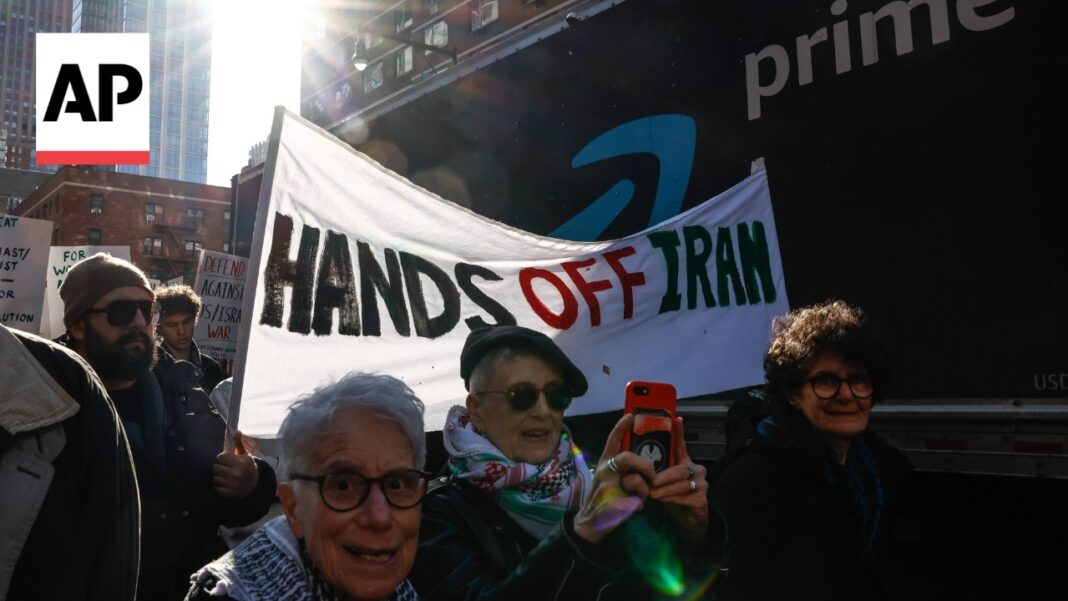
The reverberations of a rapidly escalating conflict thousands of miles away were felt with unmistakable intensity in the heart of Manhattan on Saturday, as hundreds of demonstrators filled Times Square to protest the sweeping military strikes carried out by the United States and Israel against Iran. Their chants — “Hands off the Middle East” and “Hands off Iran now” — echoed off the towering billboards and glass façades, transforming one of the world’s most iconic commercial crossroads into a theater of political dissent.
According to a report that appeared on Sunday at NY1.com, the rally began in Times Square before evolving into a march stretching roughly a mile northward to Columbus Circle. The demonstration was organized by a coalition of activist groups, including The People’s Forum, and reflected a combustible mix of grief, fear and defiance among participants who view the strikes as a dangerous escalation.
“It’s good that there is loud, vocal support for peace,” protester Josh Kaitan Lucas told NY1.com. “However, it’s unconscionable that we have to continuously come out en masse to protest some of the abhorrent actions of this administration.” His remarks encapsulated the sentiment expressed by many in attendance: that civic engagement, however necessary, is an exhausting ritual in an era of recurring geopolitical crises.
Co-organizer Layan Fuleihan, speaking to NY1.com amid a sea of placards and keffiyehs, voiced anxiety about what she characterized as the specter of “another endless war.” “I’m scared about another endless war,” she said. “I think that will only bring death and destruction to the world, and it will also be not good for the people inside the United States.” Yet Fuleihan also expressed cautious optimism, noting that “people from all walks of life came out today,” suggesting a broad coalition united by opposition to further military entanglement.
The emotional tenor of the march was palpable. Valerie Gaza of Forest Hills described her feelings to NY1.com as a turbulent mixture of “sadness and frustration and rage and overwhelming grief.” Such language underscores how international events can catalyze deeply personal reactions among New Yorkers, whose city has long served as both a global crossroads and a symbolic arena for political expression.
While protesters condemned the strikes, another gathering unfolded just a short distance away at the United Nations headquarters, where the U.N. Security Council convened an emergency session to address the deteriorating situation. As NY1.com reported, the crisis drew individuals of Iranian descent who expressed sentiments markedly different from those heard in Times Square.
Two men who said they had left Iran several years ago told NY1.com that they welcomed the military action and viewed it as a form of humanitarian intervention. “We are happy because this is like humanitarian intervening, and then done by the USA, joint USA and Israel, and all people are happy in Iran,” one man said, claiming he had spoken with friends in Tehran who were celebrating in the streets. The other described Iran’s late supreme leader, Ayatollah Ali Khamenei, in stark terms, asserting that he had “killed thousands of Iranians” and insisting that he did not regard him as a legitimate representative of the Iranian people.
These sharply divergent perspectives — anti-war demonstrators decrying escalation and exiled Iranians praising intervention — illustrate the profound complexity of diasporic politics in New York. The city is home to vibrant communities with deep ties to the Middle East, and its public spaces often become forums where those communities articulate clashing visions of justice, sovereignty and security.
The volatile geopolitical context intensified after President Donald Trump announced on social media that Ayatollah Ali Khamenei had been killed in the strikes, calling him “one of the most evil people in history.” Iranian state media later confirmed his death. The NY1.com report noted that the confirmation added another layer of urgency to the Security Council’s emergency deliberations and heightened emotions among demonstrators on both sides of the debate.
Against this backdrop, the New York Police Department adopted a precautionary posture. As NY1.com reported, officers maintained a visible presence on Manhattan’s East Side near sensitive sites close to the United Nations complex. Patrols were observed outside the Israeli consulate on Second Avenue and near the Permanent Mission of Iran to the United Nations on Third Avenue. The increased security reflected standard protocol during periods of international tension, particularly when demonstrations are expected.
Law enforcement officials have not reported any significant incidents connected to Saturday’s march, which remained largely peaceful. Nevertheless, the symbolism of uniformed officers stationed near diplomatic missions underscored the fragile intersection of global conflict and local security.
The march’s route from Times Square to Columbus Circle carried its own symbolism. Moving northward along Broadway, protesters traversed some of Manhattan’s most heavily trafficked corridors, a deliberate strategy to amplify visibility and public awareness. The NY1.com report described the procession as orderly but impassioned, with chants punctuating the city’s ambient noise.
Organizers have already announced plans for further mobilization. NY1.com reported that a rally scheduled for Sunday afternoon will begin at the United Nations before proceeding toward Times Square in what is being billed as a “March for Freedom.” Organizers anticipate more than 2,000 Iranian-Americans and their supporters will attend, signaling that Manhattan’s streets may once again serve as a microcosm of the broader geopolitical contest.
For city residents, the weekend’s events serve as a reminder that New York is inextricably linked to global affairs. Decisions made in Washington, Jerusalem and Tehran reverberate through Midtown plazas and uptown boulevards, shaping conversations in cafés, classrooms and community centers.
The spectacle of dueling narratives — anti-war activists invoking the trauma of prolonged conflict and exiled Iranians celebrating the downfall of a regime they regard as tyrannical — encapsulates the moral and political ambiguity of the moment. NY1.com’s on-the-ground reporting captured this duality with clarity, documenting both the chants of protest and the voices of those who see in the strikes a rare opportunity for change.
As night fell over Manhattan, the crowds thinned, but the questions remained. Will the military action usher in further escalation or a recalibration of power? Will it embolden dissent within Iran or deepen instability across the region? For New Yorkers gathered in Times Square and outside the United Nations, such uncertainties are not abstract. They are urgent, immediate and deeply felt.
In a city accustomed to standing at the nexus of global currents, Saturday’s demonstrations reaffirmed an enduring truth: when the world shifts, New York responds — with protest, with debate and with an unwavering insistence on being heard.
