



|
Getting your Trinity Audio player ready...
|
By: Fern Sidman – Jewish Voice News
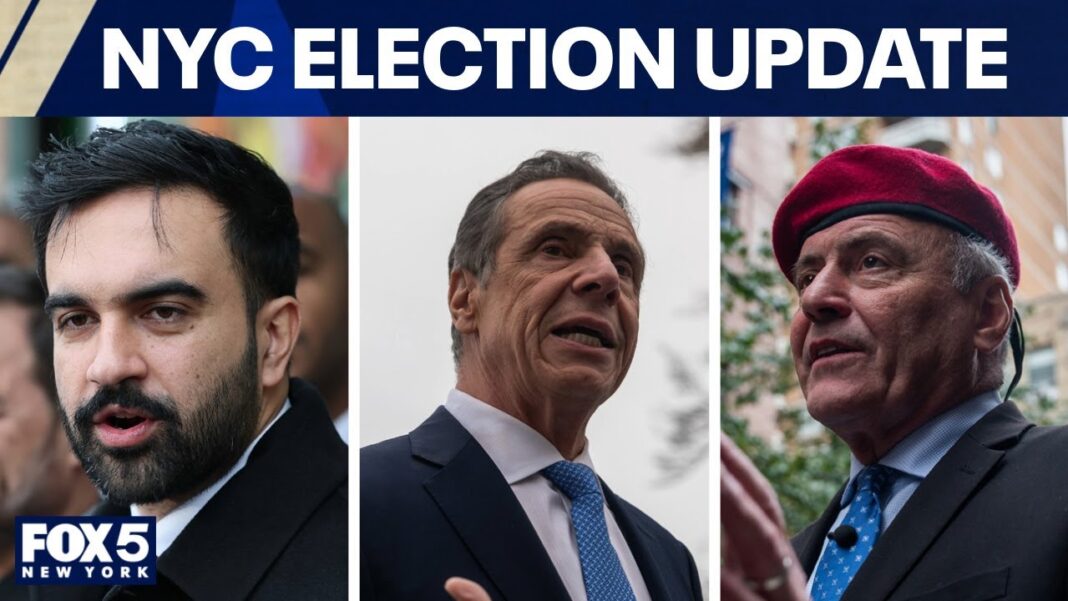
In a development that draws attention to both the political volatility of New York City’s mayoral race and the deep divisions within one of its most influential religious communities, former Gov. Andrew Cuomo secured the formal backing of key leaders within the Satmar Ahronim sect of the Orthodox Jewish community on Sunday. The endorsement came just hours after an internal uproar erupted over what insiders described as a rogue and “unauthorized” endorsement of socialist frontrunner Zohran Mamdani by another prominent rabbi in the same faction.
According to a report that appeared Monday evening in The New York Post, the dramatic reversal unfolded rapidly, revealing the complex power dynamics within the Satmar bloc—a community whose unified support has historically swayed major elections in Brooklyn and beyond. While the episode began with a single rabbi’s surprise declaration of support for Mamdani, it ended with an emphatic repudiation from the community’s senior leadership and a collective endorsement of Cuomo, whose campaign immediately capitalized on the turnabout.
In a public letter released through Cuomo’s campaign, Cheskel Berkowitz, Avrum Brach, and Shulem Yitzchok Jacobowitz—three respected figures in the Williamsburg-based Satmar Ahronim faction—announced their official endorsement of the former governor, who is running as an independent in Tuesday’s pivotal mayoral election.
“I’m deeply honored to have the support of these respected community leaders,” Cuomo said in a statement quoted by The New York Post. “Their voices carry tremendous weight in standing up for family, faith, and common sense. I share their belief that New York needs unity and balance—not ideological extremes—and together, we’ll make this city safer, fairer, and stronger for all.”
The endorsement is a significant boost for Cuomo, who has positioned himself as the centrist alternative to Democratic Socialist candidate Zohran Mamdani, whose left-wing agenda and history of anti-Israel rhetoric have alarmed many Jewish voters across the five boroughs.
Before the Ahronim leadership issued their statement, the community was briefly thrown into confusion when Rabbi Moshe Indig, another well-known Williamsburg figure, reportedly announced support for Mamdani on a local community website. As The New York Post report recounted—citing Jewish media outlet Belaaz—Indig’s post was swiftly circulated across social media and picked up by Mamdani’s campaign.
The episode immediately sparked outrage among Ahronim leaders, who accused Indig of acting “unilaterally” and “without the consent of the governing council.” Sources told Belaaz, and later confirmed by The New York Post, that the endorsement was “totally unauthorized” and “done behind the backs of other community leaders.”
Mamdani, however, wasted no time seizing on the apparent endorsement, amplifying it on X (formerly Twitter) and declaring: “I was honored to receive the endorsement of Rabbi Moshe Indig and Ahronim leaders in Williamsburg today. Together, we will fight the scourge of antisemitism and build a city that works for every New Yorker.”
But within hours, that declaration was disavowed by the community’s senior leadership—an unusual and public rebuke that underscored both the sensitivity and significance of Orthodox political alignments in New York’s electoral landscape.
As The New York Post report noted, the Satmar community, particularly the Ahronim faction, represents one of the most disciplined bloc-voting forces in the city. Its endorsements can deliver thousands of votes in closely contested races—a reality that Cuomo’s campaign clearly understood.
For Cuomo, the endorsement serves as a political and moral counterweight to Mamdani’s growing momentum among progressive and minority constituencies. It also provides a potent visual of traditional religious support rallying around a candidate promising moderation and stability, rather than radical change.
The endorsement letter released by Berkowitz, Brach, and Jacobowitz was unequivocal in tone, framing the choice as an existential one for Orthodox Jews in New York:
“Everything we value and what we stand for is at stake,” the statement read. “Each of us must do everything in our power to protect and preserve our values, communities, yeshivas, and way of life.”
This language, The New York Post report observed, is strikingly reminiscent of past appeals issued by Orthodox leadership during moments of cultural or political tension, signaling that the community views Mamdani’s rise not merely as a political challenge, but as a threat to its religious and educational autonomy.
The controversy also sheds light on the growing unease among Jewish voters—particularly Orthodox and traditional communities—regarding Mamdani’s record. As The New York Post has frequently reported, Mamdani, a Democratic Socialist of America (DSA) member, has a history of inflammatory statements about Israel and has endorsed the Boycott, Divestment, and Sanctions (BDS) movement. He has also referred to the Israeli government’s military actions as “genocide” and previously defended using the slogan “globalize the intifada,” a phrase widely condemned as a call for violence against Jews.
Although Mamdani has recently attempted to distance himself from some of his more controversial positions—claiming he no longer uses the “intifada” slogan—his reputation among Jewish New Yorkers remains fraught.
For Orthodox voters, whose communities are deeply connected to Israel and acutely sensitive to rising antisemitism in the city, Mamdani’s ideological posture is seen as dangerous and disqualifying.
“It’s not about politics—it’s about trust,” one Williamsburg resident told The New York Post. “Our community cannot support someone who stands with movements that demonize Jews and Israel. We remember too well what happens when leaders choose ideology over safety.”
For Andrew Cuomo, the endorsement also represents a form of political rehabilitation. Once a dominant figure in New York politics, the former three-term governor resigned in 2021 amid sexual misconduct allegations he continues to dispute. His return to public life, and now his mayoral run as an independent, has been met with skepticism from progressives but cautious optimism from moderates and religious voters who view him as a pragmatic leader.
As The New York Post noted in its coverage, Cuomo’s renewed engagement with Orthodox and conservative-leaning communities reflects his broader strategy of positioning himself as a bulwark against “extremism on both sides.” His message of restoring balance and competence resonates particularly well in neighborhoods weary of rising crime, economic stagnation, and what many see as the unrealistic social engineering proposed by Mamdani’s left-wing platform.
In his statement following the Satmar endorsement, Cuomo reaffirmed his commitment to values-driven governance: “New York needs unity and balance—not ideological extremes,” he said, adding that his goal is to make the city “safer, fairer, and stronger for all.”
As The New York Post report observed, the Satmar dispute is emblematic of a broader cultural and political realignment taking place in New York’s diverse electorate. Orthodox Jewish communities—traditionally pragmatic and often divided along dynastic or geographic lines—are increasingly coalescing around candidates perceived as defenders of religious liberty and law-and-order governance.
Meanwhile, Mamdani’s brand of progressive politics, grounded in class struggle and social activism, has alienated constituencies that once formed the backbone of the Democratic Party’s coalition. His alignment with far-left movements, his economic proposals to freeze rents and raise taxes on the wealthy, and his overt hostility toward Israel have made him a polarizing figure even within his own party.
The episode also reveals how identity politics can fracture, rather than unify, when religious and cultural identities collide with ideological agendas. The “unauthorized” endorsement by Rabbi Indig—though swiftly retracted—illustrated how even small acts of dissent within tight-knit communities can reverberate widely in the digital age, where social media posts can be amplified, distorted, and weaponized within minutes.
The Ahronim’s endorsement of Cuomo carries both symbolic and practical implications. Symbolically, it sends a message that Orthodox Jewish leaders are unwilling to align with candidates whose rhetoric or alliances are hostile to Jewish life or Israel’s security. Practically, it could provide Cuomo with a crucial edge in precincts where bloc voting has historically swung elections—particularly in Brooklyn neighborhoods such as Williamsburg, Borough Park, and Crown Heights.
As The New York Post report observed, the clash over endorsements within the Satmar community mirrors the larger battle for New York’s political soul: a contest between ideological radicalism and pragmatic governance, between symbolic activism and tangible results.
For many New Yorkers, especially those watching the turmoil with growing unease, the stakes could not be higher. As one community leader told the paper, “This election isn’t just about who becomes mayor—it’s about what kind of city New York chooses to be.”
