



|
Getting your Trinity Audio player ready...
|
Light Over Silence: Amy Schumer Marks Hanukkah With Defiance, Faith, and a Hard Lesson in Who Stood With Her After Oct. 7
By: Abe Wertenheim
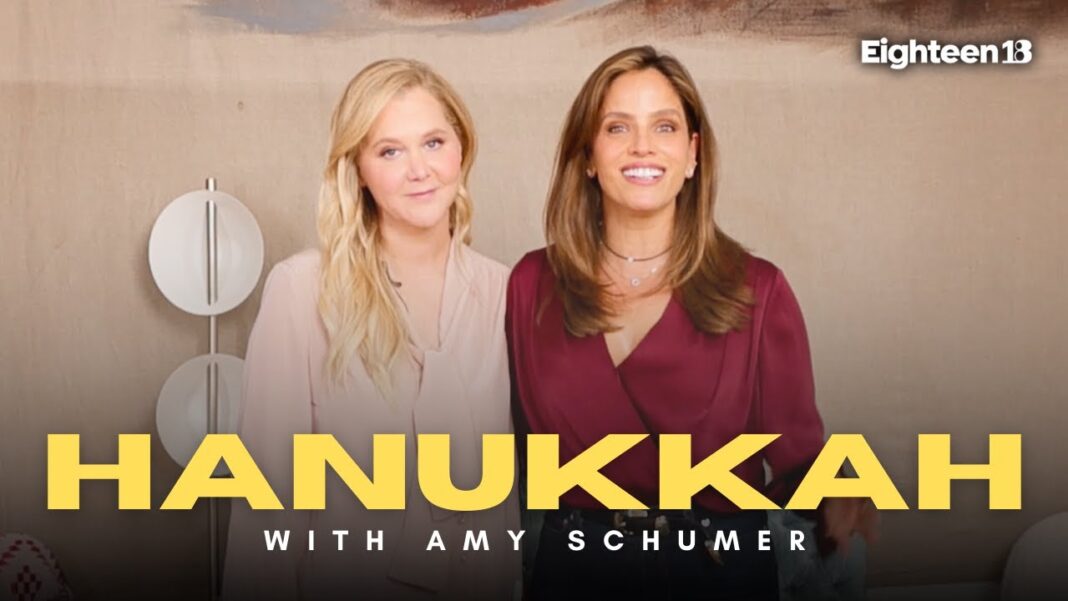
Amy Schumer’s familiar comedic bravado gave way this week to something more intimate, reflective, and resolute, as the Jewish comedian marked the final days of Hanukkah with a public candle-lighting that doubled as a searing commentary on antisemitism, personal courage, and cultural endurance. In a video recorded as part of the #BringOnTheLight campaign and widely circulated online, Schumer spoke candidly about the personal cost of speaking out after the Oct. 7, 2023 Hamas terror attacks against Israel—and the clarity that followed. The moment, reported by The New York Post on Sunday, resonated far beyond celebrity culture, tapping into a broader reckoning unfolding across Jewish communities worldwide.
“I stood up and spoke my mind after Oct. 7. I didn’t know I would be such a minority,” Schumer said in the video, filmed inside her New York home. Her words were delivered not as a punchline but as a sober admission—one that underscored how isolating public support for Jewish causes has become in some corners of entertainment and activism. According to the information provided in The New York Post report, Schumer’s remarks were among the most forthright from a major Hollywood figure since the Hamas massacre, which claimed the lives of more than 1,200 Israelis and plunged the region into a prolonged and polarizing war.
Schumer, 44, said she was stunned by how few peers were willing to speak out. “There were like three of us who opened our mouths,” she said, adding that the aftermath of Oct. 7 forced her to reassess relationships she once assumed were unshakable. “It gave me clarity,” she explained. “I learned who my real friends are.”
Amy Schumer celebrates her Jewish pride while lighting Hanukkah candles https://t.co/Xk6iyBRPk6 pic.twitter.com/l59TSAmDf1
— New York Post (@nypost) December 21, 2025
That sense of reckoning has become a recurring theme in coverage by The New York Post, which has repeatedly chronicled the silence—or outright hostility—many Jewish public figures have faced since the war began. For Schumer, the realization was painful but also galvanizing. “Knowing the few people who feel that everyone should be equal—it shouldn’t be ‘except Jews,’” she said. “It feels like everybody is fighting for everybody’s rights—except for Jewish people.”
The video was released as part of #BringOnTheLight, an antisemitism-awareness campaign spearheaded by former Israeli actress and activist Noa Tishby. The initiative encouraged Jewish celebrities and allies to light Hanukkah candles publicly, reclaiming Jewish pride at a moment when many feel pressure to retreat into silence. The campaign began with singer Pink and culminated with Schumer lighting the final candle, symbolically closing the eight-day holiday.
For Tishby, the campaign’s premise was straightforward yet defiant. “Jewish pride is the only way to fight antisemitism,” she said during her appearance alongside Schumer. The message echoed a growing sentiment among Jewish leaders and commentators, many of whom have told The New York Post that the current surge in antisemitism demands visibility rather than retreat.
The footage of Schumer lighting the menorah was intimate, almost domestic. Candles flickered on a countertop as Schumer spoke softly about family, ancestry, and survival. But the conversation was not without humor. The comedian—newly slimmed down and unmistakably herself—interspersed the gravity of the moment with wry, Borscht Belt–style observations while nibbling latkes.
“When I grew up, there was a lot of antisemitism,” she recalled. “My last name is Schumer. They changed it to Jewmer.” The line landed with a knowing laugh, but the subtext was unmistakable. Schumer went on to describe how humor functioned not merely as entertainment, but as a survival mechanism—one she sees as intrinsic to Jewish identity.
“When things are the absolute worst is when my family is the funniest,” she said. “When we hit rock bottom, we can laugh the hardest.” That philosophy, Schumer suggested, is not unique to her household but woven into the fabric of Jewish history itself.
To illustrate the point, she held up photographs of her grandparents, images that conjured an era when Jewish comedians found refuge and resonance in the Catskills’ famed Borscht Belt. One photo showed her grandmother draped in a mink stole, another her grandfather dressed for a night out, both poised to enjoy an evening of laughter. Schumer’s reflections on her grandparents struck a chord with viewers who saw in them a reminder of how comedy once offered sanctuary amid discrimination.
“That’s how we survive,” Schumer said. “That’s not unique to me. That’s Jewish character.”
Yet the tone of the evening was not nostalgic alone. Schumer was unequivocal about the present moment and her refusal to shrink from it. “So every time we gather or we take a moment with our family, every time we light the candle, I feel we’ve won,” she said. “Enjoying and being proud of being Jews… I think my ancestors would be proud.”
The assertion—that survival itself is a victory—has been a recurring refrain in The New York Post’s coverage of Jewish responses to rising antisemitism. From public menorah lightings guarded by police to college students facing hostility for wearing Stars of David, the paper has documented a climate in which even routine expressions of Jewish identity can feel like acts of defiance.
Schumer’s decision to participate publicly in #BringOnTheLight was, in that sense, deeply political—even if it was framed through faith and culture rather than policy. As The New York Post report noted, the comedian has faced backlash online for her outspoken support of Israel and her refusal to equivocate in the face of Hamas atrocities. She has been labeled divisive by critics who accuse her of oversimplifying a complex conflict. Schumer, for her part, has remained unapologetic.
Her remarks also carried a particular resonance given her family ties. Schumer is a cousin of Senate Majority Leader Chuck Schumer, one of the most prominent Jewish politicians in American history. While she did not reference politics directly in the video, her comments about abandonment and selective activism echoed criticisms leveled by Jewish leaders across the political spectrum—many of whom have spoken to The New York Post about feeling sidelined within progressive movements they once considered allies.
Noa Tishby, who organized the campaign, praised Schumer’s forthrightness. “Amy is a brilliant comedian, and I admire how fierce and unapologetic she is in every aspect of her life,” Tishby said. “It was fascinating to have her share how comedy has helped her and her family get through tough times.”
Tishby added that she was “honored” to end the holiday and the #BringOnTheLight campaign with Schumer. “To do it with a smile and a laugh,” she said, “felt exactly right.”
As The New York Post report observed, the pairing of humor and defiance was emblematic of the campaign itself. Rather than respond to antisemitism with fear, #BringOnTheLight sought to counter it with visibility, tradition, and a refusal to be cowed. Schumer’s candle-lighting, as the final installment, illustrated that ethos.
In the broader cultural landscape, Schumer’s comments come at a moment of heightened tension. Antisemitic incidents in the United States have surged since Oct. 7, according to law enforcement and advocacy groups—a trend highlighted by The New York Post. Jewish celebrities who speak out have found themselves targeted by online mobs, accused of disloyalty or warmongering simply for expressing solidarity with Jewish victims.
Against that backdrop, Schumer’s message was both simple and radical: pride is not negotiable. “Every time we light the candle,” she said, “I feel we’ve won.”
It was a quiet declaration, delivered not from a stage but from a living room, illuminated by the glow of Hanukkah flames. Yet, as The New York Post reported, the moment captured something far larger than one celebrity’s holiday ritual. It reflected a community wrestling with fear, betrayal, and resilience—and choosing, once again, to answer darkness with light.
