



|
Getting your Trinity Audio player ready...
|
By: Fern Sidman
In the seaside town of Margate, long known for its artistic revival and cultural experimentation, a newly opened exhibition has ignited a fierce and deeply polarizing national debate—one that extends far beyond the confines of a gallery space and into the broader questions of free expression, political activism, and the resurgence of antisemitic imagery in contemporary public discourse.
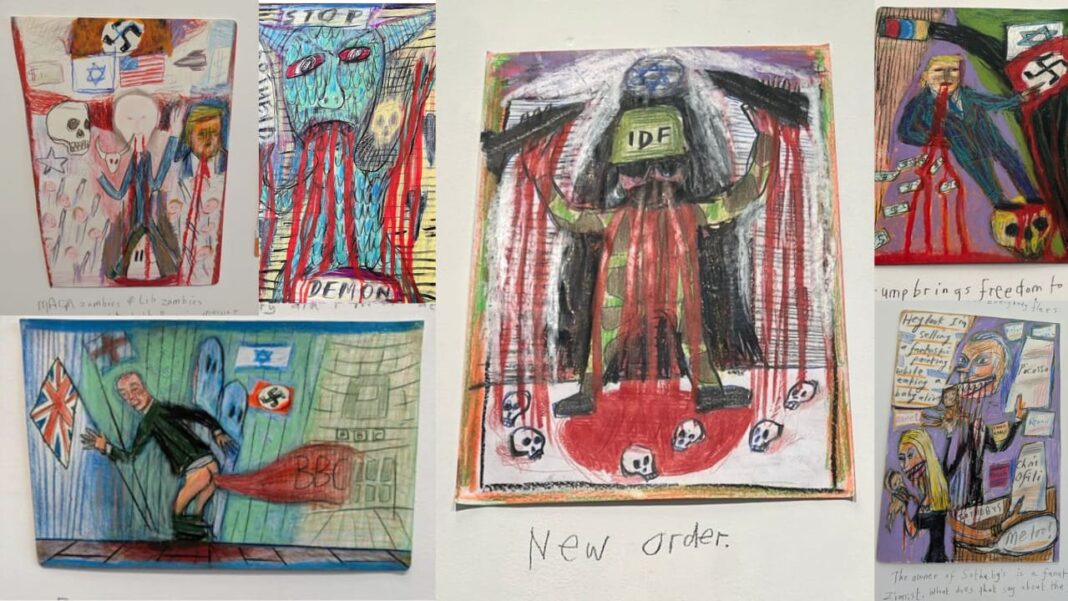
The exhibition, titled “Drawings Against Genocide,” opened this past weekend at Joseph Wales Studios and features nearly one hundred works by Matthew Collings, a seventy-year-old writer and former art critic. Organized by the advocacy groups Art for a Free Palestine and Thanet for Palestine, the collection has drawn sharp condemnation for what critics describe as a disturbing amalgamation of antisemitic tropes, incendiary political messaging, and graphic imagery that targets Jewish individuals and institutions while denying widely documented acts of violence.
As reported by The Algemeiner on Monday, the exhibition has become a flashpoint in an already tense national climate, where concerns over antisemitism have intensified in recent months. The drawings, according to observers and critics cited by The Algemeiner, do not merely critique Israeli policy—a form of expression broadly protected within democratic societies—but instead employ imagery and narratives that echo some of the most pernicious motifs in the historical canon of anti-Jewish propaganda.
Among the most controversial elements of the exhibition are depictions that incorporate swastikas alongside Israeli symbols, grotesque caricatures invoking blood libel imagery, and portrayals of Jewish individuals as conspiratorial figures wielding disproportionate influence. One drawing, as described in coverage referenced by The Algemeiner, depicts members of an alleged “Israel lobby” as controlling global affairs in a manner reminiscent of longstanding antisemitic conspiracy theories. Another employs imagery of individuals consuming infants—an unmistakable reference to medieval blood libels that have historically been used to incite violence against Jewish communities.
Additional works reportedly include representations of Israeli soldiers in exaggeratedly violent poses, as well as imagery that denies or minimizes the atrocities committed during the Hamas-led attacks in Israel on October 7, 2023. Such denialism, critics argue, compounds the offense by not only distorting historical reality but also trivializing the suffering of victims.
The exhibition also targets specific individuals, including public figures associated with Jewish organizations, journalists, and even cultural personalities with connections to Israel. In one instance, a depiction of Israeli Prime Minister Benjamin Netanyahu presents him in a grotesque and dehumanizing manner, accompanied by text suggesting manipulative intent. Other figures, such as media professionals and business leaders, are portrayed through a similarly hostile lens.
David Collier, a British investigative journalist known for his work on extremism and antisemitism, offered a stark assessment in comments cited by The Algemeiner. “This is the recycling of classic antisemitic tropes dressed up as activism,” he said, emphasizing that the normalization of such imagery within an art gallery context represents a troubling erosion of societal boundaries.
Collier’s remarks extended beyond the exhibition itself to encompass a broader critique of the current environment in the United Kingdom. He pointed to recent incidents of violence and intimidation targeting Jewish individuals and institutions, suggesting that there is an increasingly visible nexus between inflammatory rhetoric and real-world consequences. The Algemeiner has reported extensively on this dynamic, highlighting a pattern in which the boundaries between political protest and hate speech appear to be increasingly blurred.
The Combat Antisemitism Movement, an international advocacy organization, issued an equally forceful condemnation, describing the drawings as “worse than Nazi propaganda” and accusing the exhibition of perpetuating “monstrous blood libels.” Similarly, the grassroots group Stop the Hate UK characterized the collection as an expression of “obsessive hatred of Jews,” noting the recurrence of motifs—such as money and blood—that have historically been used to vilify Jewish communities.
Stop the Hate UK also drew attention to video footage circulating on social media in which an individual associated with the exhibition’s curation appears to endorse slogans calling for the dismantling of the State of Israel. Such rhetoric, while defended by some as political expression, has been widely criticized for its implications and its potential to inflame tensions.
The exhibition has not been without its defenders. Matthew Collings, in a public statement, asserted that the drawings are intended as a response to what he describes as a “genocide against the Palestinians,” framing his work as a form of political protest. The organizing groups have echoed this sentiment, stating that the exhibition seeks to “raise consciousness” and challenge what they perceive as misinformation propagated by governments and mainstream media.
Yet for many critics, such justifications fail to address the core issue: the use of imagery and narratives that draw upon deeply ingrained antisemitic stereotypes. The distinction between legitimate political critique and hate speech, they argue, is not merely a matter of intent but of content and impact.
The response from public officials has been mixed. Chris Philp publicly condemned the exhibition, as did several prominent Jewish organizations, including the Jewish Leadership Council and Campaign Against Antisemitism. These groups have called for stronger action from authorities, arguing that the exhibition crosses a line that should not be tolerated in a democratic society.
Despite these calls, local police have reportedly taken no action, and the exhibition remains open to the public. This decision has further fueled debate about the role of law enforcement in addressing expressions that may be offensive or harmful but fall within the legal parameters of free speech.
Complicating matters further is the involvement of local government. The Thanet District Council, led by the Labour Party, faced criticism after its tourism platform initially promoted the exhibition by providing details about its location and dates. Although the webpage has since been removed, the incident has raised questions about the responsibilities of public institutions in curating and endorsing cultural events.
The Algemeiner report noted that this controversy is emblematic of a broader tension within liberal democracies: the challenge of balancing the protection of free expression with the need to prevent the dissemination of harmful and potentially inciting content. In this context, the Margate exhibition serves as a case study in the complexities of contemporary cultural politics.
For the Jewish community in the United Kingdom, the stakes are particularly high. The recurrence of antisemitic imagery in a public and ostensibly respectable setting is seen by many as indicative of a troubling normalization. Community leaders are increasingly concerned about the cumulative effect of such incidents, which contribute to a sense of insecurity and marginalization.
At the same time, the broader public discourse is being shaped by competing narratives. Supporters of the exhibition argue that it represents a necessary challenge to dominant perspectives, while critics contend that it undermines the very principles of tolerance and respect that underpin democratic societies.
The debate is unlikely to be resolved easily. It touches on fundamental questions about the nature of art, the limits of expression, and the responsibilities of individuals and institutions in shaping public discourse. As The Algemeiner report observed, the controversy reflects deeper societal currents that extend beyond any single exhibition or artist.
In the final analysis, the Margate exhibition stands as a stark illustration of the tensions that define the current moment. It is a reminder that art, far from being a neutral or isolated domain, can serve as a powerful vehicle for both expression and provocation. The challenge lies in ensuring that this power is exercised in a manner that enriches public life rather than diminishes it.
As the exhibition continues to draw visitors and criticism alike, the questions it raises will persist. What constitutes legitimate political critique? Where should the boundaries of expression be drawn? And how should societies respond when those boundaries are perceived to have been crossed?
These are questions without easy answers. Yet they are questions that must be confronted, not only in Margate but wherever the lines between art, politics, and prejudice intersect.
