



|
Getting your Trinity Audio player ready...
|
By: Fern Sidman
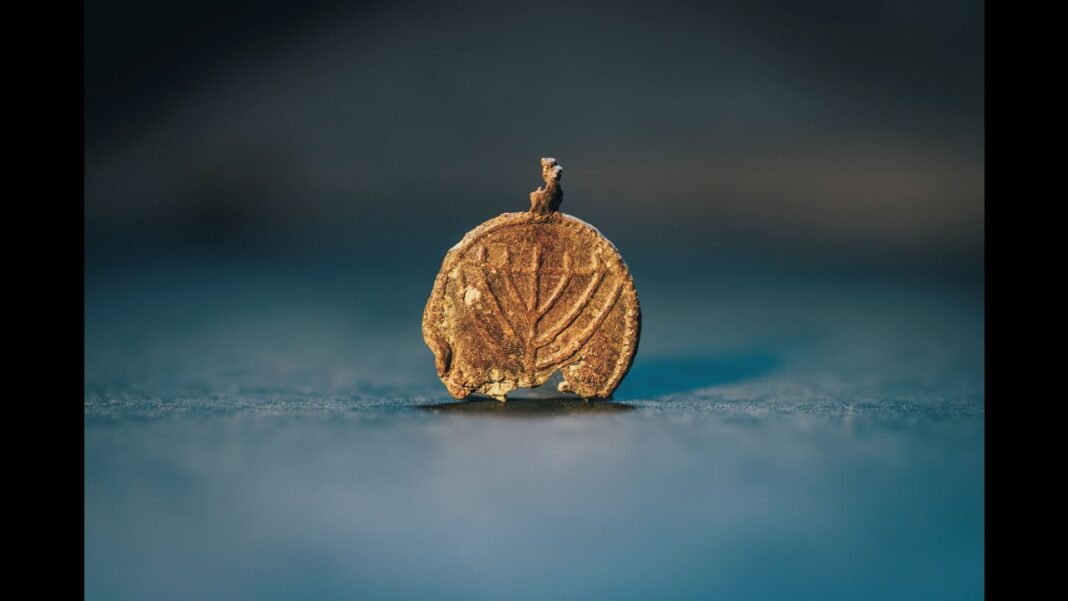
Archaeologists working in Jerusalem have uncovered an object of extraordinary historical and emotional resonance: a rare 1,300-year-old personal pendant bearing the unmistakable image of a seven-branch menorah, discovered just steps from the Western Wall. The modest artifact—fashioned from lead and worn close to the body—has emerged from the soil of the Davidson Archaeological Park as a quiet yet powerful testament to Jewish continuity, faith, and identity during one of the most turbulent eras in the city’s long and contested history.
The pendant was unearthed during a large-scale excavation conducted by the Israel Antiquities Authority in cooperation with the City of David Foundation and the Jewish Quarter Development Company. While Jerusalem has yielded countless relics from its multilayered past, experts say this find stands apart for its deeply personal nature and for what it reveals about Jewish life in the centuries following the destruction of the Second Temple.
Unlike monumental architecture or official inscriptions commissioned by rulers and elites, this small lead pendant speaks in a far more intimate register. It was not designed to dominate a public space or proclaim imperial authority. Rather, it was crafted to be worn by an individual—likely hidden beneath clothing, resting against the chest—serving as a portable declaration of faith at a time when Jewish religious expression was increasingly constrained.
The seven-branch menorah is among the most potent symbols in Jewish history. Originating in the Tabernacle and later standing at the heart of the Second Temple, the menorah came to embody not only ritual sanctity but the spiritual sovereignty of the Jewish people in their ancestral homeland. After the Roman destruction of Jerusalem in 70 CE, depictions of the menorah took on heightened significance, becoming symbols of loss, longing, and resilience.
The newly discovered pendant dates to approximately the 7th century CE—a period marked by dramatic political and religious transformations in Jerusalem. The city had passed from Byzantine Christian control to early Islamic rule, and Jewish communities, long marginalized under Byzantine governance, were navigating shifting conditions that alternately offered new opportunities and fresh uncertainties.
That a Jewish individual chose to wear a menorah pendant during this era is, according to archaeologists, profoundly meaningful. It suggests not only the survival of Jewish presence in Jerusalem but the persistence of Jewish self-identification at a time when public expressions of Judaism were often fraught with danger or restriction.
“This is not an abstract symbol carved into stone centuries later,” one archaeologist involved in the excavation noted. “This is a personal object—something someone chose to carry with them every day. It tells us that Jewish life here was not merely theoretical or remembered; it was lived.”
Menorah depictions are not unknown in the archaeological record, appearing on synagogue mosaics, oil lamps, coins, and stone carvings. However, personal pendants bearing the menorah are exceedingly rare, particularly from this period. The fact that this example was made of lead—a humble and inexpensive material—adds another layer of insight.
Lead pendants were accessible to ordinary people, not just the wealthy or elite. This suggests that the wearer may have been a common resident of Jerusalem, someone without political power or economic privilege, yet deeply invested in preserving a sense of Jewish identity. The menorah, rendered simply but unmistakably, would have functioned both as a spiritual talisman and a quiet assertion of belonging.
Archaeologists believe the pendant may have been worn on a cord or chain around the neck. Its discovery near the Western Wall—already a site of profound sanctity even after the Temple’s destruction—raises the possibility that its owner lived, worked, or prayed in the vicinity. The Western Wall area has long been a focal point of Jewish devotion, and the pendant’s location reinforces the idea of uninterrupted spiritual attachment to the site.
The excavation at Davidson Archaeological Park forms part of a broader effort to document Jerusalem’s layered past, from the First Temple period through the medieval era. Each stratum of earth tells a story, but few artifacts encapsulate the endurance of Jewish identity as succinctly as this pendant.
The 7th century marked a transitional moment in the city’s history. Under early Islamic rule, Jews were permitted to return to Jerusalem after centuries of exclusion under Byzantine Christian authorities. While conditions varied, the period is often seen as one of cautious revival for Jewish settlement and religious life in the city.
The pendant may well belong to this moment of re-emergence. Its existence suggests that Jews not only returned to Jerusalem physically but also reclaimed, in deeply personal ways, their spiritual connection to the city. Wearing a menorah—once the central symbol of the Temple itself—would have been a powerful act of remembrance and hope.
What makes the discovery particularly compelling is its human dimension. Archaeology often deals in abstractions: dates, layers, typologies. This pendant, however, collapses the distance between past and present. It invites modern observers to imagine the individual who wore it—perhaps a pilgrim, a merchant, or a local resident—moving through the same streets that millions traverse today.
The object’s survival across fourteen centuries is itself remarkable. Lead, though durable, is vulnerable to corrosion, and personal items are easily lost or destroyed. That this pendant endured long enough to be recovered speaks to both chance and the meticulous care of modern archaeological practice.
For scholars, the find provides valuable data about Jewish iconography, material culture, and daily life in early medieval Jerusalem. For the broader public, it offers something more elusive but equally powerful: a tangible connection to an individual who lived, believed, and endured in a city that has always stood at the crossroads of faith and history.
In contemporary times, the menorah has once again assumed public prominence, adorning synagogues, public squares, and the emblem of the modern State of Israel. The discovery of a menorah pendant dating back 1,400 years underscores the deep historical roots of that symbol and its enduring capacity to convey meaning across generations.
This small artifact, lifted carefully from the soil near the Western Wall, reminds us that Jewish history in Jerusalem is not merely the story of kings, conquests, and cataclysms. It is also the story of individuals—men and women who carried their faith quietly, persistently, and often at great personal risk.
As archaeologists continue to unearth the physical traces of Jerusalem’s past, discoveries like this pendant affirm a truth long known to historians and believers alike: that beneath the city’s monumental stones lies a far more intimate narrative, written in objects worn close to the heart.