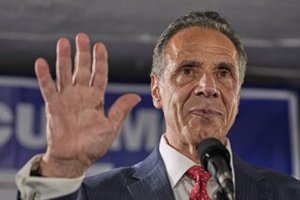
Former NY Gov. Andrew Cuomo is stepping back into the public spotlight. Credit: AP
By: Don Driggers
Former New York Gov. Andrew Cuomo is stepping back into the public spotlight with a new weekly radio program on 77 WABC, marking his most prominent media move since his failed political comeback, as NY Post reported.
Cuomo has landed a one-hour Sunday show on the talk radio station titled “The Pulse of the People,” which is set to debut at 5 p.m. this Sunday, according to NY Post reported. The program will air weekly and focus on open discussion, listener calls and issues impacting New Yorkers and the nation.
Sources familiar with the arrangement said Cuomo will not be paid for the role, a decision intended to allow him to speak freely and avoid potential conflicts of interest, NY Post reported.
“This is a moment when our country has rarely felt more divided, politics more polarizing and public discourse more toxic,” Cuomo said in a statement. “Pulse of the People is about cutting through the noise and the rancor to have real, substantive, fact-based conversations about the issues that actually affect people’s lives,” NY Post reported.
Cuomo said the show will reflect the same approach he took throughout his career in government.
“I’ve spent my career focused on making government work and getting results,” he said. “That’s the same straightforward, problem-solving approach I’ll bring to this program,” NY Post reported.
WABC owner John Catsimatidis welcomed Cuomo to the station, emphasizing that the show will lean heavily on listener participation and bipartisan dialogue.
“The show will focus on listener calls and open discussion about the issues, concerns, and views of New Yorkers,” Catsimatidis said. “WABC believes in bipartisan conversation and thoughtful discussion of solutions, and we invite listeners to tune in and be part of the discussion,” NY Post reported.
Cuomo is expected to open each episode with prepared remarks before taking calls from listeners, offering a direct line between the former governor and the public, NY Post reported.
The radio gig represents Cuomo’s first major public platform since his unsuccessful run for New York City mayor last year. Cuomo lost the Democratic primary to now-Mayor Zohran Mamdani and later mounted an independent bid in the general election, which also fell short, NY Post reported.
Cuomo served as New York governor from 2011 until 2021, when he resigned amid allegations of sexual misconduct. Cuomo has repeatedly denied the accusations. Prior to becoming governor, he served as New York’s attorney general and as U.S. secretary of housing and urban development during the Clinton administration, NY Post reported.
Despite his departure from office, Cuomo has remained a polarizing figure in state and city politics, and his return to the airwaves is likely to draw strong reactions from both supporters and critics.
The move had been anticipated for weeks. Last month Cuomo and Catsimatidis were in discussions about a possible radio partnership.
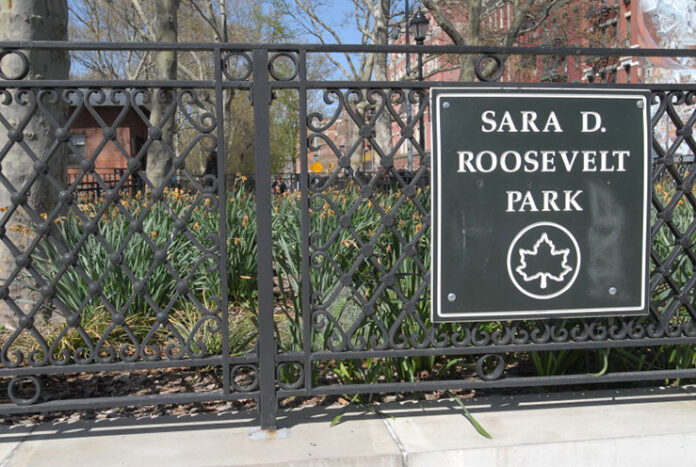
Drug addicts and vagrants overrunning Sara D. Roosevelt Park. Credit: nycgovparks.org
By: Mario Mancini
Lower East Side residents aren’t the only ones fed up with the surge of drug addicts and vagrants overrunning Sara D. Roosevelt Park — local business owners say the situation has spiraled into daily thefts that are bleeding them dry.
Merchants surrounding the long, narrow park say waves of addicts displaced from Washington Square Park have effectively turned the area into an open-air black market, according to reporting by the New York Post.
“They come in like clockwork,” one business owner told the Post. “They grab whatever they want and walk straight back to the park to sell it. Almost every day.”
As the Post previously reported, city efforts to crack down on drug use and encampments at Washington Square Park last year pushed dozens of addicts out — but instead of solving the problem, the city merely shifted it several miles south. The junkies regrouped at Sara D. Roosevelt Park, which sits in the heart of Chinatown and the Lower East Side, an area packed with small businesses and young families.
Shopkeepers say the thefts are brazen and relentless.
“Sometimes I find needles right outside my store,” a bakery owner told the Post. “It scares customers away. But we can’t do anything. If we touch them, we’re the ones who get in trouble.”
Photos obtained by the Post show addicts shooting up in broad daylight, used syringes scattered near park benches, and shopping carts overflowing with stolen goods — all just steps from playgrounds where children pass with parents and strollers.
Neighborhood leaders say City Hall has once again abandoned a working-class community.
“City agencies only act quickly when wealthy neighborhoods complain,” Democratic District Leader Jacky Wong told the Post. “They cleaned up Washington Square Park and dumped the problem on Chinatown.”
Wong said the city’s decision to surround Sara D. Roosevelt Park with five homeless shelters — including one housing parolees — created the conditions for what he described as a “built-in market” for drug dealers and addicts.
“That concentration didn’t happen by accident,” he said. “It created a pipeline for drugs and chaos.”
According to the Post, residents say conditions at the park deteriorated rapidly after the NYPD cleared Washington Square Park, with addicts simply migrating en masse. Locals report seeing drug deals, public intoxication, and aggressive behavior at all hours.
“You can’t even walk through the park after six o’clock,” one merchant said. “It’s completely taken over.”
Community Board 3 member Karlin Chan told the Post that enforcement has become nearly nonexistent.
“NYPD arrests someone who’s completely drugged out, and the courts throw the case out,” Chan said. “It’s a vicious cycle. Nothing changes until someone gets hurt.”
Former City Councilwoman and retired state Supreme Court Justice Kathryn Freed, who has lived in the neighborhood since 1969, said the park has been dangerous for years — but the current situation is the worst she’s seen, according to the Post.
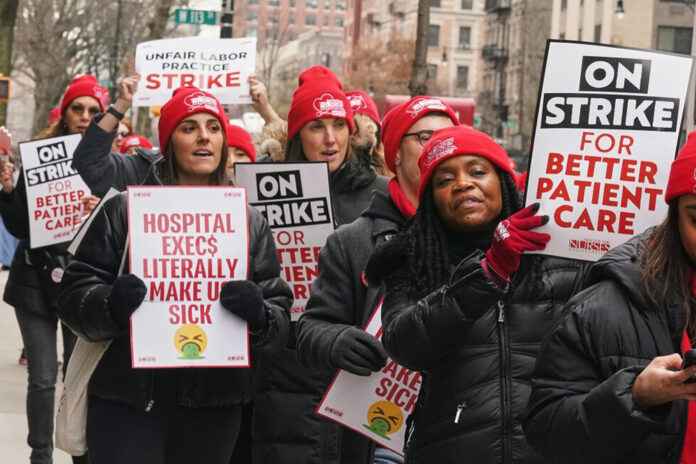
NYC’s longest nursing strike may be approaching a turning point, as union leaders are set to meet with three major hospital systems. Credit: AP
By: Meyer Wolfsheim
New York City’s longest nursing strike may be approaching a turning point, as union leaders representing roughly 15,000 striking nurses are set to meet Monday with executives from three major hospital systems in a renewed effort to end the bitter walkout, as NY Post reported.
The talks will bring together representatives from the New York State Nurses Association (NYSNA) and officials from Presbyterian, Mount Sinai and Montefiore hospitals. Both sides say they have submitted revised proposals in hopes of breaking a 22-day stalemate that has paralyzed staffing across large swaths of the city’s health-care system, NY Post reported.
In a statement released Saturday, the nurses’ union said it streamlined its demands to encourage hospital leaders to negotiate seriously and reach a deal that would send nurses back to the bedside.
“We revised our proposals in an effort to bring hospital executives back to the table in good faith and settle fair contracts as quickly as possible,” NYSNA said, according to NY Post reported.
Hospital systems involved in the talks also struck a cautiously optimistic tone. In a joint statement, hospital representatives said they presented what they described as a responsible economic offer that includes annual wage increases while preserving existing health-care and pension benefits.
“We made a fair, reasonable, and responsible proposal under an economic structure that works for all parties, including safety-net hospitals,” hospital officials said, NY Post reported. They added that they are now reviewing the remaining union proposals in order to craft a comprehensive settlement offer aimed at ending the strike.
The dispute centers on pay, staffing levels, workplace safety and benefits. Hospital executives have argued that NYSNA’s original demands — including wage increases totaling 30% over three years — were unrealistic at a time when medical facilities are facing tightening budgets and reduced federal funding, NY Post reported.
Nurses, however, say the fight is about more than money. The union has emphasized concerns about unsafe staffing ratios, rising incidents of workplace violence, and the need for higher wages to recruit and retain experienced nurses in an increasingly strained health-care environment.
“NYSNA nurses are serious about settling fair contracts and getting back to work delivering quality care,” the union said, urging hospital leaders to end the strike and reinstate nurses immediately, NY Post reported.
While nurses earn an average salary of about $160,000 annually, union leaders argue that compensation has failed to keep pace with rising living costs and mounting job demands. They have also pointed to multimillion-dollar compensation packages for executives at nonprofit hospital systems as a source of resentment among frontline staff, NY Post reported.
Hospitals counter that they have already spent an estimated $100 million on traveling nurses and emergency staffing to keep facilities operational during the strike.
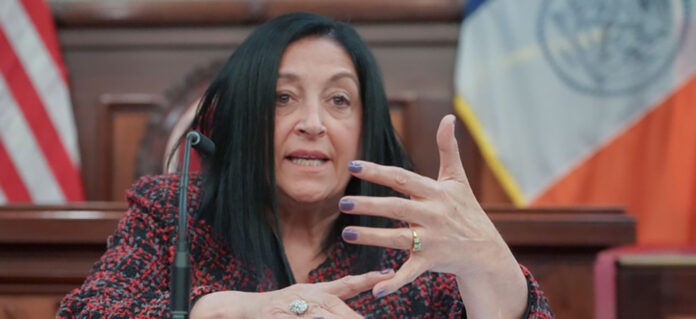
Queens Council Minority Leader Joann Ariola expressed disbelief that the bill remains stalled. Credit: Gerardo Romo/NYC Council Media Unit
By: Hal C Clarke
A House bill aimed at honoring the 25th anniversary of the Sept. 11 terror attacks by minting commemorative gold and silver coins has stalled in Congress, leaving families of victims and first responders questioning whether lawmakers are losing focus nearly a quarter-century after the attacks, as NY Post reported.
The legislation would require the U.S. Mint to design and issue special coins marking the 25th anniversary of 9/11, with proceeds earmarked for the financially strained National September 11 Memorial & Museum at the World Trade Center. But despite bipartisan backing from lawmakers in the New York–New Jersey region, the measure appears stuck in committee, congressional insiders told NY Post reported.
Introduced last March by Rep. Dan Goldman (D-NY), the bill has attracted just 184 co-sponsors — 34 short of what is needed to move forward. Of those supporters, only 52 are Republicans, even though the GOP currently holds the House majority, NY Post reported. The remaining 152 co-sponsors are Democrats.
While the bill has drawn support from several Republicans in the tri-state area, including Reps. Nicole Malliotakis, Andrew Garbarino and Jeff Van Drew, it has failed to gain meaningful traction beyond the region most directly impacted by the attacks, NY Post reported.
The legislation would allow the U.S. Mint to issue up to 50,000 $5 gold coins and 400,000 silver dollar coins in 2026. Each gold coin would include a $35 surcharge and each silver coin a $10 surcharge, generating as much as $5.75 million for the 9/11 Memorial & Museum, NY Post reported.
For families who lost loved ones, the delay feels like a painful reminder of fading urgency. Monica Iken-Murphy, whose husband Michael Iken was killed at the World Trade Center, said she was stunned by the lack of momentum as the anniversary approaches.
“These people representing us should be more vigilant and on top of what’s going on and preparing for the 25th anniversary,” she said, NY Post reported. Iken-Murphy noted that she still has not recovered her husband’s remains and considers the memorial a sacred refuge.
“I would gladly buy the coins,” she added, saying the memorial plays a vital role in preserving the memory of those lost.
Advocates for first responders also voiced frustration. John Feal, a longtime activist for 9/11 rescue and recovery workers, said the bill would help the museum meet what he described as a moral obligation to tell the full story of the attacks and their aftermath, NY Post reported.
Still, Feal cautioned that while the coin legislation matters, Congress faces an even more pressing issue: securing long-term funding for health programs that treat 9/11-related illnesses — funding that is projected to run dry later this decade, NY Post reported.
Queens Council Minority Leader Joann Ariola expressed disbelief that the bill remains stalled, particularly given that Congress approved commemorative coins for the upcoming FIFA World Cup without apparent controversy.
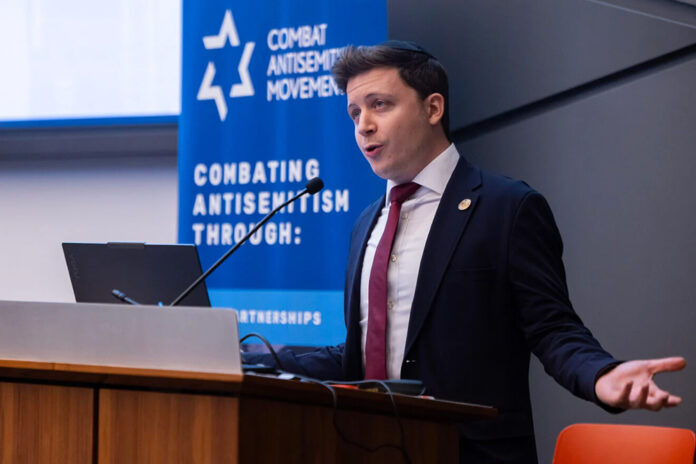
The report was authored by Moshe Davis, executive director of the Mayor’s Office for Combating Antisemitism. Credit: Office of the New York City mayor
By: Meyer Wolfsheim
City officials warned Mayor Zohran Mamdani’s incoming administration about the urgent need to install bollards and other protective measures at vulnerable houses of worship weeks before a car-ramming attack targeted the Chabad-Lubavitch World Headquarters in Brooklyn, as the NY Post reported.
According to information obtained by NY Post reported, a detailed security assessment dated Dec. 30 — just two days before Mamdani was sworn in as mayor — specifically recommended adding bollards and other hardening measures at high-risk religious sites across the city to prevent antisemitic attacks in 2026 and beyond.
The report was authored by Moshe Davis, executive director of the Mayor’s Office for Combating Antisemitism (MOCA), which was created under former Mayor Eric Adams. Among the locations flagged for heightened protection was the Chabad-Lubavitch headquarters on Eastern Parkway in Crown Heights, sources briefed on the matter told NY Post reported.
That same site was attacked last week when Dan Sohail, a 36-year-old New Jersey man, allegedly rammed his vehicle into the building’s doors five times during a religious celebration. Sohail was arrested and charged with hate crimes after video captured the violent incident, NY Post reported.
Under Adams, MOCA partnered with the Department of Transportation and the NYPD’s Counterterrorism Threats Reduction Infrastructure Protection Section to streamline the permitting process for installing bollards at houses of worship and reduce bureaucratic delays, the report noted, NY Post reported.
“The 2026 expansion proposes establishing a dedicated city budget line for bollard installation and other hardening measures at vulnerable institutions,” the report stated. “This mirrors previous successful iterations of such funding before resources were exhausted,” according to the NY Post report.
New York City has previously invested heavily in physical security infrastructure. In 2018, under then-Mayor Bill de Blasio, the city committed $50 million to install more than 1,500 metal bollards citywide to prevent vehicle-ramming attacks, primarily in high-traffic tourist areas such as Times Square, major business corridors, and sites like St. Patrick’s Cathedral.
That initiative followed a string of terror attacks, including a deadly incident along the West Side Highway bike path where eight people were killed by a truck-driving attacker.
Community leaders in Crown Heights had also pushed years ago for a pedestrian plaza in front of the Chabad headquarters that would have incorporated bollards and planters as security barriers. The proposal, however, never advanced with City Hall, the NY Post reported.
“It could have helped prevent what happened,” said Rabbi Eli Cohen, director of outreach for the Crown Heights Jewish Community Council, who helped lead the earlier effort. “Hopefully now there’s renewed interest in the project,” he told the NY Post.
Another Crown Heights source familiar with the plan said broader community support was never fully secured at the time, despite the plaza being envisioned as a shared public space that could host events beyond religious use.
City officials said it remains unclear how much funding will ultimately be allocated for synagogue security, as budget negotiations are still underway. Even if approved, installation of new protective infrastructure would take several months.
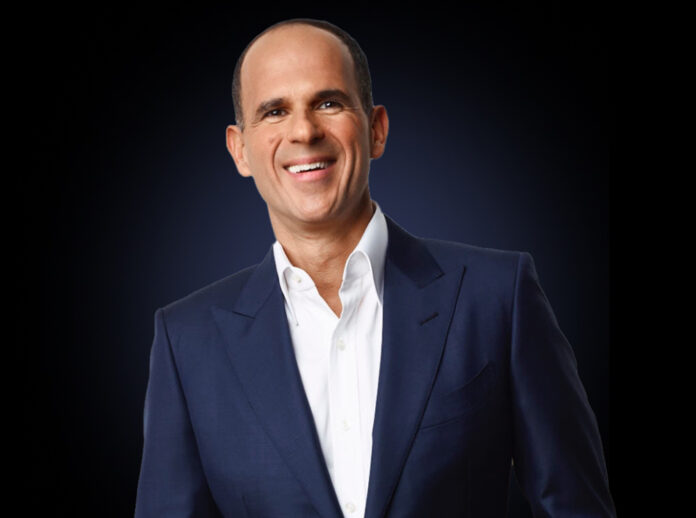
Businessman Marcus Lemonis has pledged to fully fund the project. Credit: marcuslemonis.com
By: Peter Babinsky
A high-profile campaign is gaining momentum to install a towering, permanent American flag at Ground Zero — a patriotic tribute supporters say is long overdue — with a billionaire television personality stepping forward to pay the entire cost, as the New York Post first reported.
The proposal calls for erecting a massive flagpole flying “Old Glory” at the World Trade Center site in Lower Manhattan, timed to coincide with two major milestones: the 25th anniversary of the Sept. 11 terror attacks and the United States’ 250th birthday later this year, the Post reported.
Public backing for the idea has surged, with more than 86,000 people already signing a Change.org petition urging officials to approve the installation, according to the New York Post.
The initiative is being spearheaded by conservative artist Scott LoBaido, who recently made a formal presentation to the National September 11 Memorial & Museum advocating for the permanent flag. Businessman Marcus Lemonis — best known for CNBC’s “The Profit” and now the star of Fox’s “The Fixer” — has pledged to fully fund the project, the Post first reported.
Lemonis said there should be no financial obstacles standing in the way.
“I will be happy to pay for the 150-foot flagpole,” Lemonis said. “I need you to tell me when and where, but you can count on it. I will take care of the bill,” according to the Post.
Lemonis is no stranger to supersized patriotic displays. Flagpoles rising as high as 130 feet stand outside more than 200 Camping World locations nationwide — a company he co-founded. While some states and municipalities have challenged the size of the installations, Lemonis noted that the flags remain standing, the New York Post reported.
“I want to make sure putting the flagpole at Ground Zero actually happens,” he said.
Under the proposal, a 150-foot flagpole would be installed near the Freedom Tower, flying a 30-by-60-foot American flag. Supporters say the display would serve as a daily reminder of the victims of 9/11 and the first responders who rushed into danger, as the Post reported.
“This memory should be honored every day, not only on anniversaries,” LoBaido said. “We should never be ashamed to display our flag proudly.”
“This is about more than a flag,” he added. “It’s about making sure every American — and every visitor from around the world — is reminded that even in our darkest hour, we stood together.”
LoBaido said the initial installation would cost roughly $150,000, with an additional $2,500 to $3,000 needed several times a year to replace flags damaged by wind and weather, the New York Post reported. He noted that while two smaller flags currently sit on the memorial grounds, they are largely unnoticed by visitors.
The proposal has also drawn support from families of fallen first responders. Massimo DiDonna, who chairs the foundation honoring fallen firefighter Carl V. Bini, called the flagpole a symbol of resolve.
Former New Jersey Gov. Chris Christie is pointing the finger at President Trump for the Republican Party’s bruising losses in last year’s Garden State elections. Credit: AP
By: Jordan Baker
Former New Jersey Gov. Chris Christie is pointing the finger at President Trump for the Republican Party’s bruising losses in last year’s Garden State elections, arguing that the president’s deep unpopularity with New Jersey voters doomed GOP candidates down the ballot, as the New York Post reported.
In a wide-ranging radio interview aired Sunday, Christie said Republican gubernatorial nominee Jack Ciattarelli was “dragged down” by his close association with Trump, leading to a landslide victory for Democrat Mikie Sherrill, who defeated Ciattarelli by 14 percentage points, according to the Post.
“It was an absolute disaster,” Christie said during an appearance on 77 WABC’s “Cats Roundtable,” the New York Post reported. “We lost the governorship by 14 points. We lost five seats in the New Jersey General Assembly, which means we’re now at the lowest number since Watergate.”
Christie, once a prominent Trump ally before their bitter falling out, said the party’s strategy in New Jersey ignored basic political math. He noted that Republicans cannot win statewide races in the Garden State without strong support from independent voters — a bloc that he said Trump has alienated, according to the Post.
“The problem for Jack Ciattarelli was when he tied himself so close to the president, a lot of independents in New Jersey were turned off by that,” Christie said.
Christie emphasized that for the first time in many years, a Republican gubernatorial candidate lost independents outright to Democrats — a fatal outcome in a state with roughly 850,000 more registered Democrats than Republicans, the New York Post reported.
“If that happens, you have no chance of winning,” Christie said.
According to Christie, President Trump’s brand plays far better in other parts of the country than it does in New Jersey, making a full MAGA strategy uniquely damaging in the state, the Post reported.
“The fact is, the president is not nearly as popular in the state of New Jersey as he is elsewhere,” Christie said. “Jack made himself 100% MAGA. That really, really hurt him. It wasn’t a narrow loss — it was a huge one.”
Christie said the election results have left New Jersey Republicans politically weakened at a time when Democrats continue to dominate Trenton. He warned that residents are likely to face even higher taxes, pointing to already soaring corporate, property, and income tax rates, as the New York Post reported.
“I wouldn’t be surprised if they raised taxes again this June,” Christie said.
Still, Christie argued that New Jersey remains better positioned than neighboring New York, stressing that Gov. Sherrill is not a hard-left progressive like New York City Mayor Zohran Mamdani, according to the Post.
“New Jersey is a very tough place,” Christie said. “But I bet you it will be better than New York.”
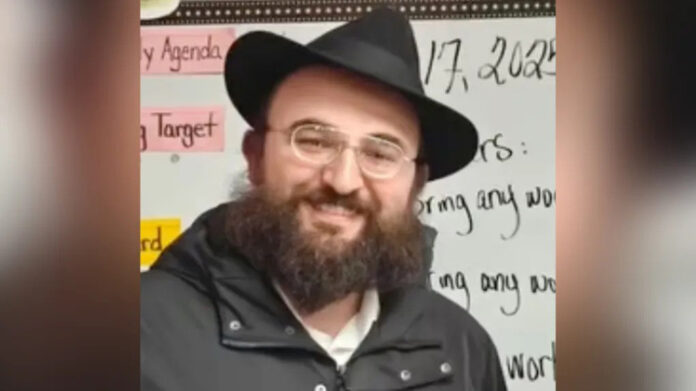
Rabbi David Shushan was punched in the chest by a stranger hurling antisemitic slurs
By: Abe Wertenheim
On a winter afternoon meant for remembrance, reflection, and moral reckoning, the streets of Queens became the stage for a violent reminder that the ancient hatreds many believed belonged to history remain disturbingly alive in the present. As Jews across the globe marked International Holocaust Remembrance Day on Tuesday, Rabbi David Shushan, a 30-year-old spiritual leader and youth mentor, was punched in the chest by a stranger hurling antisemitic slurs—an attack that has since reverberated far beyond the sidewalks of Forest Hills and into the heart of New York’s civic, political, and moral discourse.
In a report on Wednesday, The New York Daily News documented both the brutality of the encounter and the profound symbolism of its timing. The assault occurred Tuesday afternoon near Queens Boulevard and 71st Avenue, just three blocks from the Bukharian Jewish Community Center, where Rabbi Shushan serves not only as a religious figure but as a youth leader and mentor to the next generation. According to The New York Daily News report, he was walking calmly toward a synagogue when a man dressed in a black hoodie and black pants suddenly emerged, shouting “F— Jews” before striking him.
“I was shocked,” Rabbi Shushan told The New York Daily News, recounting the moment with a mixture of disbelief and resolve. “It was a regular day. I was walking along, looking at the street, when this guy comes out of nowhere, starts cursing at me and struck me.”
What followed was not a swift attack and escape, but a raw, physical confrontation that unfolded in full public view. Rather than retreat, Shushan stood his ground. The two men grappled, fell into the snow, and fought for several minutes, rolling across the icy pavement as passersby looked on. At one point, the assailant struck the rabbi in the face, sending both men crashing into the snow again. Shushan’s clothing became soaked and stained, his face bruised, his body aching—but his resolve unbroken.
“We were fighting for a few minutes, rolling around in the snow,” he told The New York Daily News. “At one point he punched me in the face and we both fell into the snow and got dirty.”
The scene might have ended even more tragically had someone who knew Shushan not intervened, pulling him away and separating the two men. The attacker fled down Queens Boulevard, but not before the rabbi managed to photograph him with his cellphone—an image that would later prove critical.
The New York Daily News reported that Shushan immediately contacted both the NYPD and the local Shomrim volunteer security organization. Within minutes, a coordinated search began. Volunteers soon located the suspect entering a nearby train station. In a moment that seemed almost surreal, police officers, Shomrim members, and Rabbi Shushan himself boarded the train to confront the man.
“I went into the subway car and the guy saw me. He was shocked at how we found him,” Shushan told The New York Daily News. “He started screaming, ‘Keep away from me! Stay back!’ as the cops closed in.”
The suspect, identified as 32-year-old Eric Zafra Grosso of Corona, Queens, was arrested and charged with assault and aggravated harassment as hate crimes. According to The New York Daily News report, he has no prior criminal history. He pleaded not guilty at his arraignment in Queens Criminal Court and was released without bail.
For Rabbi Shushan, the legal process is secondary to the moral clarity of what occurred.
“I don’t know if he is unhealthy in his mind or not,” he said in his interview with The New York Daily News. “But he chose me because I was Jewish. I wear Jewish apparel in the streets. He chose me. It was simple. I was his target.”
That stark clarity—of identity as motive, of hatred as intent—has given the incident a weight far beyond a single act of street violence. It has transformed it into a symbol, a case study in contemporary antisemitism, and a rallying point for civic leaders across the city and state.
Mayor Zohran Mamdani personally called Rabbi Shushan and invited him to City Hall, according to The New York Daily News report. In a public statement posted on X, the mayor framed the attack not as an isolated incident but as part of a broader societal crisis.
“New Yorkers were confronted with a painful truth: antisemitism is not a thing of the past—it is a present danger that demands action from all of us,” Mamdani wrote. “There is no place for antisemitism in our city. I stand in solidarity with Jewish New Yorkers and my administration is committed to rooting out this hatred.”
Governor Kathy Hochul, Senator Chuck Schumer, and New York City Comptroller Mark Levine also issued condemnations, with Levine calling the assault “yet another sickening reminder of the scale of the hatred we are confronting,” according to the report in The New York Daily News.
The symbolism of the date has only intensified the public response. International Holocaust Remembrance Day commemorates the liberation of Auschwitz-Birkenau and honors the memory of the six million Jews murdered in the Holocaust, along with millions of other victims of Nazi persecution. It is a day dedicated to memory, vigilance, and the moral imperative of “never again.”
“I don’t think he was aware of the day,” Rabbi Shushan said of his attacker, speaking to The New York Daily News. “Regardless, this shouldn’t have happened.”
Yet the coincidence is impossible to ignore. A rabbi assaulted for being visibly Jewish on the very day the world pauses to remember the consequences of unchecked hatred is not merely tragic—it is haunting.
For Shushan, the incident has not led to fear or withdrawal, but to a deeper sense of purpose.
“We know all about the dark years and what happens if we do nothing,” he said, invoking the Holocaust. “I could not step down and run away from him.”
Now nursing a bruised face, a persistent headache, and a painful knee from hitting the concrete, he remains resolute.
“My wish is for everyone to live peacefully,” he told The New York Daily News. “But the last thing we should do is step down. We must step up and we should not run away.”
The New York Daily News report situates this attack within a broader context of rising antisemitism in New York City. While overall hate crimes reportedly decreased by 12% last year, antisemitic incidents still accounted for 57% of all reported hate crimes in 2025, despite Jewish New Yorkers comprising only about 10% of the city’s population. Just days before the Forest Hills assault, police arrested two teenagers accused of vandalizing a Brooklyn playground with more than 50 swastikas in Borough Park—a chilling reminder that hatred is not confined to words, but increasingly expressed through symbols, violence, and intimidation.
Queens Borough President Donovan Richards. Credit: Wikipedia.org
By: Nick Carraway
A senior Democratic official who backed Mayor Zohran Mamdani’s rise to City Hall is now publicly urging the mayor to reverse course on homeless encampments, warning that leaving people outdoors in brutal winter conditions is putting lives at risk, as the New York Post reported.
Queens Borough President Donovan Richards, a prominent Mamdani ally who endorsed the left-leaning mayor during last year’s election, said the city must act decisively to move homeless New Yorkers into safe shelter before more die in the cold, according to comments he gave to the Post.
“Being homeless shouldn’t be a death sentence,” Richards told the outlet. “You can’t let people stay out there. These are people in crisis.”
Richards’ remarks mark a notable break from Mamdani’s current policy, which has restricted city agencies from dismantling homeless encampments. As the New York Post exclusively reported last week, the Mamdani administration ordered police and sanitation workers to stop clearing encampments just weeks before a deadly Arctic deep freeze gripped the city.
Since then, at least 14 people have been found dead outdoors across New York City, the Post reported, with eight of those deaths linked directly to hypothermia or freezing conditions.
Images published by the New York Post showed homeless individuals sleeping on snow-covered benches near Prospect Park and huddling under the Manhattan Bridge as temperatures plunged well below freezing.
The growing death toll has intensified criticism of the mayor from both sides of the political aisle. Staten Island Borough President Vito Fossella, a Republican, joined Richards in calling on Mamdani to abandon his hands-off approach to encampments, warning that the consequences were entirely predictable, according to the Post.
“We said before that people will die,” Fossella told the paper. “Now it looks like the policy is leading to more deaths.”
Fossella added that encampments pose serious dangers even in warmer months, citing widespread drug use, crime, and unsafe conditions — problems that become exponentially worse during extreme winter weather, as the New York Post reported.
“Don’t be surprised if more people die,” Fossella warned.
Richards said he agrees that the encampments must come down, but stressed that the process should be handled with care and dignity. He criticized how previous administrations, including that of former Mayor Eric Adams, sometimes cleared sites by discarding homeless individuals’ belongings, according to the Post.
“I do think the mayor has to take the encampments down,” Richards said. “But it has to be done in a humane way.”
At the same time, Richards acknowledged the long-standing challenges that have kept many homeless New Yorkers on the streets. Many avoid shelters because they believe they are unsafe, overcrowded, or poorly managed — a concern that city leaders have failed to adequately address, he said, as the Post reported.
“That’s a big reason people are out in the street or in the subway,” Richards said. “We have to fix that problem long term.”
Still, he emphasized that immediate action is necessary as freezing temperatures continue.
JFK airport is set to unveil its vast new Terminal 1—a $9.5 billion investment that officials hope will propel Kennedy into the top tier of global airports. Credit: VIN News
By: Jamie Herndon
New York’s John F. Kennedy International Airport is on the cusp of a transformation that its stewards believe will redefine how the world experiences America’s largest city. Later this year, after years of construction carried out amid the daily churn of one of the planet’s busiest aviation hubs, the airport is set to unveil its vast new Terminal 1—a $9.5 billion investment that officials hope will propel Kennedy into the top tier of global airports. The project, detailed in a recent interview with The New York Times and reported by VIN News on Monday, represents not merely an expansion, but a fundamental reimagining of the airport’s role as New York’s primary gateway to the world.
Spanning an astonishing 2.6 million square feet—nearly rivaling the floor space of the Empire State Building—the new Terminal 1 is designed to overwhelm travelers in the best possible way. Wide, open concourses replace the cramped corridors that have long defined JFK’s reputation. Sightlines stretch from security checkpoints to aircraft gates, allowing passengers to orient themselves intuitively, reducing the sense of dislocation that often accompanies air travel. According to the report at VIN News, airport planners have deliberately emphasized transparency and scale, aiming to create an environment that feels both monumental and navigable.
The Port Authority of New York and New Jersey, which oversees JFK, has been unapologetically ambitious in its vision. Officials have described Terminal 1 as a “world-class, knock-your-socks-off gateway,” a phrase that reflects both the aspirations and the pressures surrounding the project. For decades, JFK has been a paradox: one of the world’s most important international airports, yet frequently criticized for outdated facilities and a fragmented passenger experience. The new terminal is intended to close that gap decisively.
Jessica Forse, the Port Authority executive leading the redevelopment, told The New York Times that the complexity of the undertaking cannot be overstated. The terminal is being constructed while Kennedy remains fully operational, a logistical challenge that would test even the most seasoned infrastructure planners. The difficulty has been compounded by the fact that the AirTrain—JFK’s elevated rail system—runs directly through the building. Coordinating heavy construction around an active transit artery and constant passenger flow has required meticulous planning and, at times, improvisation.
Yet Terminal 1 is only the most visible component of a much broader overhaul. The Port Authority is simultaneously investing roughly $4 billion in supporting infrastructure: redesigned roadways to ease traffic congestion, expanded parking facilities, upgraded utilities, and modernized systems intended to handle record passenger volumes. The VIN News report noted that these behind-the-scenes improvements are critical to the terminal’s success. A state-of-the-art building, after all, cannot fulfill its promise if travelers remain mired in gridlock before they ever reach the check-in counter.
The redevelopment of JFK comes on the heels of widely praised transformations at LaGuardia Airport and Newark Liberty International Airport. Once derided as symbols of urban dysfunction, both facilities have undergone sweeping renovations that have earned international design awards and improved passenger satisfaction. The Port Authority hopes to replicate—and perhaps surpass—that success at Kennedy. The VIN News report observed that the stakes are particularly high: JFK is not only an airport, but a global emblem of New York itself.
Terminal 1 is also part of a carefully sequenced strategy to modernize the airport without overwhelming it. The first phase, scheduled to open later this year, will begin welcoming passengers even as construction continues on subsequent sections. This phased approach allows the airport to incrementally retire older facilities while maintaining capacity. Alongside Terminal 1, a privately developed Terminal 6 is also taking shape, further expanding JFK’s footprint and providing airlines with additional options for modern operations.
The design philosophy behind Terminal 1 reflects broader shifts in how airports are conceived. Rather than treating terminals as mere conduits for processing passengers, planners increasingly view them as civic spaces—places that shape first and last impressions of a city. Terminal 1 incorporates this thinking, emphasizing natural light, generous seating areas, and amenities that encourage travelers to linger rather than endure.
For airlines, the new terminal promises operational efficiencies and a platform for premium services. For passengers, it offers the prospect of a smoother journey through security, clearer wayfinding, and a sense of calm often absent from major hubs. And for New York, it represents a statement of intent: a declaration that the city is willing to invest at scale to remain competitive in a fiercely contested global aviation landscape.
Still, the transformation has not been without its critics. Large infrastructure projects inevitably invite scrutiny over cost overruns and timelines. At $9.5 billion, Terminal 1 is among the most expensive airport projects ever undertaken in the United States. Port Authority officials argue the price tag reflects both the scale of the ambition and the long-term economic benefits. JFK supports hundreds of thousands of jobs and generates billions in regional economic activity; modernizing it, they contend, is not optional but essential.
The opening of Terminal 1 later this year will not mark the end of JFK’s evolution, but rather a pivotal chapter in an ongoing story. Additional construction will continue as part of the airport’s long-term redevelopment plan, with the goal of creating a cohesive, world-class complex rather than a patchwork of aging terminals. The VIN News report described the effort as a generational investment—one that will shape travel to and from New York for decades to come.
As the finishing touches are applied and anticipation builds, the symbolism of the moment is hard to miss. For years, JFK has been criticized as an unworthy first impression for a global capital. With Terminal 1, New York is attempting to turn that narrative on its head. If the Port Authority’s vision is realized, travelers arriving at Kennedy later this year may find themselves stepping not into a relic of the past, but into a confident, expansive statement about the city’s future—a front door worthy of the world it serves.
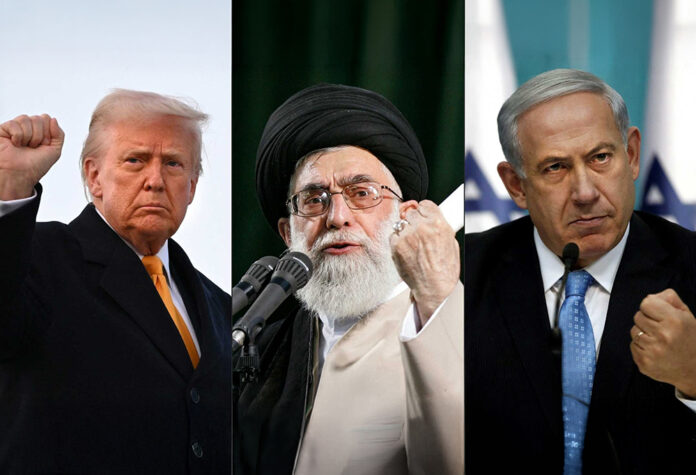
The Middle East awoke this week to a familiar yet increasingly perilous rhythm: thunderous threats from Tehran paired with carefully calibrated hints of diplomacy. Pictured above is: President Donald Trump, Iran’s supreme leader, Ayatollah Ali Khamenei and Israeli PM Benjamin Netanyahu. Credit: crisisgroup.org
By: Fern Sidman
The Middle East awoke this week to a familiar yet increasingly perilous rhythm: thunderous threats from Tehran paired with carefully calibrated hints of diplomacy. As senior Iranian officials escalated their rhetoric against Washington, warning of regional infernos and direct attacks on American interests, parallel signals emerged suggesting that talks—however fragile—might soon resume. The juxtaposition, as was reported on Monday by World Israel News, reflects a dual-track strategy that has become a hallmark of Iran’s posture at moments of acute tension: intimidate to deter, negotiate to buy time.
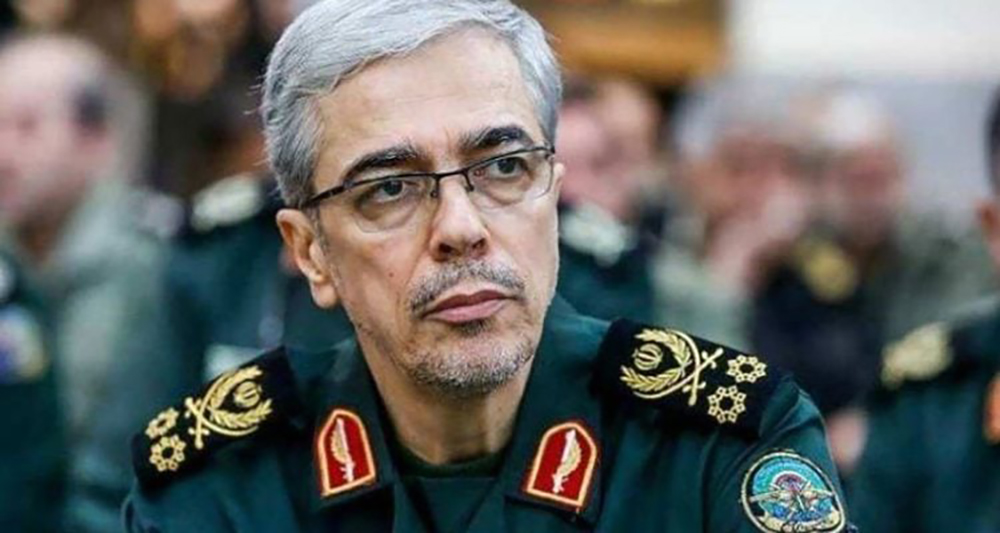
On Monday, Iran’s armed forces chief Mohammad Bagheri delivered one of the starkest warnings heard in recent months. His message to the United States was unambiguous and chilling. “Any small mistake will open our hands for action,” Bagheri said, according to remarks cited in the World Israel News report. “The world will see the other face of powerful Iran. Then no American will be safe, and the fire of the region will burn the United States and its partners.”
The language was not merely rhetorical flourish. Bagheri framed his warning as the product of a strategic reassessment following what Iranian officials have described as a recent 12-day conflict. In his telling, Iran has moved beyond a posture of reactive defense and has embraced an explicitly offensive doctrine. “After the 12-day war, Iran reviewed its defense doctrine and changed the approach of the armed forces to an offensive doctrine based on rapid, decisive, and sustained operations,” he declared. Iran, he added, is now “fully prepared for confrontation.”
The World Israel News report noted that this declaration represents a significant shift in tone, if not necessarily in substance. Iranian leaders have long emphasized deterrence through the threat of retaliation, but Bagheri’s remarks suggest a willingness to initiate or rapidly escalate military action should Tehran perceive a provocation. The warning that “no American will be safe” was particularly striking, signaling that U.S. personnel and assets across the region could be targeted in the event of conflict.
Yet even as Bagheri issued these threats, another branch of the Iranian government was striking a markedly different note. Iran’s Foreign Ministry spokesman indicated that Tehran is simultaneously examining “several diplomatic processes” and expects developments in the coming days. The comment, reported by World Israel News, suggested that Iran is keeping open the possibility of negotiations even as it rattles sabers.
On Monday, Iran’s armed forces chief Mohammad Bagheri delivered one of the starkest warnings heard in recent months. His message to the United States was unambiguous and chilling. “Any small mistake will open our hands for action,” Bagheri said. Credit: IRNA
This duality was reinforced by reporting later Monday from Tasnim News Agency, which said talks between Tehran and Washington could begin in the near future. According to Tasnim, the discussions might involve Abbas Araghchi on behalf of Iran and Steve Witkoff representing the United States, with Turkey mentioned as a possible venue. While no official confirmation has been issued by Washington, the report added another layer of complexity to an already volatile situation.
The backdrop to these developments is a series of warnings issued just a day earlier by Iran’s supreme leader Ali Khamenei. On Sunday, Khamenei cautioned that any U.S.-initiated conflict would not remain contained. “If the Americans start a war, this time it will be a regional war,” he said, a statement that World Israel News highlighted as one of his most direct threats to date. Notably, Khamenei also posted the remarks to his official Hebrew-language account on X, a move widely interpreted as a pointed message to Israel as well as to Washington.
Khamenei also accused foreign powers—specifically the United States and what he termed “Zionists”—of orchestrating the recent wave of unrest that shook the Islamic Republic. Casting the protests not as a domestic uprising rooted in social or economic grievances but as a meticulously engineered conspiracy, Khamenei insisted the turmoil was planned, directed, and managed from abroad. His remarks, reported on Monday by Israel National News, offer a revealing portrait of how Tehran’s leadership interprets dissent—and how it seeks to justify its response.
According to Khamenei, the unrest amounted to nothing less than a “sedition,” a term heavy with ideological significance in Iran’s political lexicon. He claimed that the plan behind the disturbances “was developed abroad, and it was managed from abroad,” asserting that Iran’s enemies had poured resources into destabilizing the country. In language that the Israel National News report described as unusually explicit, Khamenei alleged that he had been informed “through a certain channel” that the Central Intelligence Agency and Mossad had deployed “all of their resources into the field.” Despite this, he declared triumphantly, “they were defeated.”
These claims, which the Israel National News report noted were made without publicly presented evidence, fit squarely within a longstanding narrative employed by Iran’s leadership: that internal dissent is never organic, never spontaneous, and never legitimate. Instead, protests are framed as the work of external enemies exploiting discontent to weaken the state. By situating the unrest within a global conspiracy, Khamenei effectively absolves the regime of responsibility for the conditions that gave rise to the demonstrations in the first place.
Khamenei went further, arguing that U.S. involvement was evident not merely through intelligence assessments but through the words of the American president himself. Quoting remarks he attributed to the U.S. leader, Khamenei wrote that the president had explicitly encouraged the rioters, telling them, “Keep going, keep going. I’m coming [to help].” For Khamenei, this statement served as proof that Washington was not a distant observer but an active instigator. Such accusations reflect Tehran’s deep-seated conviction that the United States views regime change in Iran as an ultimate objective.
The Supreme Leader framed the unrest as part of a recurring pattern rather than an isolated episode. Iran, he wrote, is a country “in friction with the interests of global aggressors,” and therefore destined to face repeated attempts at destabilization. When he posed the question of how long such efforts would continue, his answer was characteristically defiant: they would persist “until the Iranian nation reaches a point where the enemy is left hopeless.” “And we will reach that point,” he added, projecting confidence that endurance and resistance would ultimately prevail.
The convergence of these messages—Bagheri’s warning of immediate retaliation, Khamenei’s prediction of regional conflagration, and the Foreign Ministry’s hints of diplomacy—illustrates the delicate balancing act underway in Tehran. On one hand, Iran seeks to project strength and deterrence, signaling that it will not be cowed by U.S. pressure or military posturing. On the other, it appears keenly aware of the costs of open war and is leaving the door ajar for negotiations that could de-escalate tensions or at least delay confrontation.
For Israel, these developments are being watched with acute concern. World Israel News reported that Israeli officials have confirmed that Steve Witkoff is expected to arrive in Israel shortly for consultations with senior leadership. The visit underscores Israel’s central role in any regional calculus involving Iran, particularly given Tehran’s repeated threats against the Jewish state and its support for armed proxies on Israel’s borders.
Israeli officials have confirmed that Steve Witkoff is expected to arrive in Israel shortly for consultations with senior leadership. Credit: AP
Israeli analysts cited by World Israel News note that Iran’s rhetoric often intensifies ahead of diplomatic initiatives, a pattern designed to improve Tehran’s bargaining position. By threatening catastrophic consequences for any U.S. “mistake,” Iranian leaders may be attempting to deter military action while simultaneously signaling that they are willing to talk—on their terms. The danger, critics warn, is that such brinkmanship increases the risk of miscalculation, especially in a region crowded with military assets and overlapping lines of communication.
Bagheri’s assertion that Iran has adopted an offensive doctrine is particularly unsettling in this context. While Iran has long relied on asymmetric warfare and proxy forces, an explicit shift toward rapid and sustained offensive operations suggests a readiness to escalate more directly. The World Israel News report emphasized that this posture could encompass missile strikes, cyber operations, and attacks on shipping or energy infrastructure—actions that would reverberate far beyond the immediate theater.
At the same time, the diplomatic overtures hint at internal debates within Iran’s leadership. The Foreign Ministry’s emphasis on “examining several diplomatic processes” suggests that not all factions are eager for confrontation. Economic pressures, domestic unrest, and international isolation have taken a toll, and some voices in Tehran may view negotiations as a necessary pressure valve. The World Israel News report observed that this tension between hardline and pragmatic impulses has characterized Iranian policymaking for decades, often producing contradictory signals.
The potential involvement of Turkey as a venue for talks adds another dimension. Ankara has sought to position itself as a regional mediator, maintaining channels with both Tehran and Washington. Whether such a role would be accepted by all parties remains uncertain, but the mere mention of a location suggests that preliminary discussions may already be underway behind the scenes.
For Washington, the challenge lies in interpreting Iran’s messages without falling prey to either intimidation or false reassurance. Bagheri’s threats cannot be dismissed as empty bluster, yet neither can the diplomatic hints be taken at face value without concrete steps. World Israel News has reported that U.S. officials remain wary of negotiations that serve primarily to buy time for Iran to advance its strategic capabilities.
As Witkoff prepares for consultations in Israel, coordination between Washington and Jerusalem is expected to intensify. Israeli leaders have consistently argued that any engagement with Iran must be accompanied by credible deterrence and clear red lines. The recent statements from Tehran, combining menace with overtures, only reinforce that assessment.
In the end, the current moment is defined by uncertainty—and by the narrow margin separating dialogue from disaster. Iran’s leaders are signaling readiness for both war and talks, daring their adversaries to guess which path will prevail. As the World Israel News report highlighted, the stakes could scarcely be higher. A single misstep, as Bagheri himself warned, could ignite a regional firestorm. Whether diplomacy can dampen the flames before that happens remains the unanswered question at the heart of this unfolding crisis.
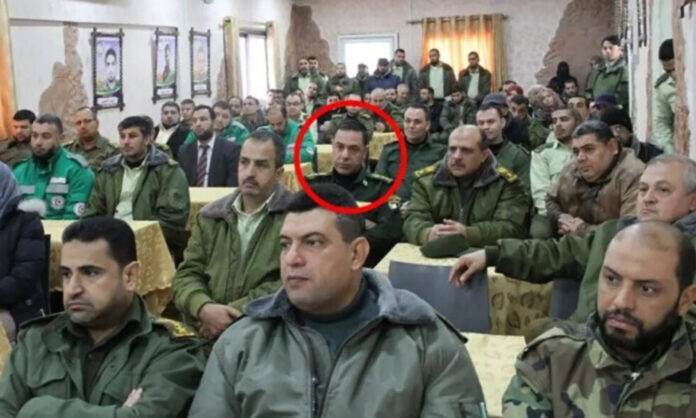
The photograph shows Hussam Abu Safiya, the director of Kamal Adwan Hospital in northern Gaza, clad in what appears to be a Hamas uniform and standing alongside senior figures from the terror organization. Credit: VIN News
By: Arthur Popowitz
In the long and bitter wars over narrative as much as territory, photographs have a way of returning at the most inconvenient moments. This week, a single image taken nearly a decade ago has surged back into public view, unsettling long-standing assumptions about the line between humanitarian institutions and terrorist power structures in Gaza. As first reported by the New York Post and closely examined by NGO Monitor, the photograph shows Hussam Abu Safiya, the director of Kamal Adwan Hospital in northern Gaza, clad in what appears to be a Hamas uniform and standing alongside senior figures from the terror organization.
The resurfacing of this image, now widely discussed and scrutinized, has reopened a debate that VIN News has followed closely throughout the war: whether Gaza’s medical infrastructure has been systematically entangled with Hamas’s military and political apparatus.
According to NGO Monitor, the photograph dates back to 2016 and was originally posted on a Facebook page affiliated with Hamas’s Military Medical Services. The image depicts Abu Safiya at a gathering marking the completion of Kamal Adwan Hospital, surrounded by senior Hamas officials, including commanders from the organization’s Military Medical Services and National Security Forces. Palestinian media outlets, as well as Hamas’s own Medical Services, have previously identified Abu Safiya as holding the rank of colonel within this Hamas-affiliated body. The VIN News report noted that this detail, while long accessible in Arabic-language reporting, drew little attention outside the region until now.
The Military Medical Services, while distinct from Hamas’s armed wing, the al-Qassam Brigades, occupies a crucial and often opaque position within Hamas’s organizational ecosystem. It is formally described as a separate entity, responsible for medical logistics and support, yet Israeli authorities have stated that members of this unit actively participated in the Hamas-led October 7, 2023, attack on southern Israel.
That assault, which left more than 1,200 Israelis dead and hundreds taken hostage, shattered any remaining illusions about the purely auxiliary role of Hamas-linked medical bodies. VIN News has repeatedly reported that Israeli intelligence views these divisions not as neutral humanitarian services but as integral components of Hamas’s war-fighting capacity.
Abu Safiya himself has been at the center of this controversy since December, when Israeli forces raided Kamal Adwan Hospital during intense fighting in northern Gaza. During the operation, Israeli troops detained Abu Safiya along with nearly 240 other individuals found at the facility. The Israeli military asserted that the hospital had been used as a Hamas command center, an allegation that Hamas and hospital officials vehemently denied at the time. Abu Safiya remains in Israeli custody, and his attorneys have alleged that he was subjected to severe abuse during detention. These claims have not been publicly addressed by Israeli authorities, a silence that has drawn criticism from human rights advocates and sustained scrutiny from media outlets.
The resurfaced photograph has lent new weight to Israel’s longstanding accusations, even as it has intensified questions about transparency and disclosure in international media coverage. Abu Safiya is not an obscure figure. He has authored two opinion essays published by The New York Times in which he sharply criticized Israel’s military campaign in Gaza, portraying the devastation of the enclave’s healthcare system and the suffering of civilians under bombardment.
Notably, the newspaper did not disclose any Hamas affiliation in those pieces, presenting Abu Safiya solely as a medical professional and hospital director. The VIN News report pointed out that this omission has now become a focal point of criticism, particularly among readers who argue that full context is essential when evaluating testimony from figures operating within Hamas-controlled institutions.
Israeli officials have previously described Abu Safiya as a senior Hamas operative, though they have stopped short of accusing him of direct involvement in specific attacks. This distinction, subtle yet significant, underscores the complexity of Hamas’s governance model in Gaza, where civilian, medical, and military roles often overlap. As VIN News has documented throughout the conflict, Hamas has for years embedded its personnel and assets within civilian infrastructure, a strategy designed both to shield its operations and to complicate Israel’s military response.
That strategy was laid bare in chilling detail during the interrogation of another former Kamal Adwan Hospital director, Ahmed Kahlot. Detained earlier in the war, Kahlot reportedly told Israeli interrogators that the hospital had been converted into a Hamas-controlled military site. According to his testimony, the facility at one point held a kidnapped Israeli soldier, and multiple staff members, including medical personnel, were also Hamas operatives serving in the al-Qassam Brigades. While such statements, obtained during detention, are inevitably contested and scrutinized, they align with a broader body of Israeli intelligence assessments and material evidence gathered during raids on Gaza hospitals.
The implications of these revelations extend far beyond the fate of one hospital director or one photograph. They strike at the heart of an international discourse that has often treated Gaza’s medical institutions as unequivocal sanctuaries, insulated from the politics and militancy that define the enclave’s governance. The image of Abu Safiya in a Hamas uniform does not, by itself, prove operational wrongdoing. Yet, as NGO Monitor argues and the VIN News report emphasized, it challenges the narrative of strict separation between healthcare leadership and terrorist command structures.
For Israel, the photograph reinforces its claim that Hamas has systematically violated international humanitarian law by militarizing hospitals and exploiting their protected status. For critics of Israel’s war conduct, the image complicates efforts to frame the conflict in starkly binary terms of aggressor and victim. And for global media organizations, it raises uncomfortable questions about vetting sources, contextualizing commentary, and disclosing affiliations in coverage of one of the world’s most polarizing conflicts.
The debate is not merely academic. It carries tangible consequences for how wars are fought and judged. If hospitals are indeed functioning as command centers, they lose their protected status under the laws of armed conflict, a point Israel has repeatedly stressed. Conversely, if allegations of abuse during detention are substantiated, they would represent serious violations that demand accountability. The truth, as is often the case in war, may be layered, contested, and resistant to simple moral clarity.
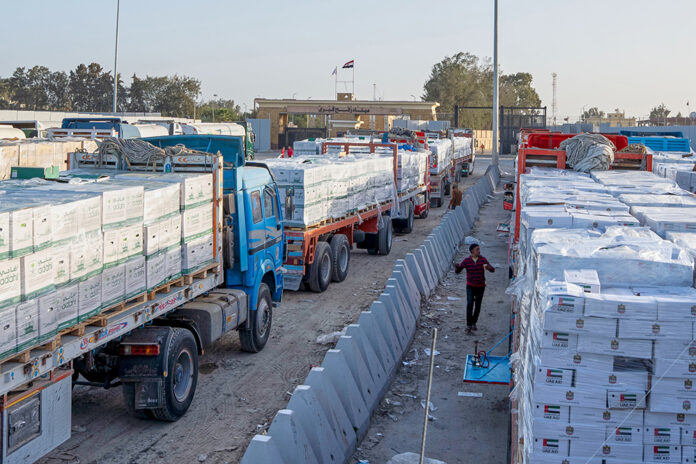
Trucks carrying humanitarian aids line up to enter the Egyptian gate of the Rafah crossing, heading for inspection by Israeli authorities before entering the Gaza Strip, in Rafah, Egypt, Sunday, Feb. 1, 2026. Credit: Mohammed Arafat/ AP
By: Fern Sidman
In a development freighted with humanitarian urgency and security calculation, the Israel Defense Forces on Sunday unveiled video footage of a newly established military checkpoint in southern Gaza’s Rafah area, offering the clearest picture yet of how Israel intends to manage the partial reopening of the Rafah Border Crossing after more than a year of near-total closure. As detailed in a report that appeared on Sunday at VIN News, the facility—known as the “Regavim” checkpoint—represents a hybrid model of direct Israeli control, remote technological oversight, and international supervision, reflecting both the fragility of the ceasefire arrangements and the enduring mistrust that defines Israel’s relationship with Hamas-run Gaza.
The checkpoint sits in territory firmly under Israeli military control, just outside the Egypt–Gaza crossing. According to the Israel Defense Forces, its purpose is straightforward in theory but complex in execution: Palestinians returning from Egypt will undergo Israeli security screening before they are permitted to proceed into Hamas-administered areas of the enclave. The screening process, the military says, will involve identity verification against approved lists compiled by Israel’s defense establishment, alongside thorough inspections of luggage and personal effects. Only those who clear these checks will be allowed to pass onward.
For Israel, this arrangement is presented as a necessary compromise between easing humanitarian pressure and preserving hard-won security gains. For Palestinians and international observers, it is a reminder that even the most basic movement across Gaza’s borders remains subject to layers of scrutiny shaped by the ongoing war. The reopening, though limited, marks the first pedestrian access through Rafah since Israeli forces seized the crossing in 2024 amid the intensification of the Israel–Hamas conflict, effectively severing Gaza’s primary outlet to the outside world.
The partial reopening is being rolled out in stages. A pilot phase began quietly over the weekend, with Israeli officials indicating that the scope of pedestrian movement is expected to expand on Monday. The initial priority, according to information provided in the VIN News report, is to facilitate the return of Gazans who fled to Egypt during the height of the fighting. Alongside this, humanitarian aid deliveries from the Egyptian side are resuming, offering a modest but symbolically significant lifeline to a population battered by months of war and deprivation.
Yet the mechanics of the reopening spotlight how profoundly the status quo has shifted. For Palestinians seeking to leave Gaza for Egypt, Israel will not maintain a physical presence at the crossing itself. Instead, the IDF has opted for remote oversight. Officers stationed in a control room will employ facial recognition technology to confirm that departing individuals appear on pre-approved lists. Once verified, Israeli personnel will remotely open the gate, allowing travelers to proceed. On-site screening for those exiting Gaza will be conducted by Palestinian Authority personnel, with European Union monitors observing the process.
This multilayered system is intended to balance competing imperatives. Israeli officials, as quoted by VIN News, argue that remote control reduces friction and limits direct contact between Israeli forces and Palestinian civilians, while still ensuring that individuals deemed security risks cannot exploit the crossing. The involvement of the Palestinian Authority and EU monitors is meant to lend a degree of international legitimacy and transparency to the process, echoing mechanisms used earlier in 2025 before the most recent escalation rendered them obsolete.
Central to the operation is COGAT, Israel’s Coordinator of Government Activities in the Territories. COGAT emphasized that all movement through Rafah—whether into or out of Gaza—requires prior Israeli security clearance and close coordination with Egypt. The EU’s supervisory role, officials stressed, is designed to mirror earlier arrangements while adapting to the new reality of Israeli military dominance over the area.
For Israel, the Regavim checkpoint is as much a statement of principle as a logistical node. By situating the screening facility in IDF-controlled territory and insisting on Israeli approval lists, Jerusalem is signaling that the era of largely unmonitored passage through Rafah is over. The fear, repeatedly articulated by Israeli security officials is that any loosening of controls could allow terrorists, weapons, or intelligence assets to slip through under the cover of humanitarian movement.
At the same time, the reopening acknowledges the mounting international pressure to alleviate Gaza’s humanitarian crisis. The closure of Rafah since 2024 had cut off a critical artery for civilians seeking medical treatment abroad, families attempting reunification, and aid organizations struggling to deliver supplies. By allowing limited pedestrian movement and resuming aid deliveries, Israel is seeking to demonstrate compliance with ceasefire understandings brokered in part under U.S. auspices, even as it retains decisive leverage over the process.
The introduction of facial recognition technology adds another layer of controversy. Human rights groups have long warned that such systems, particularly when deployed in conflict zones, raise serious privacy and due process concerns. VIN News has reported that Israeli officials defend the technology as a precision tool that minimizes arbitrary decision-making and speeds up processing, reducing the need for prolonged questioning or detention. Critics counter that reliance on opaque databases and algorithms risks errors with life-altering consequences for those affected.
For Palestinians on the ground, the experience of passing through Regavim is likely to be fraught with uncertainty. Even those cleared to return from Egypt must submit to Israeli screening before setting foot back in Gaza, a reality that underscores the extent of Israel’s control over the enclave’s borders. Conversely, those seeking to leave Gaza face the prospect of being vetted by multiple authorities, with approval contingent on factors beyond their visibility or influence.
The broader political context cannot be ignored. The Rafah crossing has long been a symbol of Gaza’s tenuous connection to the outside world, and its control has been a point of contention among Israel, Egypt, the Palestinian Authority, and Hamas. Israel’s seizure of the crossing in 2024 was justified as a security necessity amid intensified fighting, but it also deepened Gaza’s isolation. The current partial reopening, as the VIN News report has observed, reflects neither a return to the pre-war status quo nor a fully new arrangement, but rather an improvised structure born of ceasefire diplomacy and ongoing hostilities.
Egypt’s role, while less visible in the immediate mechanics of the Regavim checkpoint, remains crucial. Cairo has coordinated closely with Israel on the reopening, balancing its own security concerns in Sinai with pressure to alleviate Gaza’s humanitarian plight. The resumption of aid deliveries from the Egyptian side is a reminder that Egypt remains an indispensable intermediary, even as Israel asserts unprecedented control over the crossing.
Internationally, the European Union’s involvement is being closely watched. EU monitors at Rafah serve as a buffer of sorts, offering a measure of oversight that both Israel and the Palestinian Authority can point to as evidence of good faith. Yet their mandate is limited, and their presence does not alter the fundamental asymmetry of power at play. The EU’s role is supervisory rather than decisive, leaving ultimate authority in Israeli hands.
Whether the pilot phase will indeed expand smoothly remains an open question. Past experience at Rafah suggests that even minor incidents can prompt sudden closures or tightening of procedures. Israeli officials have been explicit that the reopening is contingent on calm and compliance, a caveat that hangs over every step of the process. Any perceived abuse of the crossing, they warn, could lead to an immediate reassessment.
For now, the Regavim checkpoint stands as a concrete manifestation of Israel’s attempt to square an almost impossible circle: responding to humanitarian imperatives without relinquishing security control. The video footage released by the IDF appears designed to project order and professionalism, emphasizing structured procedures and technological safeguards. Whether that image aligns with the lived experience of those passing through remains to be seen.
In the broader arc of the Israel–Hamas conflict, the partial reopening of Rafah is unlikely to be a turning point. Yet it is a significant marker of how borders, technology, and diplomacy are being reshaped by war. As Gazans tentatively begin to move again through their southern gate, every passport scanned and gate remotely opened will serve as a reminder that even limited freedom of movement in Gaza is now mediated by an elaborate apparatus of control.
For Israel, the message is clear: humanitarian access will be granted, but only on terms defined by security considerations. For Palestinians, the reopening offers a narrow corridor of hope shadowed by uncertainty. And for the international community, as the VIN News report emphasized, the Regavim checkpoint is a test case—an experiment in whether humanitarian relief and military oversight can coexist in one of the world’s most volatile conflict zones without collapsing under the weight of mutual distrust.
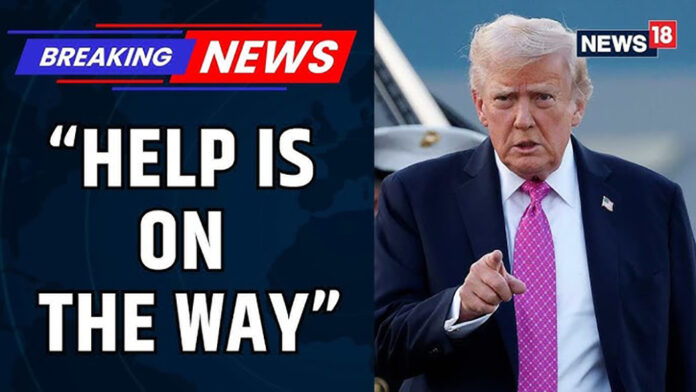
President Trump recently declared, “Help is on the way.” Those words resonated in the hearts of Iranians who dared to believe that the world had not abandoned them. Credit: YouTube.com
There comes a moment in international affairs when the language of diplomacy, once a necessary instrument of restraint, hardens into an excuse for inaction. With Iran, that moment is no longer approaching—it has arrived. For decades, the Islamic Republic has mastered the art of negotiation as a delaying tactic, using talks not to resolve disputes but to buy time: time to enrich uranium, time to entrench regional proxies, time to tighten its grip on a suffering population. If diplomacy fails once more to produce a verifiable, enforceable end to Iran’s nuclear ambitions, the United States, under the leadership of President Donald Trump, must act decisively. A bold military strike would not be an act of recklessness; it would be an act of necessity—strategic, moral, and humanitarian.
The Iranian nuclear threat is not theoretical. It is not speculative. It has been a looming danger for years, openly acknowledged by Tehran’s own leadership and reinforced by repeated violations of international commitments. The regime under Ayatollah Ali Khamenei has demonstrated, time and again, that it has no genuine interest in abandoning its pursuit of nuclear weapons capability. Agreements are signed, then hollowed out. Inspections are promised, then obstructed. Red lines are crossed, and the world is asked to accept each transgression as the last. This cycle has one predictable outcome: a nuclear-armed Iran or a nuclear-capable Iran that can cross the threshold at a moment of its choosing.
Such an outcome would be catastrophic—not only for regional stability, but for the global order. A regime that openly chants for the destruction of another sovereign state cannot be treated as a normal actor. Iran’s threats against Israel are not rhetorical flourishes; they are doctrinal. Israel, a democracy surrounded by hostile forces, has lived for years under the shadow of annihilation promised by Tehran. To demand that Israel accept the risk of nuclear destruction in the name of endless diplomacy is not realism—it is moral abdication. No nation should be asked to tolerate the possibility of its own eradication.
Yet the nuclear issue, grave as it is, represents only one dimension of the Iranian crisis. The other, often discussed in hushed tones, is the humanitarian catastrophe unfolding within Iran’s borders. The Iranian people have not been silent. They have risen—again and again—against a regime that governs through fear, brutality, and systematic repression. Women have torn off mandatory head coverings in defiance. Students, workers, and ordinary citizens have filled the streets demanding dignity, accountability, and freedom. Their courage has been extraordinary. The regime’s response has been monstrous.
Human rights organizations have produced concrete, harrowing evidence of mass executions. Protesters are arrested in the dead of night, swallowed by a prison system designed not for justice but for disappearance. Thousands are detained, many never to be heard from again. Torture is routine. Trials, when they occur at all, are theater. This is not a government struggling to maintain order; it is a regime waging war on its own population. To treat such a system as a legitimate negotiating partner indefinitely is to ignore the blood staining its hands.
President Trump once declared, “Help is on the way.” Those words resonated not in diplomatic salons, but in the hearts of Iranians who dared to believe that the world had not abandoned them. But help delayed too long becomes help denied. Negotiations that drag on without consequence signal not patience, but weakness. The regime in Tehran interprets delay as permission. Every month spent talking without results is another month of executions, another month of enriched uranium, another month in which hope is strangled in prison cells.
A military strike, if diplomacy fails, must be understood in this context. It would not be a war against the Iranian people; it would be a confrontation with a rogue regime that has hijacked a nation. Carefully targeted action against nuclear facilities and key military infrastructure would serve multiple purposes: halting Iran’s nuclear march, degrading the regime’s capacity for regional aggression, and shattering the illusion of invincibility that sustains its rule. Authoritarian systems often collapse not when they are persuaded, but when they are exposed as fragile.
Critics will argue that regime change cannot be imposed from outside. They are correct—and they are missing the point. The goal is not to dictate Iran’s future, but to remove the boot from the neck of its present. Regime change in Iran will ultimately be achieved by Iranians themselves. But history shows that internal liberation movements often require external catalysts. By dismantling the regime’s most dangerous capabilities and confronting it with the consequences of its crimes, the United States can create the conditions in which the Iranian people can reclaim their country.
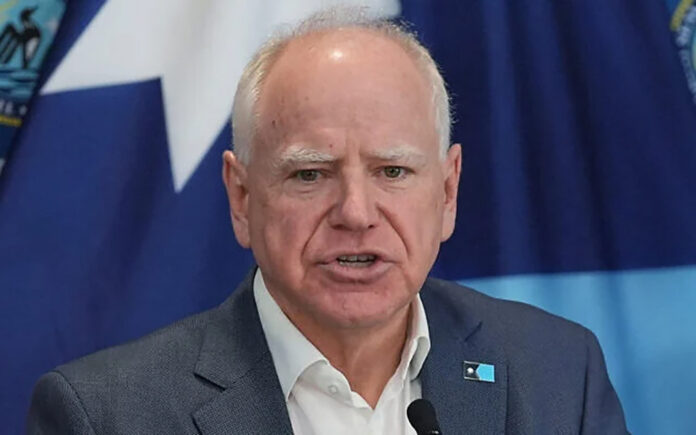
Minnesota Governor Tim Walz compared illegal migrants in his state to Anne Frank hiding from the Nazis in the infamous attic in Amsterdam. (AP Photo/Abbie Parr)
Invoking well-known names from the Holocaust in order to score political points seems to be the latest fad. What a cruel and distasteful fad it is.
This past week, Minnesota Governor Tim Walz compared illegal migrants in his state to Anne Frank hiding from the Nazis in the infamous attic in Amsterdam. That outrageous analogy minimizes what Anne Frank suffered, and why she was targeted. It also gravely distorts the legitimate public debate concerning those who are living illegally in the United States.
Meanwhile, a group of extreme partisans have set up an institute named after the late Raphael Lemkin, the Polish Jewish scholar who first coined the term “genocide,” back in the 1940s. Media reports indicate that this Institute has no authorization from the Lemkin family. Yet it continues to use his name to advance an extremist agenda.
High on that agenda is the slanderous allegation that Israel is committing genocide in Gaza. Everything about the “genocide” slur is an obvious lie, from the fact that Israeli soldiers have risked their lives to avoid harming Gazan civilians, to the fact that more than 100,000 Gazans left that territory during the past two years, including many whom the “genocidal” Israelis allowed to leave so they could obtain medical aid abroad.
We were glad to see that more than 100 prominent Holocaust and genocide scholars from around the world signed a letter publicly challenging the Israel-bashers at the so-called Lemkin Institute. The David S. Wyman Institute for Holocaust Studies is to be commended for mobilizing our leading scholarly authorities on the subject to speak out against the abuse of Raphael Lemkin’s name.
The scholars who signed the Wyman Institute’s letter pointed out that the Lemkin Institute was accusing Israel of “genocide” just ten days after October 7, which was two weeks before Israeli soldiers eve entered Gaza. For Israel-haters, everything Israel does is “genocidal.” Even Israel’s very existence is deemed genocidal!
Perhaps, one day, such appropriation and desecration of the Holocaust will come to an end. But until then, it’s good to know that we can count on the Wyman Institute and its many suppo
There has been much confusion on what the term holocaust means. Allow me to clarify.
The Holocaust is the systematic mass murder of European Jewry by the Nazis. The term Holocaust literally means a fire that causes total destruction.Yehuda Bauer, one of the world’s most eminent historians of the Holocaust, differentiates between the term genocide and Holocaust by defining the term genocide as partial murder.While there have been numerous instances of genocide, the total annihilation of a people was never an officially sanctioned purpose of a national government as it was in Nazi Germany. It is precisely this which differentiates the Nazi action against the Jews from other genocidal attempts against a people.
The Nazis wished to conquer the world and therefore threatened the very existence of every single Jew in the world. The principle target of the Nazis was always the Jews. Yes, it is true that as many as 50 million human beings were murdered by the Nazis and their collaborators. The Nazis destroyed the lives of Gypsies, homosexuals, the mentally disabled, Jehovah’s Witnesses, communists, socialists, trade unionists and religious opponents. But it was only the Jews who were singled out for the Final Solution.
Sincerely Rabbi Dr. Bernhard Rosenberg New Jersey
An Israel-Hater of Long Standing
A news article in the New York Times last week noted that since the start of the Gaza war two years ago, Turkish president Recep Tayyip Erdogan has “repeatedly compared [Israeli prime minister Benjamin] Netanyahu to Adolf Hitler.”
That’s true, but it wrongly implied that such statements by Erdogan are of recent origin and were made in response to Israeli actions in Gaza. In fact, Erdogan’s vile rhetoric long predated the Gaza war.
Way back in July 2014, for example, Erdogan declared that Israel had “surpassed Hitler in barbarism.” In May 2018, he asserted that there was “no difference” between the Holocaust and Israeli policies regarding Gaza. In July 2018, he asserted that “Hitler’s spirit” guides Israel. And in December of that year, he accused Israel of committing “cultural genocide.”
Erdogan’s record of ugly declarations about the Jewish state is not the result of any particular Israeli policy and has nothing to do with who the prime minister of Israel happens to be. He is an Israel-hater of long standing.
Is it any wonder that Israelis are concerned about Erdogan or his representative serving on the U.S. Board of Peace that is supposed to disarm Hamas?
Sincerely Prof. Rafael Medoff
Stop Medically Assisted Suicide
Dear Editor:
There is an urgent and critical need for concerned citizens to take immediate action by contacting our elected officials in Albany to oppose the legalization of medically assisted suicide in New York State. This legislation represents a profound moral, ethical, and societal turning point—one that would fundamentally alter the value we place on human life, particularly the lives of the elderly, disabled, and vulnerable.
Governor Hochul has indicated she will not sign this bill into law unless specific amendments are added. Those amendments are now moving through the legislature in the Assembly as bill A9515 and in the State Senate as bill S8835. These amendments must also be opposed. This is not a minor policy adjustment—it is a matter of life and death, and it deserves the full attention and engagement of the public.
I strongly urge every resident to personally call their representatives. You can reach your State Assemblymember at (518) 455-4100 and your State Senator at (518) 455-2800. When calling, it is essential to fully identify yourself with your full name, address, and ZIP code. Clearly and calmly state that you oppose medically assisted suicide and that you want them to vote NO on both the legislation and its amendments.
This proposal is not compassionate—it is dangerous. It risks normalizing state-sanctioned death instead of strengthening care, dignity, and true compassion for those who are suffering. Please be respectful and courteous in every interaction but be firm in your request. Silence now would be a tragic mistake.