



|
Getting your Trinity Audio player ready...
|
Khamenei Issues Stark Warning: U.S. Strike on Iran Would Ignite Regional Conflict
By: Fern Sidman
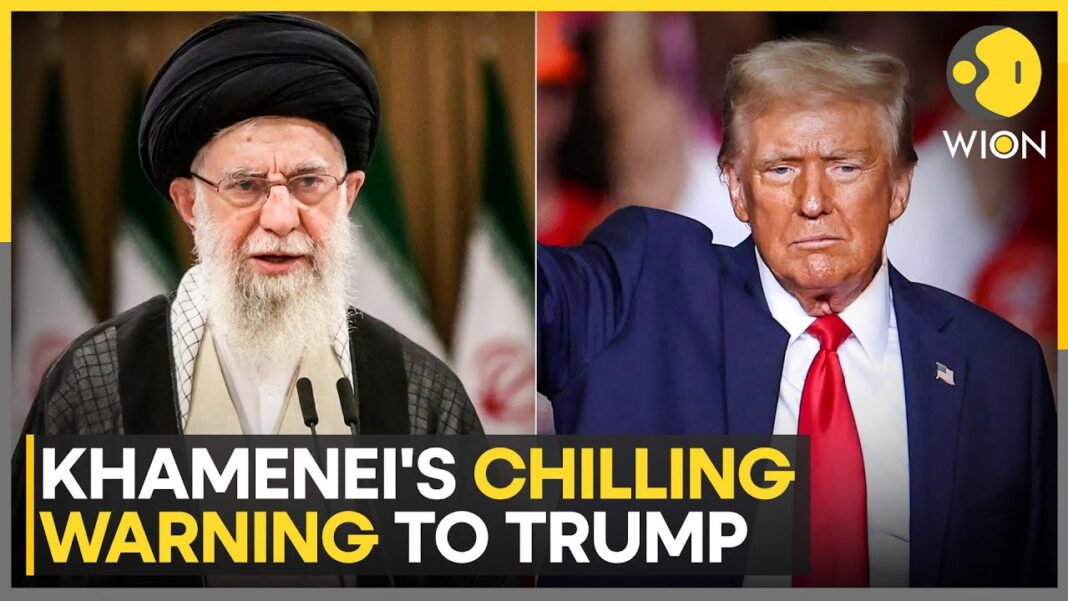
The Middle East edged closer to a precipice this weekend as Iran’s Supreme Leader, Ayatollah Ali Khamenei, issued his most explicit warning yet to Washington: any American military strike on Iran would not remain a contained confrontation, but would ignite a regional war. The declaration, reported by Iran’s semi-official Tasnim news agency and closely analyzed by The Times of Israel in a report on Sunday, came amid a rapidly intensifying standoff marked by U.S. naval deployments, simmering domestic unrest in Iran, and a widening international rift over Tehran’s conduct.
“The Americans should know that if they start a war, this time it will be a regional war,” Khamenei was quoted as saying on Sunday. For an 86-year-old leader known for calibrated rhetoric, the remark stood out for its bluntness and breadth. As The Times of Israel report noted, it marked the most direct and expansive threat Khamenei has made during the current crisis, suggesting that Tehran is prepared to activate a network of allies and proxies stretching across the Middle East should hostilities erupt.
The warning came against the backdrop of a visible American military buildup. The United States has surged naval assets into the region, with President Donald Trump repeatedly threatening intervention if Iran refuses to accept limits on its nuclear program or halt its lethal repression of protesters. According to U.S. defense officials cited in The Times of Israel report, the Navy now maintains six destroyers, one aircraft carrier, and three littoral combat ships in regional waters—an unmistakable signal of readiness and resolve.
Khamenei sought to project defiance rather than alarm. “[Trump] regularly says that he brought ships,” he said, according to Tasnim. “The Iranian nation shall not be scared by these things; the Iranian people will not be stirred by these threats.” He added that Iran does not seek to initiate conflict, but would respond forcefully to any attack. “We are not the initiators and do not want to attack any country,” he said. “But the Iranian nation will strike a strong blow against anyone who attacks and harasses them.”
For analysts quoted by The Times of Israel, the remarks underscore Tehran’s effort to deter Washington by raising the perceived costs of intervention—not only for U.S. forces, but for Israel and other American partners in the region. Iranian officials have already warned that if Trump orders strikes, Iran will target Israeli territory and American military assets across the Middle East, a threat that has prompted heightened alert levels in Jerusalem.
At the same time, the Iranian leadership has been careful to leave the door ajar to diplomacy. Even as Khamenei issued his warning, Tehran reiterated that it remains open to “fair” negotiations—provided they do not curtail what Iran describes as its defensive capabilities. Trump, for his part, said on Saturday that Iran is “seriously talking” with Washington, a comment that The Times of Israel interpreted as an attempt to maintain leverage while keeping diplomatic channels nominally open.
Yet diplomacy is unfolding in the shadow of profound internal turmoil within Iran. Khamenei devoted a significant portion of his remarks to condemning the wave of anti-government protests that erupted late last year, initially over economic hardship but rapidly morphing into the most severe political challenge to the Islamic Republic since its establishment in 1979. State media reported that Khamenei likened the unrest to a “coup,” accusing protesters of orchestrating a coordinated assault on the state.
“They attacked the police, government centers, IRGC centers, banks, and mosques, and burned the Quran,” Khamenei said. “It was like a coup.” He added that “the coup was suppressed,” a phrase that carried a grim resonance given the scale of the regime’s response. Iranian authorities have acknowledged thousands of deaths linked to the unrest, though independent verification remains elusive.
Official figures place the death toll at 3,117. However, the U.S.-based Human Rights Activists News Agency (HRANA) said on Sunday that it had verified at least 6,713 deaths so far. Reuters noted it could not independently confirm either figure, a caveat echoed in The Times of Israel report, which has emphasized the opacity surrounding casualty counts amid widespread arrests, internet shutdowns, and media restrictions.
The ferocity of the crackdown has reverberated far beyond Iran’s borders. It was a key factor behind Trump’s decision to dispatch an aircraft carrier group to the region, a move The Times of Israel report described as both a warning to Tehran and a reassurance to U.S. allies. It also galvanized European leaders to take a step long advocated by Israel: formally designating Iran’s Islamic Revolutionary Guard Corps (IRGC) as a terrorist organization.
On Thursday, the European Union announced that it had added the IRGC to its list of terrorist groups, citing the Guards’ central role in violently suppressing the protests. The decision aligned Europe with similar classifications already enacted by the United States, Canada, and Australia. “Repression cannot go unanswered,” EU foreign policy chief Kaja Kallas wrote on X. “Any regime that kills thousands of its own people is working toward its own demise.”
Iran’s response was swift and incendiary. On Sunday, lawmakers in Tehran voted to designate European armies as terrorist organizations in retaliation. State television footage showed legislators wearing the green uniforms of the IRGC in a dramatic display of solidarity. As they convened, chants of “Death to America,” “Death to Israel,” and “Shame on you, Europe” echoed through the chamber.
Parliament speaker Mohammad Bagher Ghalibaf slammed the EU’s move as “irresponsible,” declaring that under “Article 7 of the Law on Countermeasures Against the Declaration of the IRGC as a Terrorist Organization, the armies of European countries are considered terrorist groups.” He claimed the EU decision, “which was carried out in compliance with the orders of the American president and the leaders of the Zionist regime,” would hasten Europe’s slide into irrelevance in a changing world order.
What immediate practical impact Iran’s counter-designation will have remains unclear. European officials have downplayed its legal significance, while analysts cited by The Times of Israel suggest it is largely symbolic—intended to rally domestic support and signal defiance rather than alter military realities. Ghalibaf himself acknowledged that the move had already boosted internal backing for the Guards, a key objective for a regime eager to shore up loyalty amid dissent.
The symbolism of Sunday’s parliamentary session was heightened by its timing. It coincided with the 47th anniversary of the return from exile of Ruhollah Khomeini, the revolutionary cleric who founded the Islamic Republic in 1979. For the leadership, the anniversary served as a reminder of the regime’s origins in upheaval—and as a warning against challenges to its authority.
The IRGC itself occupies a uniquely powerful position within Iran’s political and economic system. Established after the 1979 revolution to safeguard the Shiite clerical order from internal and external threats, the Guards have evolved into an ideological army with sweeping influence. As The Times of Israel report has documented, the IRGC controls vast segments of Iran’s economy, exerts decisive sway over the armed forces, and oversees the country’s ballistic missile and nuclear programs. Its designation as a terrorist organization by the EU thus strikes at the heart of Iran’s power structure.
Israel, which has long pressed European governments to take such a step, welcomed the decision. Foreign Minister Gideon Sa’ar hailed it as “historic,” calling the IRGC “the number one force behind the spread of terror and the destabilization of the region.” According to the information provided in The Times of Israel report, Sa’ar said the move would help thwart the Guards’ activities in Europe and send “an important message to the men and women of the Iranian people who are fighting for their freedom.”
France and Italy, previously hesitant to endorse the designation, lent their support this week, reflecting a hardening European stance. For Israel, the alignment of U.S. and European policy represents a diplomatic victory—but also raises the stakes. Iranian officials have repeatedly warned that pressure on the IRGC is tantamount to pressure on the state itself, a red line that could accelerate confrontation.
Within Iran, the protests that so rattled the leadership have now abated, at least for the moment, following a campaign of repression. Yet observers cited in The Times of Israel report caution that the underlying grievances—economic despair, corruption, and demands for greater freedom—remain unresolved. Khamenei’s characterization of the unrest as a foreign-backed “sedition” may serve to delegitimize dissent in official discourse, but it does little to address its root causes.
Against this volatile backdrop, the risk of miscalculation looms large. Khamenei’s warning of a regional war appears designed to deter Washington by invoking the specter of a multi-front conflict involving Israel, U.S. bases, and shipping lanes. Trump’s dispatch of naval forces, in turn, signals that the United States is prepared to absorb and respond to such risks if necessary. Both sides are engaging in a high-stakes game of signaling, each seeking to project strength without crossing the threshold into open war.
Whether diplomacy can still avert that outcome remains an open question. Trump’s assertion that Iran is “seriously talking” suggests that channels of communication persist, even as rhetoric hardens. Tehran’s insistence on “fair” negotiations hints at a willingness to engage, albeit on terms it deems acceptable. Yet trust is scarce, and the accumulation of grievances—nuclear concerns, human rights abuses, regional proxy warfare—has narrowed the space for compromise.
As the crisis deepens, the implications extend well beyond Washington and Tehran. For Israel, the prospect of being drawn into a regional conflagration is a tangible and immediate concern. For Europe, the confrontation tests its resolve to uphold human rights principles in the face of potential retaliation. And for Iranians themselves, the clash between external pressure and internal repression threatens to shape the country’s trajectory for years to come.
In issuing his stark warning, Khamenei sought to draw a clear line: an American attack would not be answered in isolation, but with a response reverberating across the Middle East. Whether that warning deters or provokes remains to be seen. As The Times of Israel has repeatedly observed, the current moment represents one of the most perilous junctures in U.S.–Iran relations in decades—an inflection point where words, deployments, and decisions could determine whether the region steps back from the brink or plunges into a conflict of unprecedented scope.